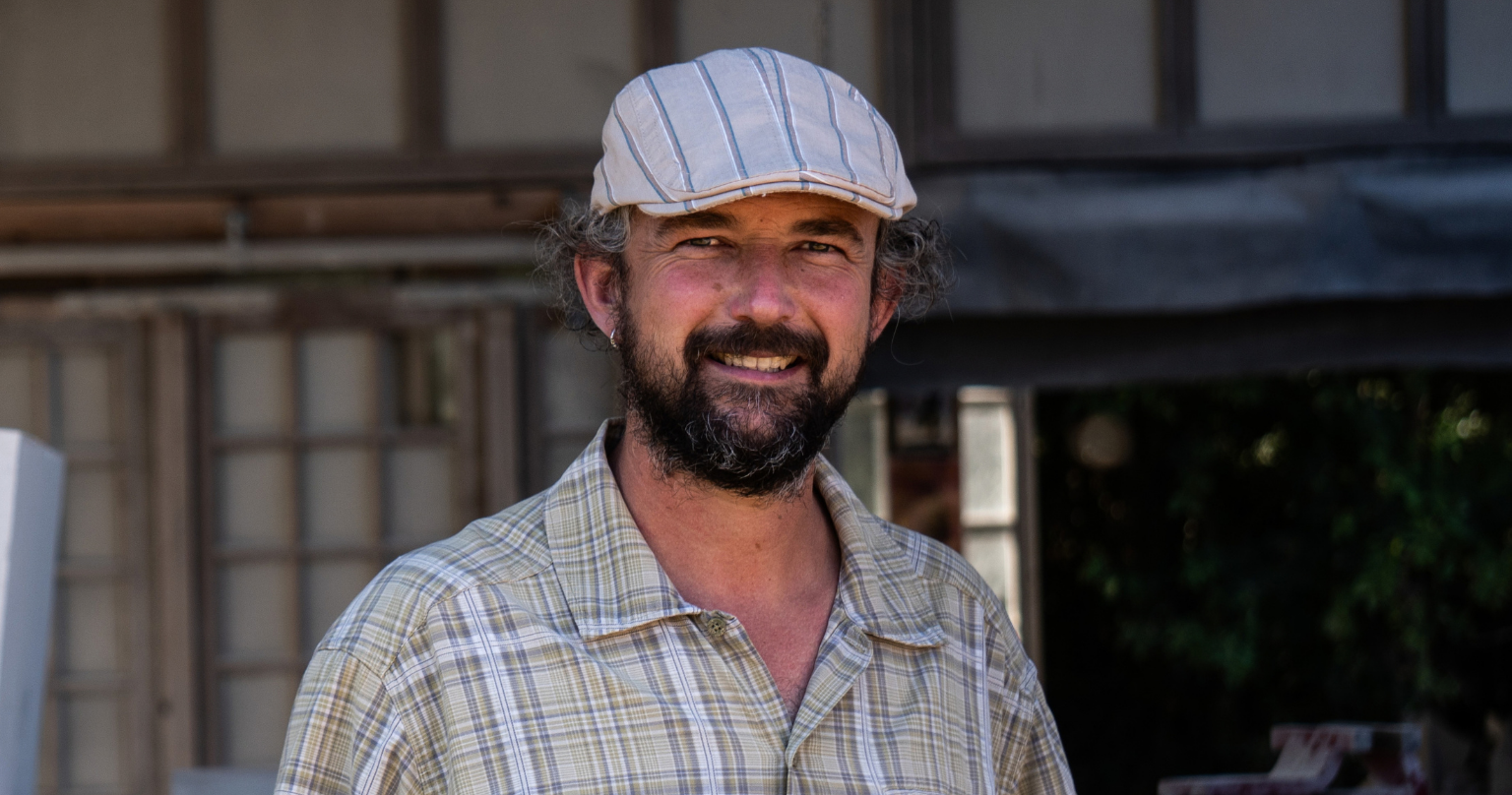
A stonemason for many years before devoting himself fully to sculpture, Richard Mougel has developed a relationship with his material shaped by experience. From Carrara marble to Chauvigny and Tervoux stone, each block is carefully selected before the sculptor’s hand begins to reveal the form within.
Everything begins with the stone. Before even imagining what it might become, Richard Mougel observes its veining, colour, density and character.
His understanding of the material comes not only from his artistic practice. It was built over many years working as a stonemason—an experience that continues to inform his approach to sculpture today.
“I go to Italy myself to choose my blocks.”
In the quarries of Carrara or Portovenere, selecting the block therefore becomes the first stage of the creative process. Stone imposes its own constraints, while also suggesting what it might become.
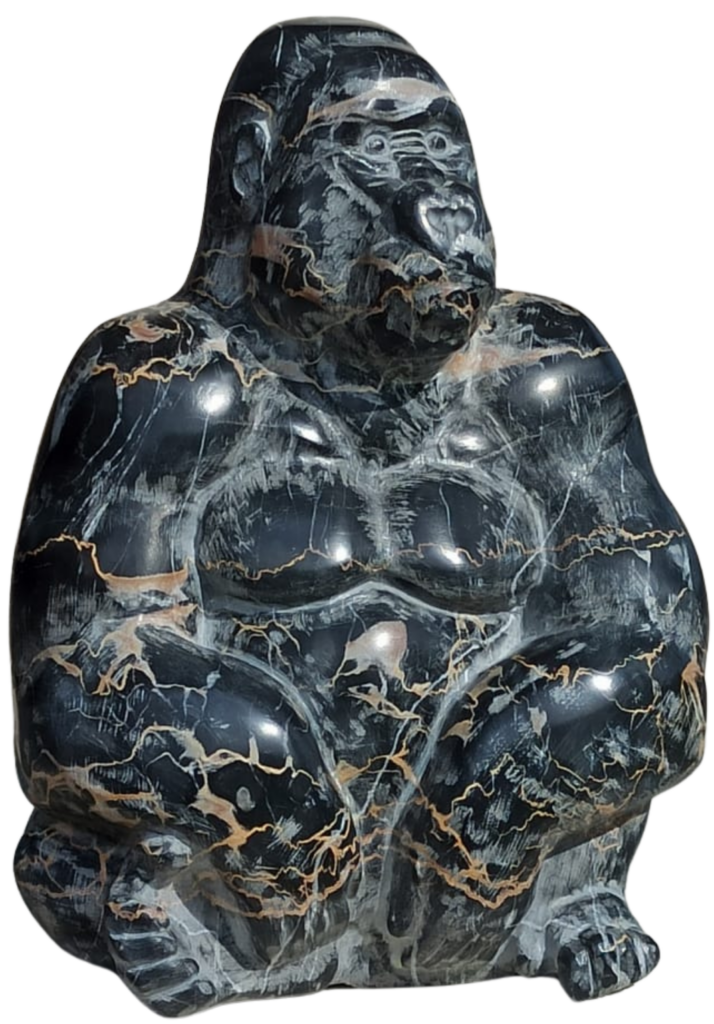
The Gorilla, sculpture by Richard Mougel in black Portovenere marble.
A Bestiary Between Power and Restraint
The animal world occupies a central place in Richard Mougel’s work. Gorillas, tigers, owls, cobras and snakes form a bestiary in which the sculptor seeks above all the accuracy of a posture and the presence of the animal.
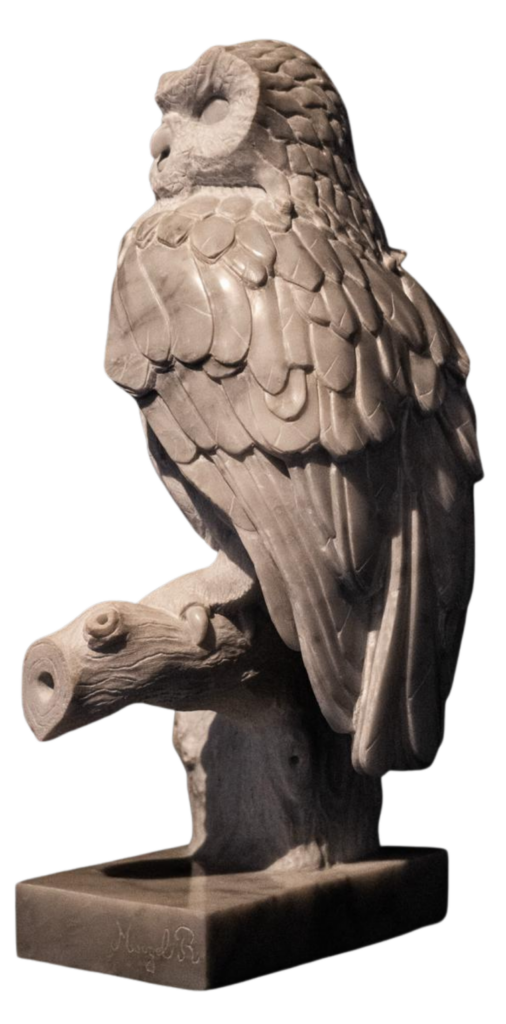
The Gorilla, carved from black Portovenere marble, conveys restrained power. The Tiger, sculpted from white Carrara marble, concentrates its energy in a poised stance. With the Owl, the artist instead explores the contrast between polished and matt surfaces, allowing light to animate the stone.
From one work to another, the properties of the material become an integral part of the sculpture itself.
The Owl, sculpture by Richard Mougel in Colonnata marble.
Mastery Behind the Apparent Simplicity
Although the forms may appear to emerge naturally, their creation relies on rigorous preparation.
Depending on the work, Richard Mougel produces clay studies before beginning direct carving—a process that leaves little room for hesitation, as every removal of material is irreversible.
“Before I begin, the sculpture is already constructed in my mind.”
Anticipation, precision and patience therefore accompany every gesture.
At a time when machines are taking up an increasingly important place in workshops, Richard Mougel remains deeply attached to a direct understanding of the material and to the craftsmanship acquired over many years.
Yet technical virtuosity is never an end in itself. On the contrary, it must disappear behind the work.
Behind each sculpted animal lies an essential question: how can stone be transformed without losing the qualities that give it its strength?
How does Richard Mougel select his stone? What role does his experience as a stonemason still play in his artistic practice? And how does he create sculptures in which technical mastery seems to disappear behind the presence of the animal?
Richard Mougel is a French sculptor and former stonemason. His extensive experience with stone informs an artistic practice in which an intimate knowledge of marble and other natural materials plays an essential role.
What materials does Richard Mougel use?
Richard Mougel works with Carrara and Portovenere marble as well as different types of stone, including Chauvigny and Tervoux stone. He personally selects some of his blocks from Italian quarries.
What does Richard Mougel depict in his sculptures?
The animal world lies at the heart of Richard Mougel’s work. Gorillas, tigers, owls, cobras and snakes form a sculptural bestiary in which he explores the accuracy of posture, the qualities of the material and the physical presence of the animal.
Where can I discover more about Richard Mougel’s work?
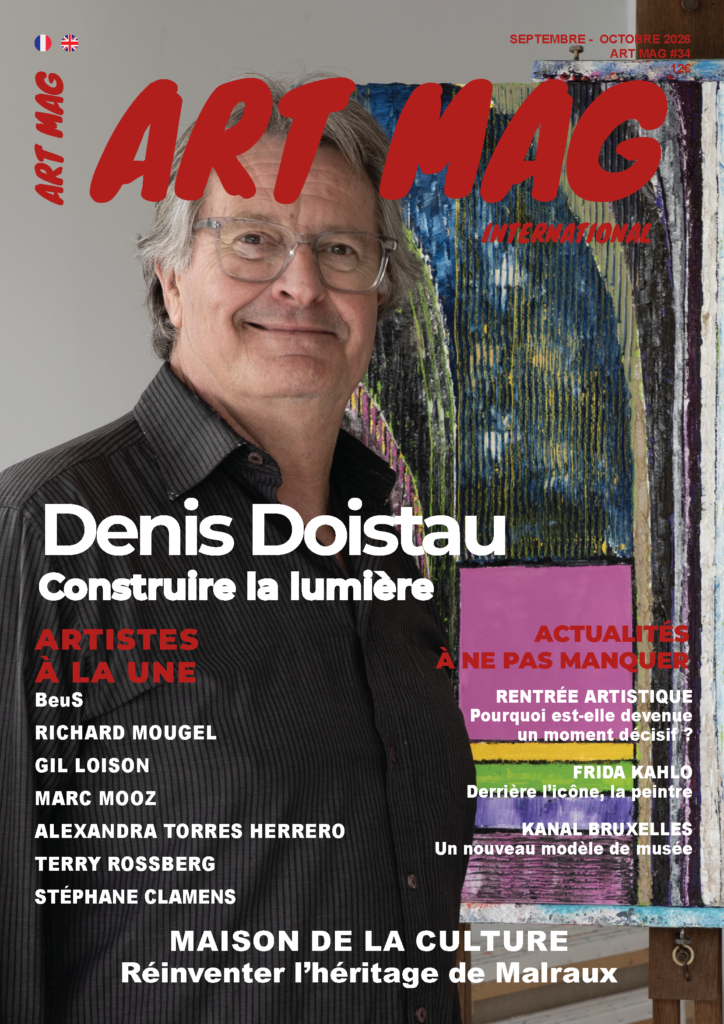
ART MAG International features Richard Mougel in “Stone as a Natural Choice” in issue #34, with a more extensive presentation of his career, his relationship with stone and his sculptural practice.
With Les Irrévérencieuses, BeuS brings the imagery of the 18th century into dialogue with the visual codes of our time. Working in blue ballpoint pen, the artist creates portraits in which historical references and contemporary signs collide, deliberately blurring periods and representations.
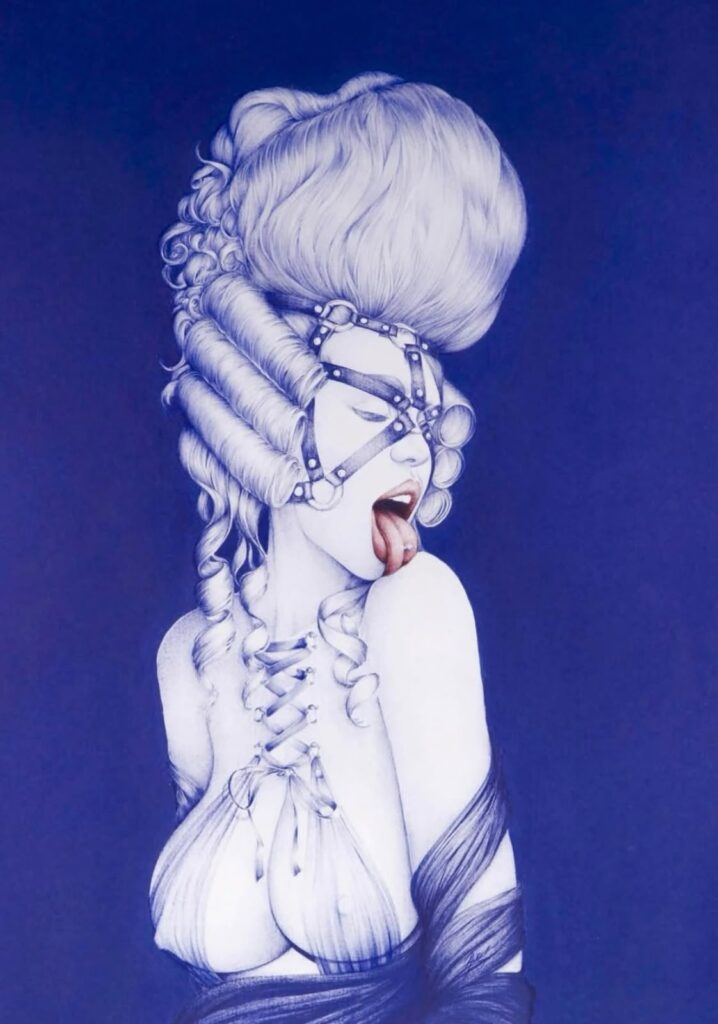
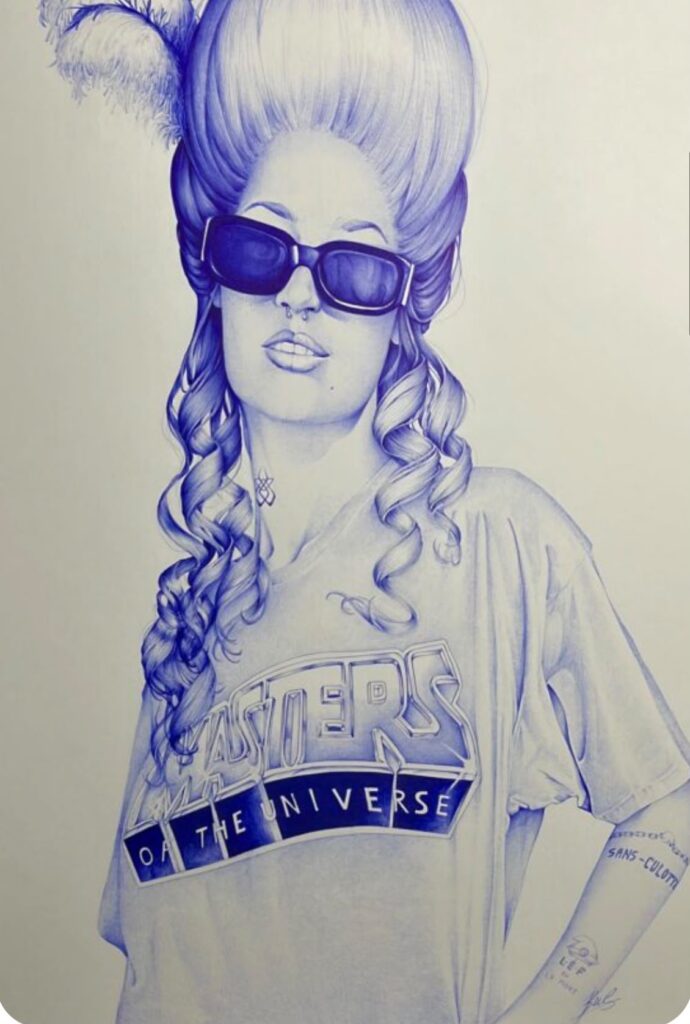
A powdered hairstyle, a silhouette seemingly belonging to another century. Then a detail disrupts the image: dark glasses, a tattoo, a leather harness or contemporary clothing. In BeuS’s work, portraiture constantly plays with this sense of displacement.
BeuS, also known as Sébastien Boismoreau, draws on the codes of art history without seeking to reproduce them. In his series Les Irrévérencieuses, the 18th century encounters the present, turning the female figure into a space where different periods enter into dialogue.
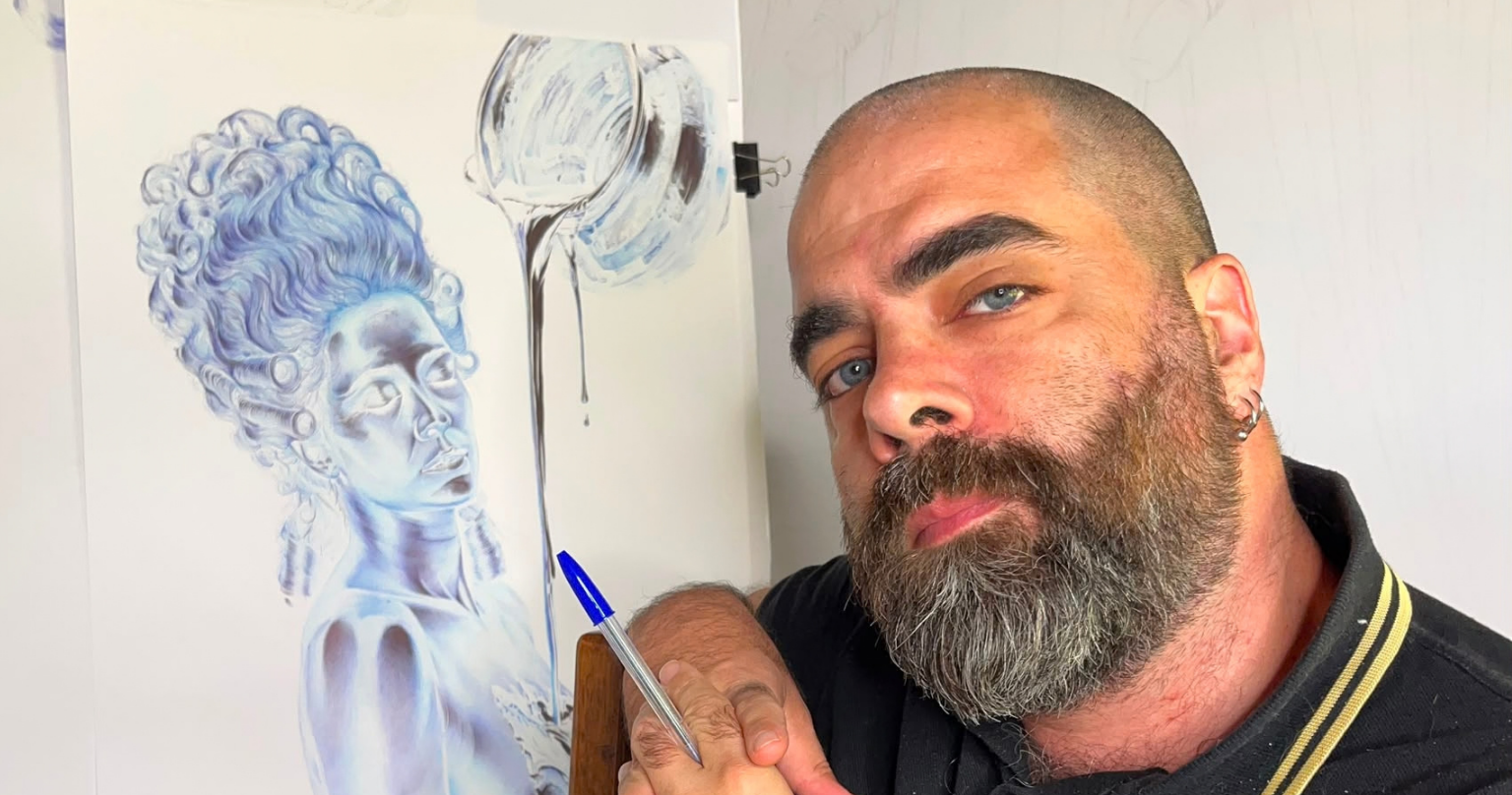
BeuS, Sébastien Boismoreau, in his studio with his blue ballpoint pen drawings
Images that resist the first glance
Marie Antoinette naturally inhabits this world. Yet BeuS is less interested in the historical figure herself than in what her image has become: a representation endlessly reproduced, transformed and reinterpreted.
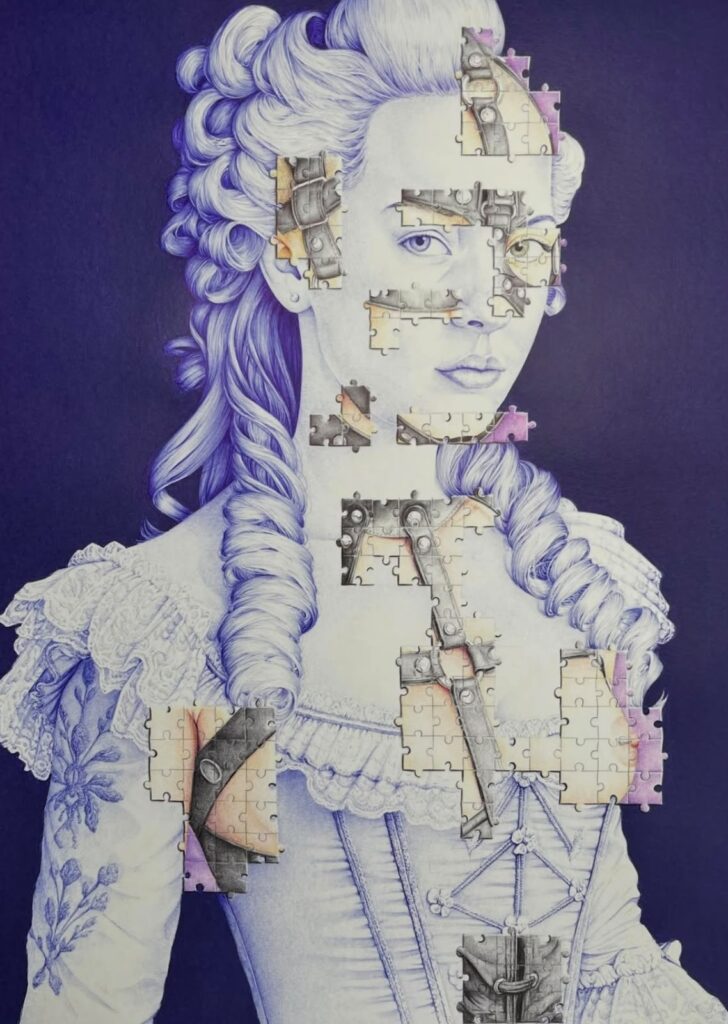
In Irrévérence, a young woman wearing an 18th-century-inspired hairstyle conceals her gaze behind a leather harness. Only her red lips interrupt the dominance of blue. Elsewhere, a face fragments into puzzle pieces, as though identity itself were still being reconstructed.
These encounters between historical references and contemporary signs gradually shift our perception. The portrait no longer simply seeks to represent: it introduces uncertainty.
Sans culotte by BeuS, blue ballpoint pen drawing combining 18th-century imagery and contemporary culture, 2025
Ballpoint pen as an artistic language
This tension is also expressed through technique. BeuS works primarily with blue ballpoint pen, transforming an everyday object into a remarkably precise drawing medium.
Through layers of lines and variations in density, he creates volume, texture, shadow and light. Blue becomes a visual signature, giving the works their unity while allowing certain details to emerge in striking contrast.
Technical virtuosity, however, is never an end in itself. It serves a broader visual construction in which every detail contributes to the narrative.
L’Affirmée by BeuS, fragmented puzzle portrait in blue ballpoint pen, 2026
Slowing down to look again
At a time when images pass across our screens in a matter of seconds, BeuS’s portraits move in the opposite direction. They invite us to stop, examine a detail and then reconsider the image as a whole.
Beneath the elegance of the compositions and the precision of the drawing, Les Irrévérencieuses explores the way representations are constructed, transmitted and transformed.
In BeuS’s work, the portrait is ultimately not simply something to be looked at: it also questions the person looking.
In issue 34 of ART MAG, discover the full portrait of BeuS, his artistic journey, the world of Les Irrévérencieuses and a selection of works offering a deeper insight into his distinctive approach to ballpoint pen drawing.
BeuS, whose name is Sébastien Boismoreau, is an artist whose work notably explores portraiture. In his series Les Irrévérencieuses, he combines references to the 18th century with contemporary visual codes to question image, identity and representation.
What technique does BeuS use?
BeuS works primarily with blue ballpoint pen. Through layers of lines and variations in density, he creates volume, shadow, light and highly detailed surfaces. Blue has become one of the defining visual characteristics of his work.
What is BeuS’s Les Irrévérencieuses series?
Les Irrévérencieuses is a series of female portraits in which BeuS brings different periods into dialogue. 18th-century-inspired hairstyles appear alongside tattoos, sunglasses and contemporary accessories, blurring historical boundaries and questioning the way we perceive images.
Why does Marie Antoinette appear in BeuS’s work?
For BeuS, Marie Antoinette represents a historical figure whose image has extended far beyond historical reality. He draws on this collective imagery to explore how female figures are viewed, transformed and reinterpreted over time.
Where can you discover BeuS’s work?
BeuS is represented by Galerie La Distillerie 66. His work and the Les Irrévérencieuses series are also featured in ART MAG International #34, available in print and digital editions.
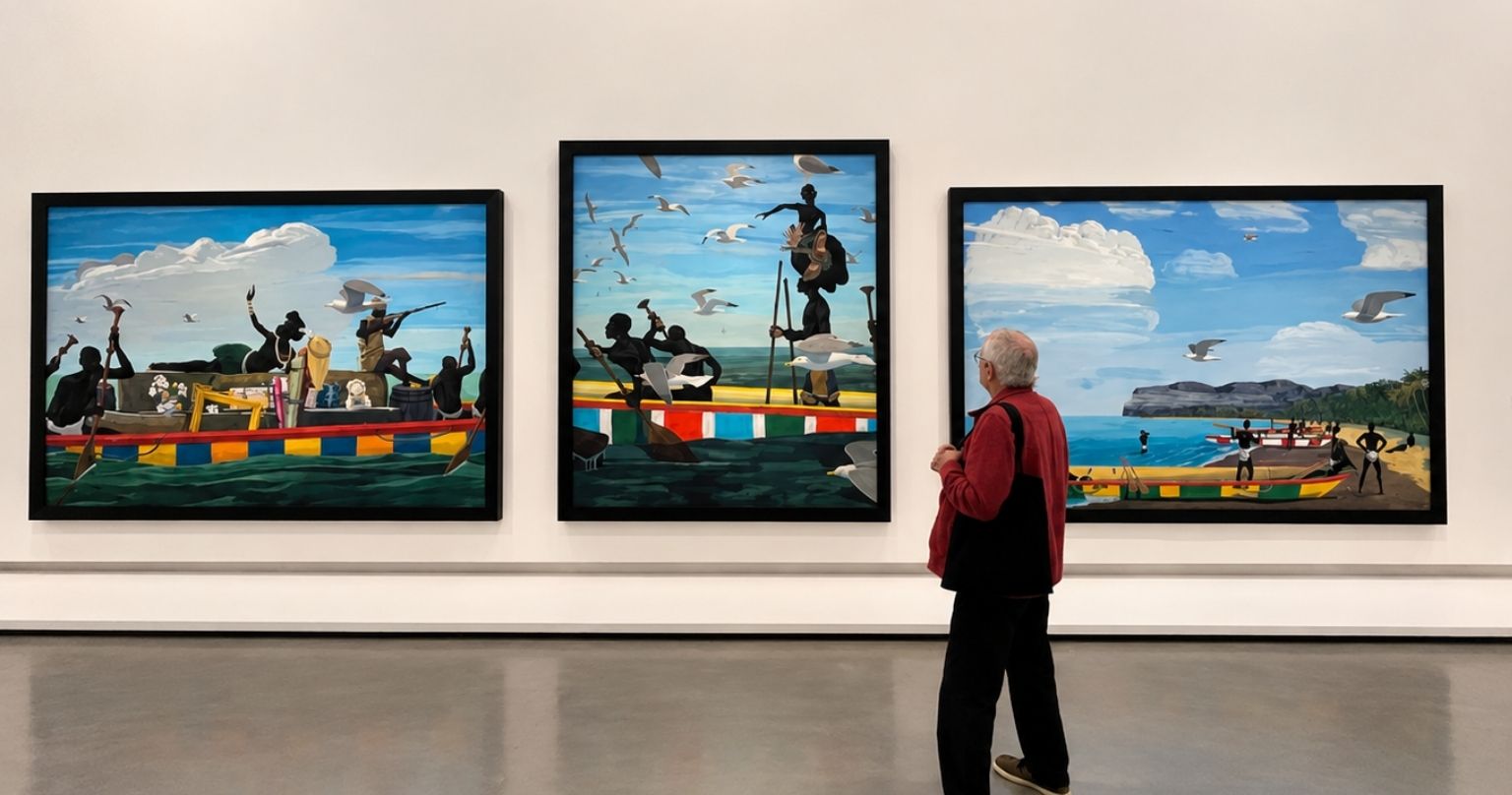
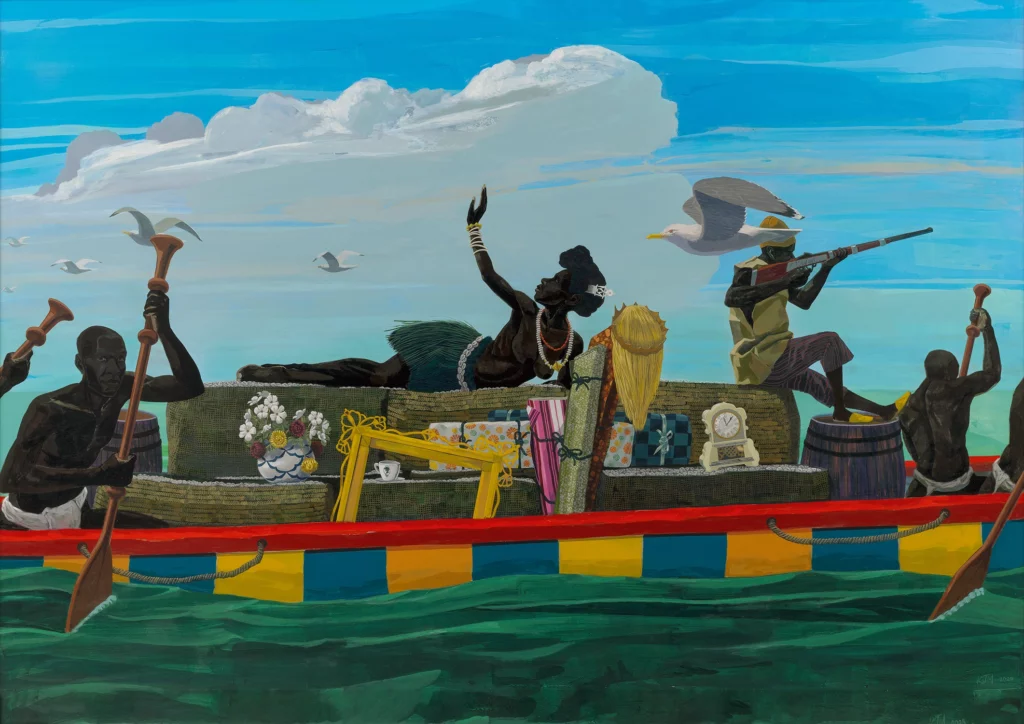
With The Histories, the Musée d’Art Moderne de Paris presents Kerry James Marshall’s first major exhibition in France. Bringing together nearly seventy works, including eight new paintings, the exhibition reveals the scope of an artistic practice that places Black figures at the heart of the grand tradition of painting while powerfully questioning how art history is written.
Kerry James Marshall at the Musée d’Art Moderne de Paris
It is one of the major highlights of the 2026 Paris art season. From 18 September 2026 to 24 January 2027, the Musée d’Art Moderne de Paris presents Kerry James Marshall: The Histories, the first major exhibition in France devoted to the American artist.
Born in Birmingham, Alabama, in 1955, Kerry James Marshall has developed a monumental body of work over several decades, in which painting, history and representation are intimately connected.
The exhibition brings together nearly seventy works, including eight new paintings created especially for the project. Organised by the Royal Academy of Arts in London in collaboration with Kunsthaus Zürich, it offers an ambitious exploration of Marshall’s work.
But The Histories goes far beyond the conventional retrospective format.
One question runs throughout the exhibition and, more broadly, through Marshall’s entire body of work: who has been allowed to occupy the foreground of the history of painting?
Support independent publishing! Subscribe to ART MAG and receive each issue in advance, in both print and digital format 👉 Subcribe 6 issues / 1 year
Bringing Black figures to the heart of grand painting
In Kerry James Marshall’s work, the presence of Black figures is never peripheral. It lies at the very heart of the painting.
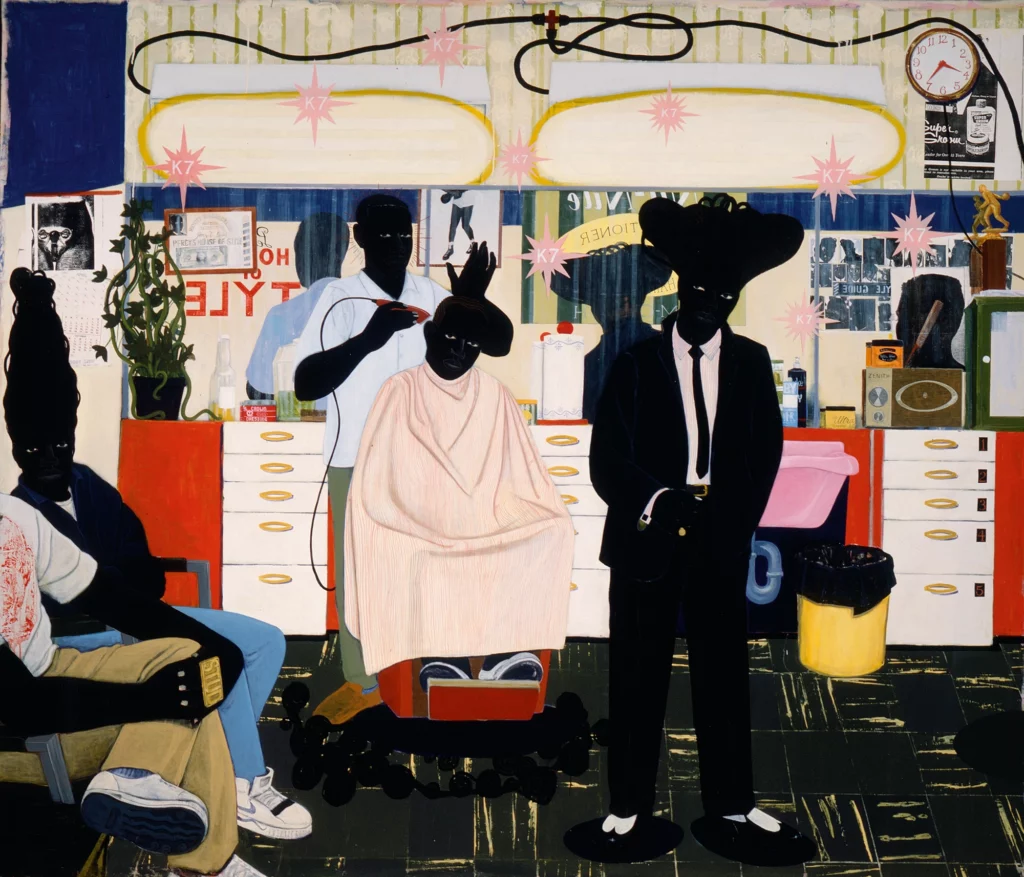
The artist draws on the formats, compositions and genres that have shaped the history of Western art: portraiture, genre painting, landscape, history painting and monumental composition. Yet he transforms their protagonists.
His Black figures fully occupy the pictorial space. They are monumental, commanding and immediately present.
Marshall is not, however, simply seeking to address an absence by adding new figures to an existing narrative. His ambition goes deeper: he works from within the history of painting itself in order to expand its narrative.
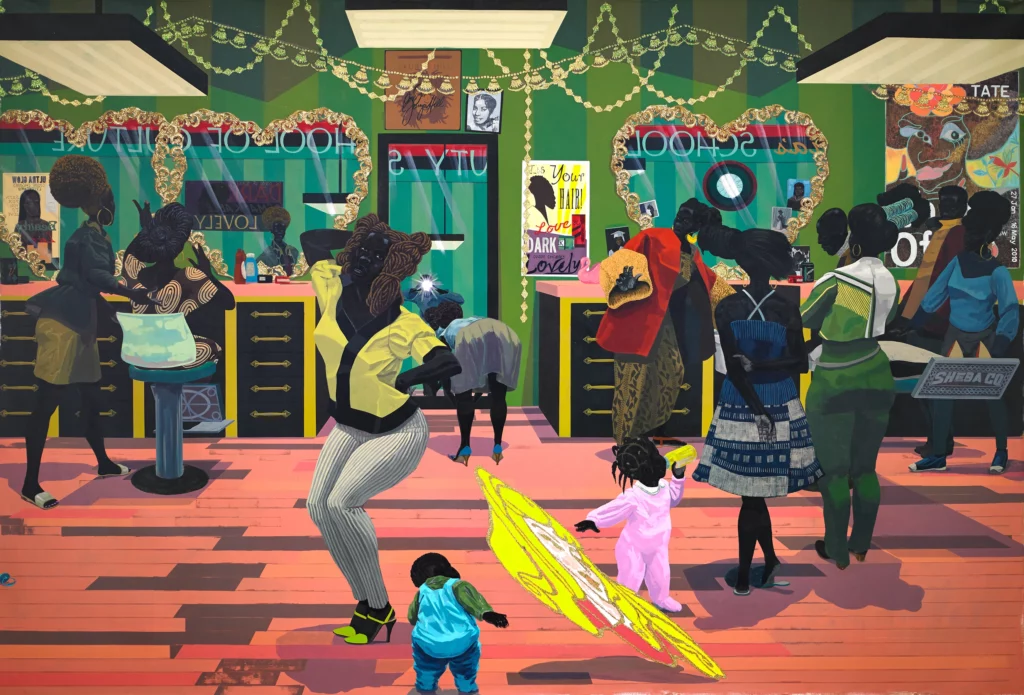
Everyday life can therefore become monumental. A domestic scene, a garden, a beauty salon or an apparently ordinary moment acquires the dignity once reserved for the grand subjects of history painting.
A constant dialogue with art history
One of the great strengths of The Histories lies in Kerry James Marshall’s dialogue with the artists and works that preceded him.
He does not reject the Western canon. He studies it, masters its codes and appropriates them to construct his own visual language.
His paintings are filled with references to art history while simultaneously incorporating elements drawn from popular culture and contemporary life.
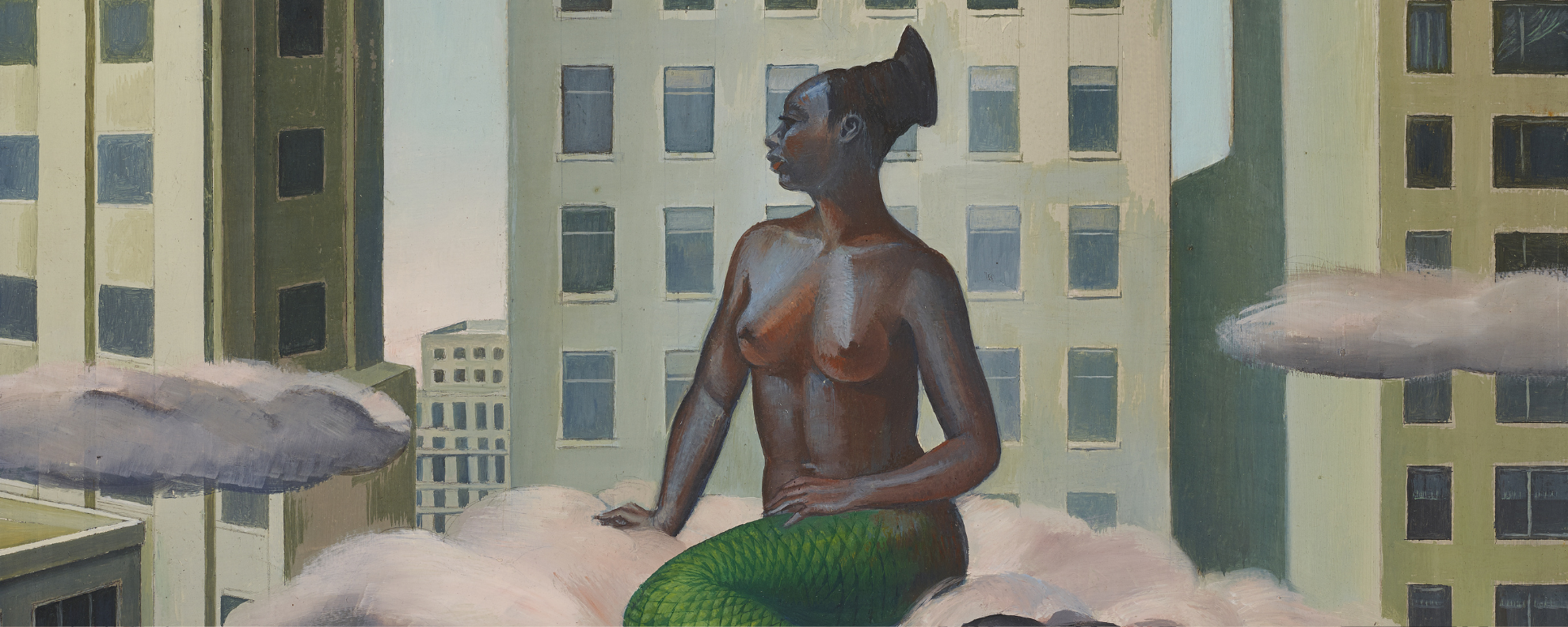
In School of Beauty, School of Culture, for example, art-historical references intersect with codes of beauty, sociability and everyday life. Different temporalities seem to coexist within the same pictorial space.
It is precisely this deep knowledge of painting that gives Marshall’s work much of its power.
He does not position himself at the margins of its history: he claims a place at its very centre.
Support independent publishing! Subscribe to ART MAG and receive each issue in advance, in both print and digital format 👉 Subcribe 6 issues / 1 year
This reflection on representation also unfolds through the very substance of painting.
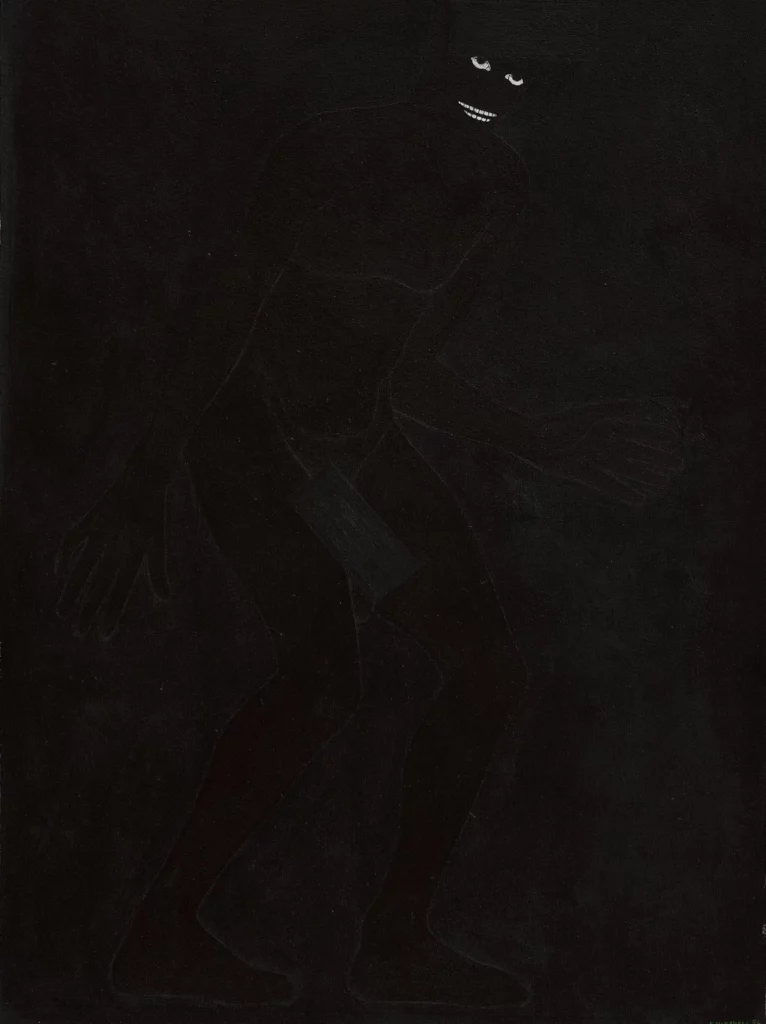
In Kerry James Marshall’s work, black is never uniform. The artist explores its nuances, densities and relationship with light, giving his figures a distinctive pictorial depth.
From a distance, some silhouettes can appear almost absorbed by the surface. But as the viewer looks more closely, variations emerge. Features become clearer; clothing, faces and bodies gradually reveal themselves.
This experience of looking is fundamental.
The question of visibility becomes simultaneously historical, political and profoundly pictorial.
Kerry James Marshall’s work also engages with some of the most painful chapters of Black history, from slavery to the Civil Rights Movement and Black Power.
Yet violence itself is not necessarily represented directly.
Instead, the artist focuses on its traces, its memory and its consequences. History emerges through signs, references, symbols and absences.
The viewer is therefore not confronted with a simple historical illustration. We are asked to look, identify, connect elements and sometimes reconstruct what the painting does not explicitly reveal.
This is where the complexity of Marshall’s work becomes particularly powerful: it shows us images while simultaneously questioning what we have learned to see.
Support independent publishing! Subscribe to ART MAG and receive each issue in advance, in both print and digital format 👉 Subcribe 6 issues / 1 year
The plural form of the exhibition’s title is essential.
The Histories does not tell a single story, but many: the history of Western painting, the history of the United States, the history of the African diaspora, the history of struggles and collective memory, as well as the stories of ordinary lives that have long remained underrepresented within dominant artistic narratives.
Across this remarkable body of work, one thing becomes clear: Kerry James Marshall is not simply introducing new protagonists into art history.
He is questioning the very way that history has been constructed.
Presented at the Musée d’Art Moderne de Paris, Marshall’s work takes on a particular resonance. It enters into dialogue with a city and collections deeply associated with the history of European modernism.
The movement therefore works in both directions: Marshall looks at art history, but his paintings compel us, in return, to look at that history differently.
A major exhibition of the 2026 Paris art season
With The Histories, the Musée d’Art Moderne de Paris offers French audiences an opportunity to discover the full scope of Kerry James Marshall’s work.
The monumentality of some of the paintings is immediately striking. Yet behind their visual power lies a much deeper reflection on representation, memory, visibility and the construction of narratives.
Marshall never turns away from the history of painting. On the contrary, he claims its legacy and demonstrates that painting can still produce new images and new histories.
An exhibition that reminds us that art history is never definitively written.
ART MAG will devote an in-depth feature to Kerry James Marshall and the exhibition The Histories in its forthcoming issue No. 35.
Support independent publishing! Subscribe to ART MAG and receive each issue in advance, in both print and digital format 👉 Subcribe 6 issues / 1 year
Practical information
Kerry James Marshall – The Histories Musée d’Art Moderne de Paris 11 Avenue du Président-Wilson, 75116 Paris, France 18 September 2026 – 24 January 2027
FAQ – Kerry James Marshall in Paris
Where can I see the Kerry James Marshall exhibition in Paris?
Kerry James Marshall: The Histories is on view at the Musée d’Art Moderne de Paris, located on Avenue du Président-Wilson in Paris’s 16th arrondissement.
Until when can I see the Kerry James Marshall exhibition?
The exhibition runs from 18 September 2026 to 24 January 2027 at the Musée d’Art Moderne de Paris.
What does “The Histories” exhibition present?
The Histories brings together nearly seventy works by Kerry James Marshall, including eight new paintings. The exhibition explores his relationship with art history, the representation of Black figures and major historical narratives.
Who is Kerry James Marshall?
Kerry James Marshall is an American artist born in Birmingham, Alabama, in 1955. For several decades, his work has examined the place of Black figures within the history of Western painting while engaging with the major genres and traditions of art history.
Support independent publishing! Subscribe to ART MAG and receive each issue in advance, in both print and digital format 👉 Subcribe 6 issues / 1 year
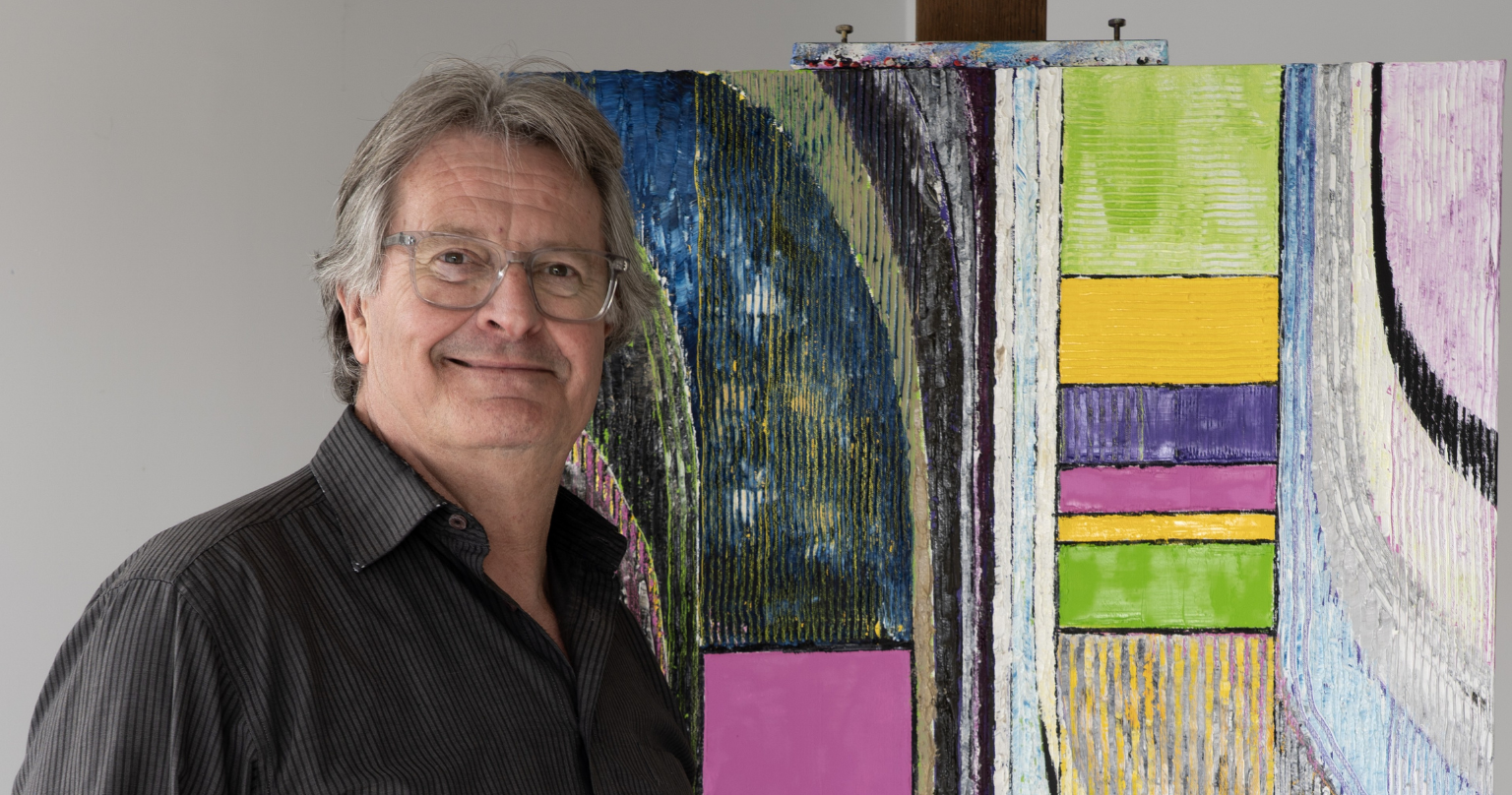
A contemporary French artist, Denis Doistau creates paintings in which light travels across lines, reveals reliefs and transforms matter. ART MAG features a portrait of the artist in issue 34.
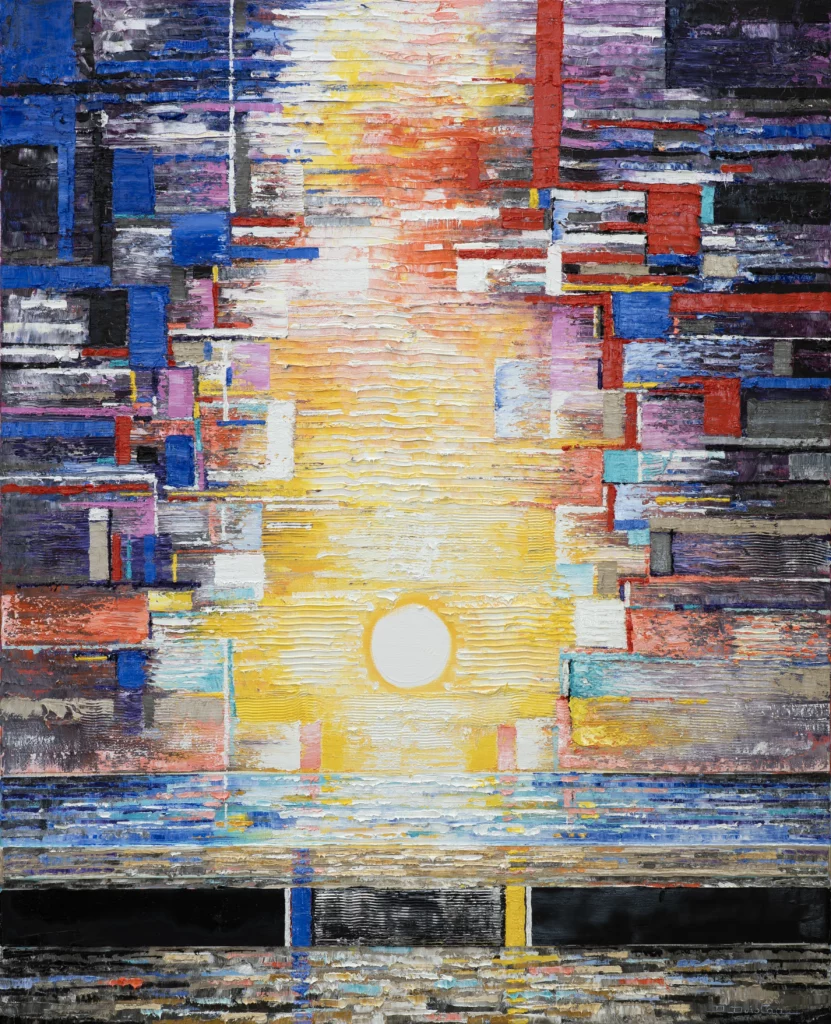
Denis Doistau, Renaître à la lumière, oil on canvas, 100 × 81 cm, 2024.
At first glance, Denis Doistau’s paintings impress through the precision of their construction. Lines structure the space, colours find their balance, and the eye appears to be guided by a perfectly controlled architecture.
Yet one only needs to move closer for this initial impression to change.
Grooves capture the light, impasto disrupts the regularity, and overlapping layers give the canvas a shifting depth. Behind the apparent order, the material remains free, alive and sometimes unpredictable.
Denis Doistau: Between Structure and Freedom
Each painting begins with a clear intention, a sketch and a carefully selected colour palette. Yet Denis Doistau does not seek to control everything.
Once he stands before the canvas, the artist allows the painting to take its own direction. Gesture, material and unexpected developments begin to shift the original balance of the composition.
This meeting between control and freedom is one of the defining features of his work. It invites the eye to move through the painting, follow a line, then wander away from it to discover a relief, a transparency or a variation of light.
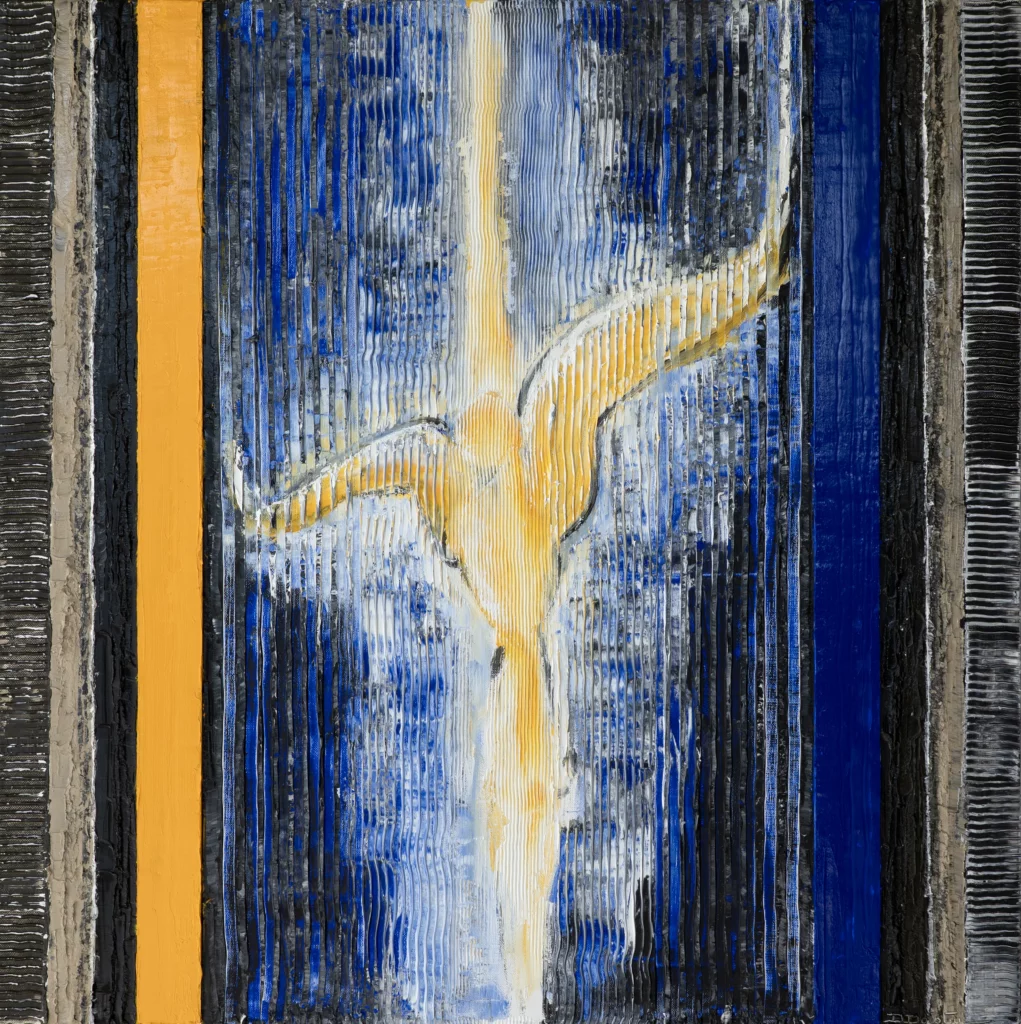
From one canvas to the next, light becomes a presence, a passage or a force of transformation. It structures the space while allowing the unexpected to emerge.
Denis Doistau, Colombe de lumière, oil and collage, 80 × 80 cm, 2025.
A Painting That Reveals Itself Over Time
Denis Doistau’s works never reveal themselves fully at first glance. Their construction initially draws the eye, before the material gradually transforms the viewer’s perception.
How does his experience as a designer and interior architect continue to shape his painting? How does he create this balance between rigour and unpredictability? And why does light occupy such an essential place in his work?
In issue 34 of ART MAG, discover the full portrait of Denis Doistau, his artistic journey and the works that reveal the distinctive character of his painting. The issue is available in print and digital editions.
Are you an artist looking to introduce your work through an editorial feature?
For each issue, ART MAG International selects contemporary artists whose careers and artistic practices are explored in articles published in both French and English.
The magazine is distributed in France and internationally to art enthusiasts, collectors, professionals and institutions.
Denis Doistau is a contemporary French artist. A graduate of the École Camondo, he first worked as a designer and interior architect before developing a body of paintings in which spatial construction, light and material play a central role.
How would you describe Denis Doistau’s paintings?
His paintings combine structured compositions with a freer, more fluid approach to material. Lines organise the space, while reliefs, impasto and variations in colour introduce an element of unpredictability.
What role does light play in his work?
In Denis Doistau’s paintings, light is more than a pictorial effect. It guides the eye, reveals the reliefs and contributes directly to the construction of each work.
What techniques does Denis Doistau use?
Denis Doistau works primarily in oils. Some of his works also combine painting and collage, allowing him to heighten the effects of material, depth and luminous vibration.
Where can Denis Doistau’s work be seen?
Denis Doistau will present a solo exhibition at AAC Galerie in Amiens from 1 to 30 October 2026. The exhibition will offer an opportunity to discover his exploration of light, material and the construction of space. ART MAG also features “Constructing Light”, an in-depth portrait of Denis Doistau, in issue 34, available in print and digital editions.
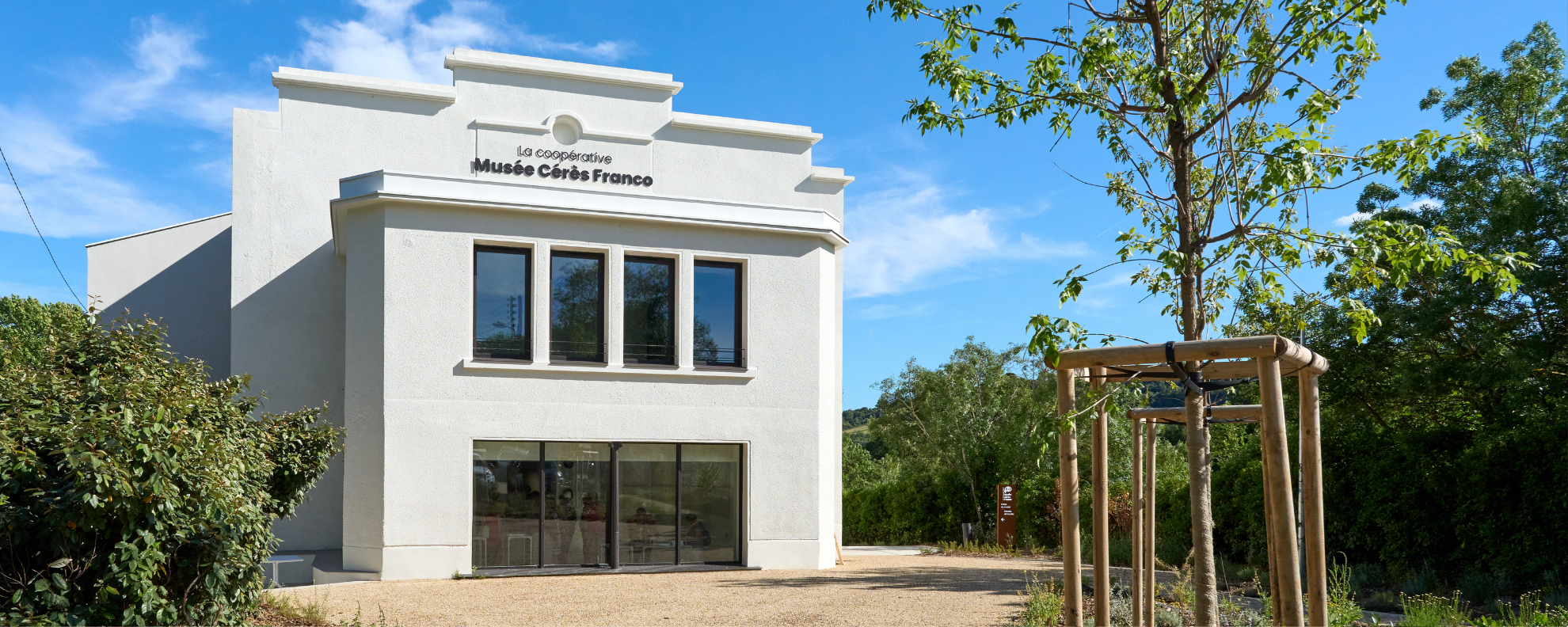
Photo Alain Machélidon - La Coopérative-Musée Cérès Franco
The Cérès Franco Museum in Montolieu is celebrating the centenary of the gallerist and collector with the exhibition “The Adventurers of the Bull’s-Eye: 100 Artists in Homage to Cérès Franco”. Following several years of renovation, the newly designated Musée de France invites visitors to rediscover artists who long remained on the margins of official art history.
In Montolieu, a Village of Books and Arts located in the Aude department, around twenty kilometres from Carcassonne, a former wine cooperative now houses an exceptional art collection. The Cérès Franco Museum preserves almost 1,750 works by 323 artists from 39 countries.
Following several years of renovation, the Coopérative-Musée Cérès Franco reopened on 20 June 2026. Its transformation and designation as a Musée de France recognise the career of a woman who spent decades championing artists often overlooked by mainstream institutions.
This institutional recognition celebrates more than a collection. It highlights a particular way of looking at art: free, instinctive and unconstrained by established hierarchies.
Cérès Franco: A Gallerist with an Independent Vision
Born in Brazil in 1926 and based in Paris from the 1950s onwards, Cérès Franco was an art critic, curator, gallerist and collector.
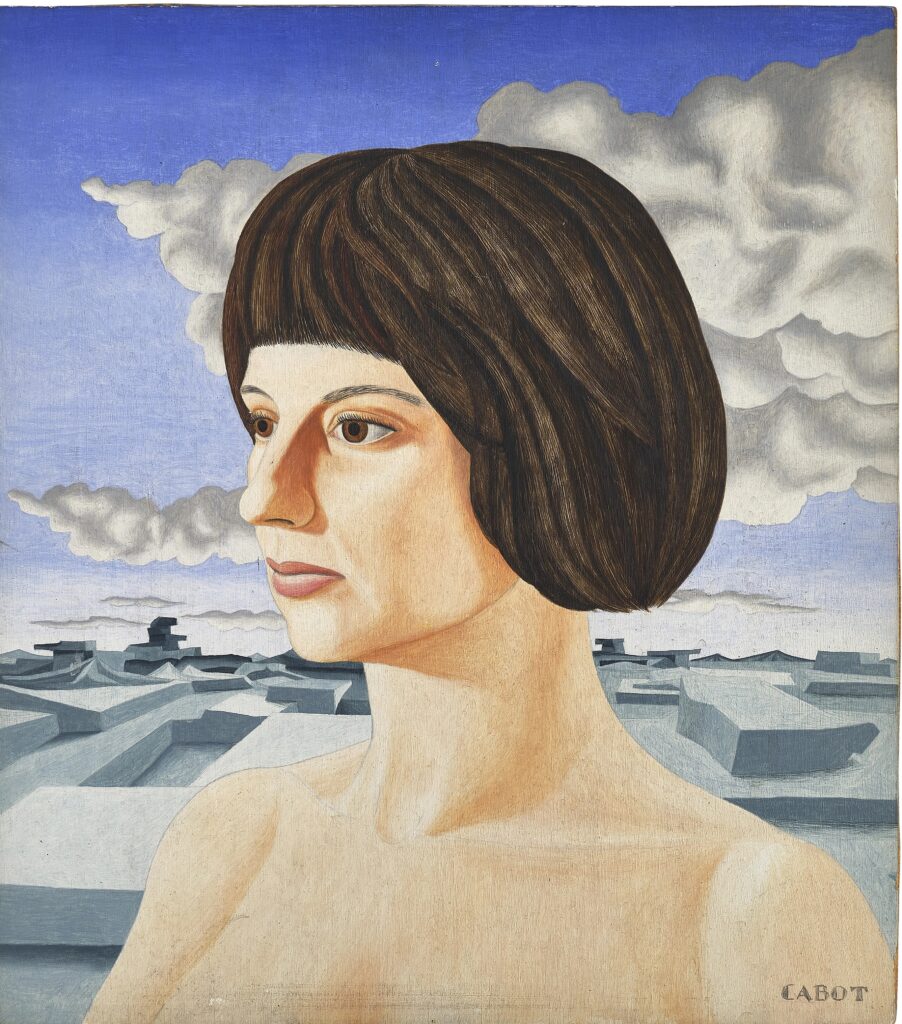
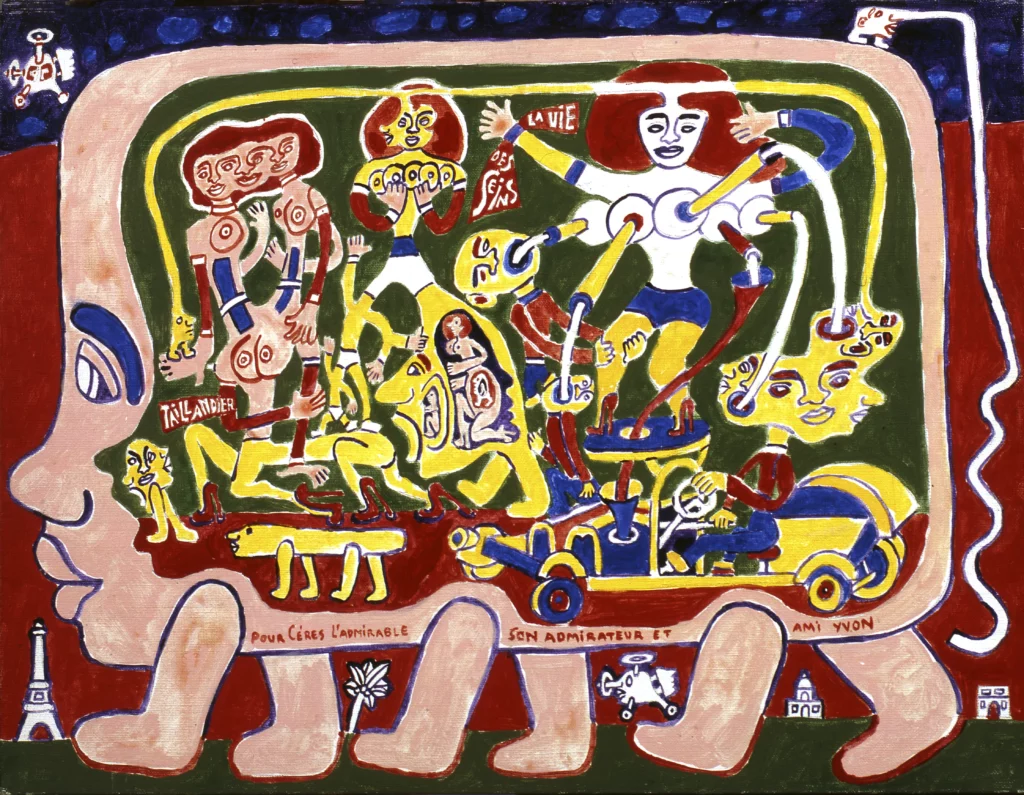
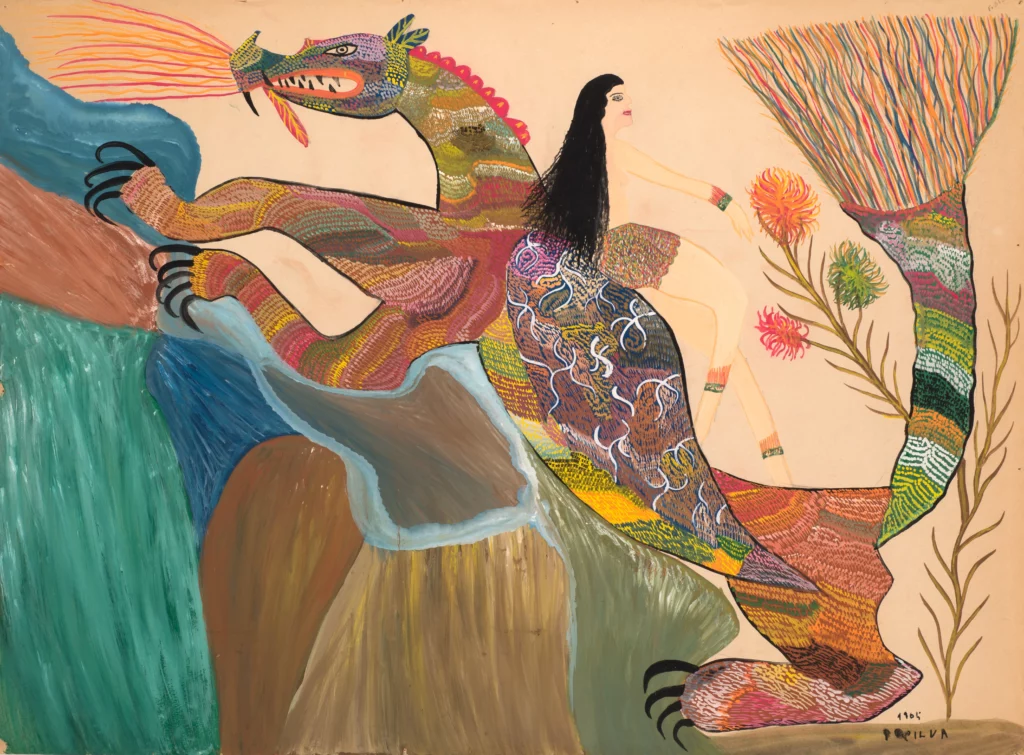
Her vision could not be confined to any single school. Brazilian and European naïve art, South American folk art, Art Brut, self-taught artists, the CoBrA movement and New Figuration all coexist within a collection that brings together forms of expression traditionally kept apart by conventional classifications.
Rather than following an encyclopaedic approach, the Cérès Franco Collection reveals an intuitive and passionate way of selecting artworks. Franco was drawn to expressive power, the human figure, colour and freedom of gesture.
She paid less attention to an artist’s position within the market or the institutional art world than to the ability of their work to provoke an emotional response. Through her choices, Cérès Franco helped bring visibility to artists who had long remained at the margins of the art world.
The collection’s current recognition therefore raises an essential question: how is art history constructed, and who decides which works will become part of our collective heritage?
The Cérès Franco Museum: A Cultural Landmark in Montolieu
Housed in a former wine cooperative since 2015, the Cérès Franco Museum has undergone a complete renovation led by the architectural practice Passelac & Roques, commissioned by the Occitanie Region.
The project preserves the building’s industrial heritage while adapting it to the requirements of a contemporary museum. Covering approximately 1,250 square metres, the institution now offers 650 square metres of exhibition space, twice its original capacity.
The museum also includes storage facilities that meet modern conservation standards, educational spaces and a documentation centre intended for both the public and researchers.
This transformation goes beyond architectural renovation. It demonstrates that a collection of national importance can be preserved and promoted from a rural setting. In Montolieu, culture is not treated as a privilege reserved for major cities, but as a space for discovery, research and transmission, open to everyone.
“The Adventurers of the Bull’s-Eye”: The Centenary Exhibition
To celebrate the centenary of Cérès Franco’s birth, the museum’s tenth anniversary and its reopening, the institution is presenting “The Adventurers of the Bull’s-Eye: 100 Artists in Homage to Cérès Franco”.
The exhibition revisits a landmark initiative launched by Cérès Franco in 1962. She invited several artists to abandon the traditional rectangular canvas and create freely on a circular or oval support, known in French as an œil-de-bœuf, or bull’s-eye.
This deliberately simple constraint transformed the way an artwork could be composed. The circular format removed conventional reference points, redirected the viewer’s gaze and encouraged artists to rethink the boundaries of the picture itself.
The initiative led to several international exhibitions and eventually brought together almost 250 creations. In Montolieu, the current exhibition presents approximately 150 historical works, archival documents and contemporary creations.
Sonia Delaunay, Niki de Saint Phalle, Jacques Monory, Mimmo Rotella and Corneille are among the artists represented.
Beyond the diversity of its celebrated names, “The Adventurers of the Bull’s-Eye” reveals Cérès Franco’s singular approach to curating. She did not seek to unite artists around a prescribed aesthetic doctrine. Instead, she offered them a shared field of experimentation: precise enough to stimulate creation, yet open enough to preserve each artist’s individuality.
The exhibition pays tribute to a woman who continuously brought artists, generations and cultures into dialogue.
The reopening of the Cérès Franco Museum has been accompanied by a major research and conservation project initiated in 2023. The museum’s team carried out an inventory of approximately 1,750 works to document their condition, provenance and possible restoration requirements.
An anoxic treatment was also organised for works affected by harmful insects. This technique involves placing artworks in an airtight, oxygen-free environment, avoiding the use of chemicals that could damage their materials.
At the same time, the museum is continuing to document and digitise its collection. The resource centre is intended to house the Cérès Franco archives and information relating to the artworks, gradually making this material available to the public and researchers.
Although less visible than an exhibition, this work is essential. It transforms a collection born from a personal adventure into a cultural heritage that can be preserved, studied and passed on to future generations.
When Artists from the Margins Enter the Museum
The rebirth of the Cérès Franco Museum ultimately tells a story of recognition: the story of works selected outside established hierarchies that are now housed within an institution holding the prestigious Musée de France designation.
It also reminds us that a collection is never neutral. It carries a vision of the world, a set of commitments and, at times, acts of refusal. By choosing artists for the intensity of their work rather than their institutional standing, Cérès Franco created a collection that is both deeply personal and resolutely international.
A century after her birth, her vision remains as powerful as ever. It invites us to reconsider the boundaries between fine art and folk art, and between celebrated artists and creators who have remained in the shadows.
In Montolieu, the margins are no longer relegated to the periphery of art history: they have become the very heart of the museum.
Practical Information
The Adventurers of the Bull’s-Eye: 100 Artists in Homage to Cérès Franco Until early January 2027
Coopérative-Musée Cérès Franco 5 Route d’Alzonne 11170 Montolieu, France
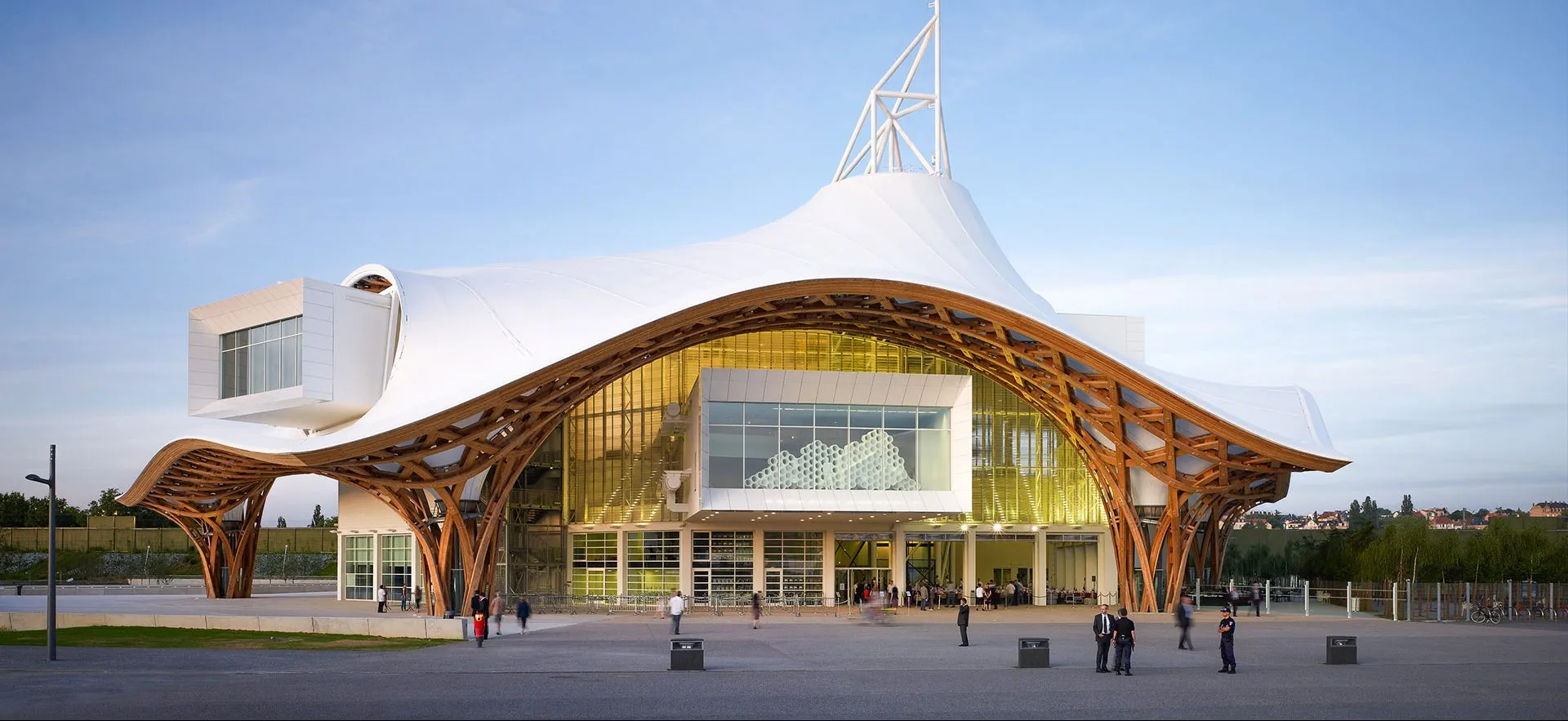
From October 31, 2026, to April 12, 2027, the Centre Pompidou-Metzwill dedicate the first truly international monographic exhibition ever devoted to this singular figure of modern art to Séraphine Louis (1864–1942), known as Séraphine de Senlis.
A self-taught visionary, mystic, and unclassifiable artist, Séraphine is now seen as a profoundly contemporary artist whose work anticipates current questions about life, spirituality, and ecology.
Paintings inspired by nature and fervor
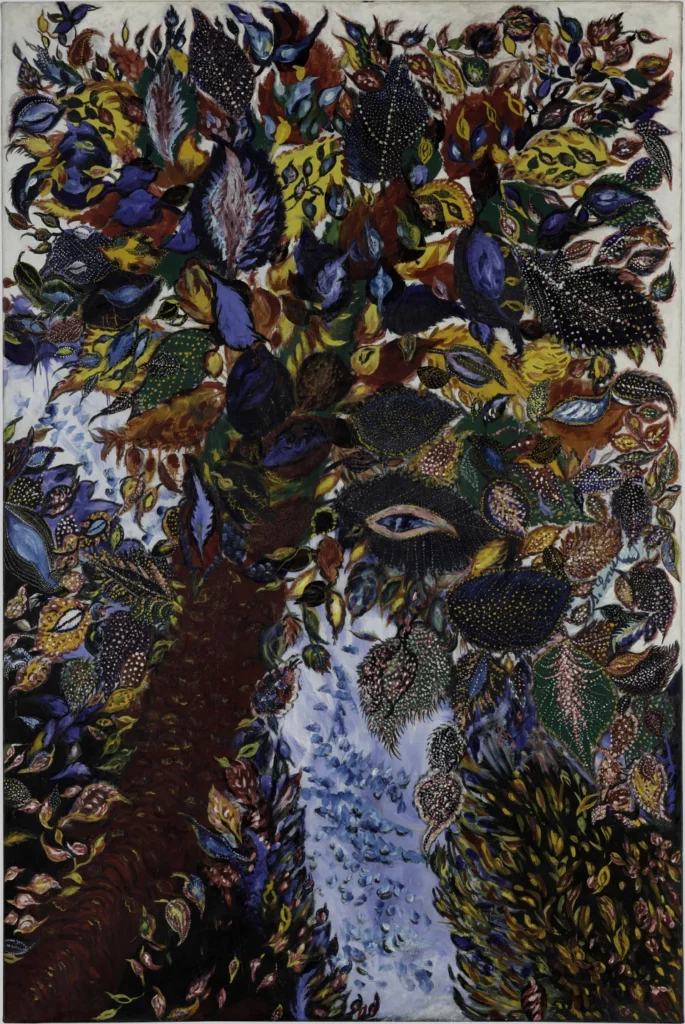
Séraphine de Senlis’ painting transforms nature into a space of power and revelation, through dense compositions in which plants appear to be animated by an inner energy.
Her works do not describe nature: they transfigure it. Each canvas becomes a telluric and supernatural territory, where color acts as a force of sublimation and prayer.
An incantatory pictorial materiality
Séraphine made her own pigments from modest materials: enamel paint, oils, varnishes, and organic pigments gleaned from her surroundings.
Séraphine de Senlis, L’Arbre du paradis (The Tree of Paradise), [circa 1929–1930]
Recent analyses have revealed the complexity of these mixtures, demonstrating remarkable empirical knowledge.
This alchemy gives her paintings an intense brilliance, depth of material, and chromatic vibration that contribute to their almost incantatory dimension. Painting becomes both a physical act and a spiritual ritual.
Between Christian mysticism and visionary botany
An orphan from a modest background, Séraphine Louis developed an ardent faith at the convent that permeates all her work.
In Senlis, the proximity of the Gothic cathedral, with its stained-glass windows and luminous verticality, had a profound influence on her imagination.
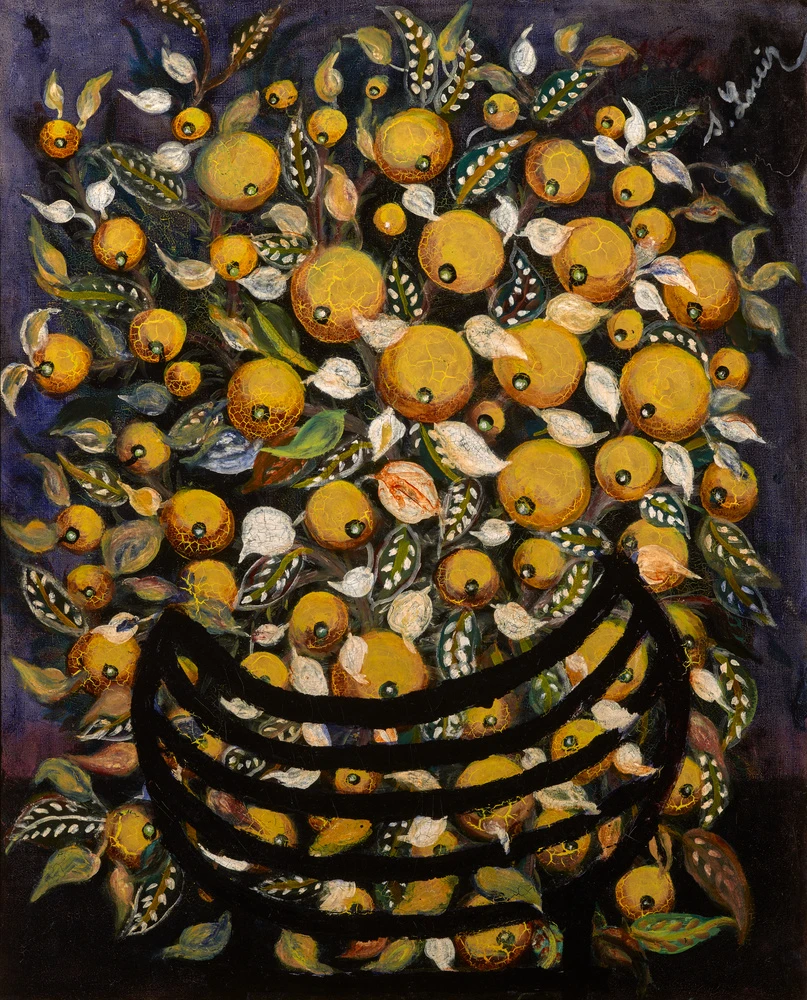
Séraphine de Senlis, Les Fruits (The Fruits), circa 1928
Inspired by botany, textile art, and sacred architecture, her painting establishes a constant dialogue between the material and the invisible. Nature becomes a sanctuary, a place of passage between the tangible world and the afterlife.
Late recognition and an unclassifiable body of work
Discovered in 1912 by collector Wilhelm Uhde, a supporter of Le Douanier Rousseau and Picasso, Séraphine enjoyed brief recognition in the 1920s.
She was then associated with the so-called “modern primitive” artists, of whom she remained the only woman, while escaping any real classification.
Interned from 1932 until her death in 1942, her work nevertheless continued to be exhibited.
From 1937 onwards, her paintings entered major international collections, from Paris to New York. A first monograph was devoted to her in 1945.
A major exhibition at the Centre Pompidou-Metz
The exhibition at the Centre Pompidou-Metz brings together an exceptional collection of paintings, tracing the evolution of his artistic language.
Initially fragile and floating compositions gradually give way to monumental works, animated by swirling movements, obsessive patterns, and radiant colors.
Bristling leaves, sparkling corollas, twisted branches, and shapes punctuated with strange eyes compose a supernatural botanical world, both telluric and cosmic, which continues to fascinate with its metamorphic power.
Séraphine de Senlis, an artist more relevant than ever
At a time when the links between art, ecology, and spirituality are being reexamined, Séraphine de Senlis appears as a pioneering figure.
Her work embodies an organic relationship with the world, based on attention to living things, modesty of means, and the power of the sacred.
She does not paint the world as it is, but as it vibrates, breathes, and transforms.
KANAL–Centre Pompidou will open its doors in Brussels on 28 November 2026. To inaugurate this former Citroën garage transformed into a museum, the institution will present ten exhibitions devoted to modern and contemporary art, architecture, colonial memory and the political issues shaping our time. From the major exhibition A truly immense journey to installations by Otobong Nkanga, Banu Cennetoğlu, Joëlle Tuerlinckx and Joshua Serafin, ART MAG presents the highlights not to be missed.
The opening of KANAL–Centre Pompidou is drawing closer. Housed in the former Citroën garage beside the Brussels canal, the new museum will welcome its first visitors on 28 November 2026.
For its inauguration, KANAL has chosen not to focus all attention on a single blockbuster exhibition. Instead, the institution will present ten complementary projects: nine exhibitions organised by KANAL and one major exhibition dedicated to architecture.
The programme will bring the Centre Pompidou’s collections into dialogue with the Belgian and international art scenes, while giving an important place to the history of Brussels, its industrial and colonial past, and the debates shaping society today.
While A truly immense journey is likely to emerge as the centrepiece of the opening, both in scale and in the number of works on display, the projects by Otobong Nkanga and Banu Cennetoğlu may prove to be among the most memorable, thanks to their collective and political dimensions.
Support independent publishing! Subscribe to ART MAG and receive each issue in advance, in both print and digital format 👉 Subcribe 6 issues / 1 year
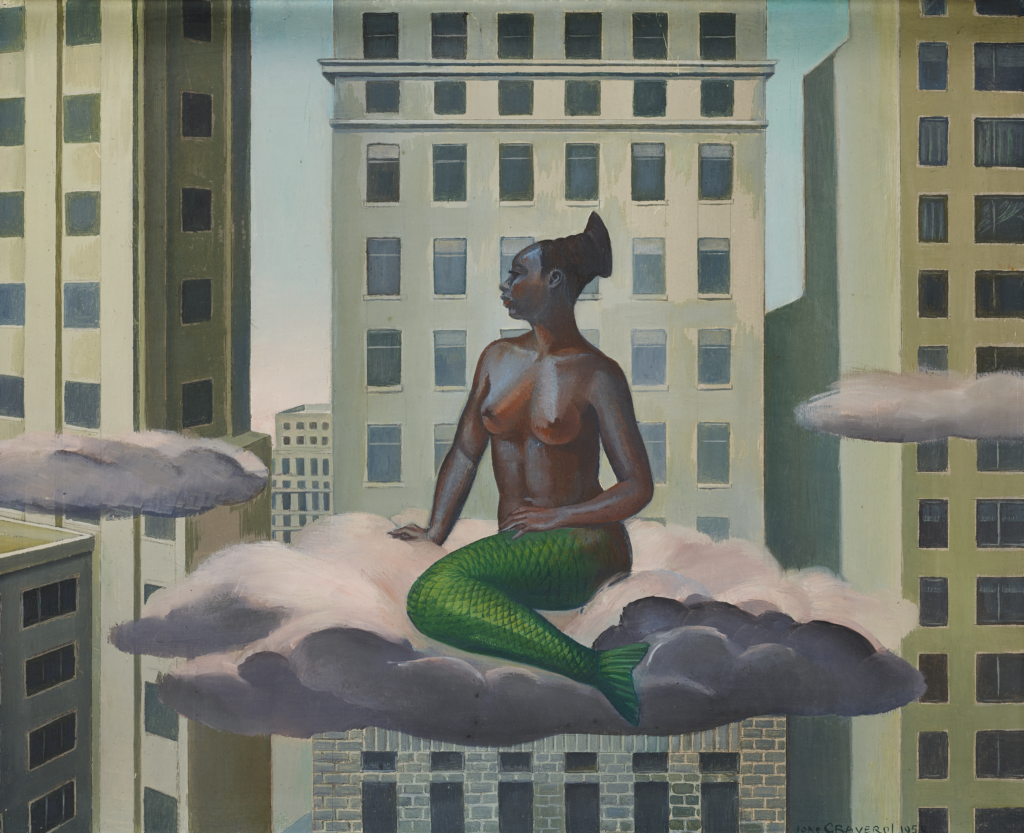
Jane Graverol, L’Afrique inconnue – La Mythologie comparée, 1958. Mu.ZEE Collection, Ostend – Collection of the Flemish Community. Photo: Steven Decroos.
A truly immense journey: More Than 350 Works Brought Together in Brussels
Featuring more than 350 works, A truly immense journey is the flagship exhibition of KANAL’s opening. Most of the works come from the Centre Pompidou’s collections, supplemented by pieces belonging to KANAL and several Belgian public and private collections.
The exhibition will bring together major figures of modern art, including Lygia Clark, Sonia Delaunay, Henri Matisse, Wifredo Lam, Pablo Picasso and Alberto Giacometti. Their works will enter into dialogue with those of contemporary artists from the Brussels and international art scenes, such as Sammy Baloji, Edith Dekyndt, Aglaia Konrad and Hana Miletić.
The exhibition will not, however, present a conventional chronological history of art. Instead, it will explore the circulation of people, ideas and artistic practices from the 1900s to the present day. Migration, the movement of forms and colonial legacies will be among the recurring themes guiding visitors through the collections.
A truly immense journey will also launch a series of long-term exhibitions offering audiences in Brussels an evolving selection of works from the Centre Pompidou.
From 28 November 2026 to 10 January 2028.
Support independent publishing! Subscribe to ART MAG and receive each issue in advance, in both print and digital format 👉 Subcribe 6 issues / 1 year
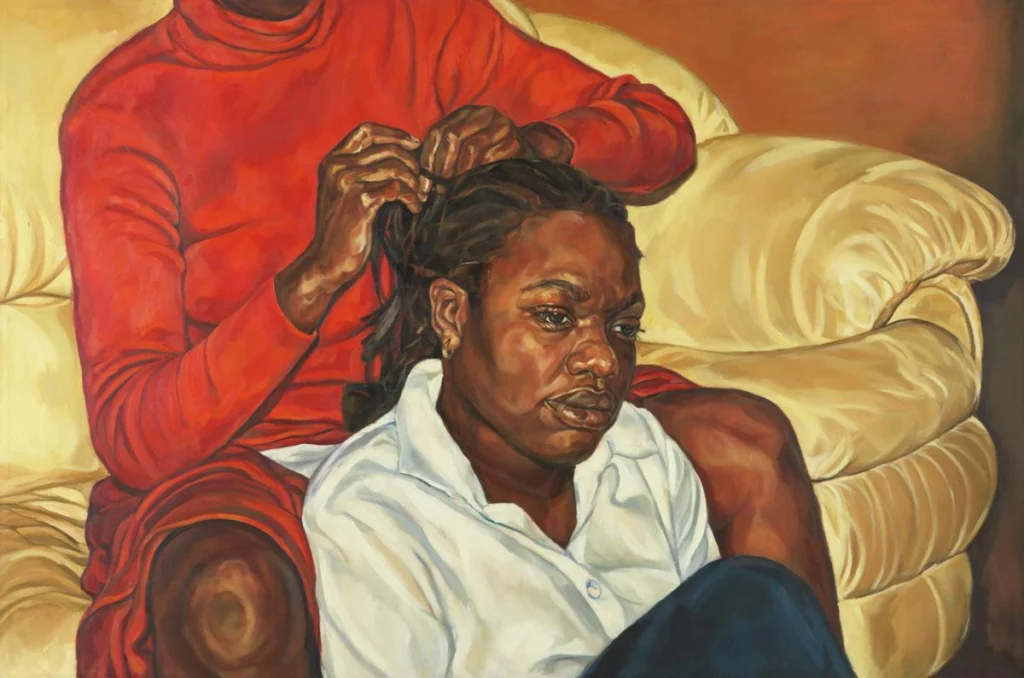
Barbara Walker, An Infinite Woman, an intimate portrait exploring care, transmission and intergenerational bonds.
An infinite woman: Revisiting Citroën’s Colonial History
This exhibition is directly connected to the history of the building that now houses KANAL.
In 1925, the portrait of a Mangbetu woman from north-eastern Congo became one of the emblems of the Croisière Noire, a colonial expedition organised by Citroën across the African continent. A few years later, the car manufacturer built the monumental garage in Brussels that has now been transformed into a museum.
Entitled An infinite woman – Black archives in two acts, the exhibition examines the creation and circulation of this colonial imagery. It also considers how artists of African descent have reclaimed these representations in order to question and transform them, and to create alternative narratives.
Works by Raphaël Barontini, Sonia Barrett, Roméo Mivekannin, Faith Ringgold, Carrie Mae Weems, Frida Orupabo and Barbara Walker will address questions of representation, memory and transmission.
More than a historical examination, the exhibition confronts the new museum directly with the darker aspects of the building it has inherited.
From 28 November 2026 to 26 April 2027.
Support independent publishing! Subscribe to ART MAG and receive each issue in advance, in both print and digital format 👉 Subcribe 6 issues / 1 year
Joëlle Tuerlinckx at KANAL: Experiencing a First Time
To inaugurate KANAL, Joëlle Tuerlinckx has chosen one of the museum’s most unusual spaces: a room situated at foundation level.
After observing the transformation of the former Citroën garage over several years, the Belgian artist has devised an installation composed of light, sounds, voices and traces left by the construction work. These different elements will alter the way visitors perceive and move through the space.
Entitled La première fois, the work reflects a practice developed by Joëlle Tuerlinckx since the 1980s, exploring the relationships between time, space and perception.
Rather than presenting an object to contemplate, the artist proposes an attentive experience of the building and the evidence of its successive transformations.
From 28 November 2026 to 29 March 2027.
Support independent publishing! Subscribe to ART MAG and receive each issue in advance, in both print and digital format 👉 Subcribe 6 issues / 1 year
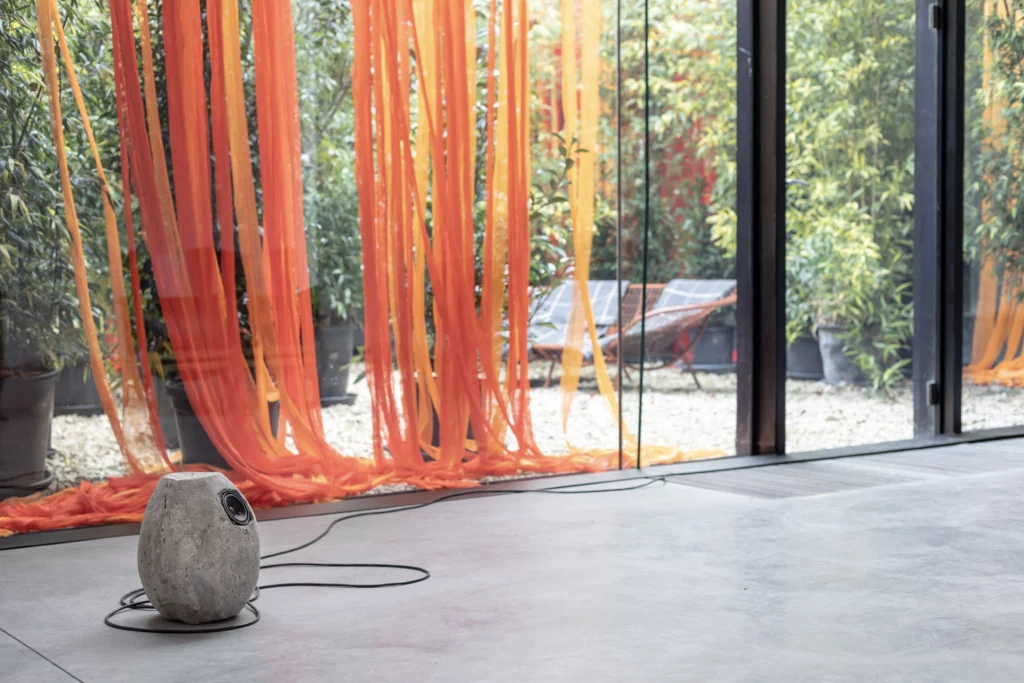
Manon de Boer, Blindsight, sound installation combining a sculptural loudspeaker with long strips of orange fabric.
Manon de Boer: Listening Rather Than Looking
With Blindsight, Manon de Boer invites visitors to slow down and give their full attention to sound.
Developed with choreographer Latifa Laâbissi and sound designer Laszlo Umbreit, the installation reverses the usual hierarchy between image and listening. Seated in a cinema chair, visitors encounter a soundscape broadcast through various devices, including loudspeakers concealed inside vases.
This sensory proposition extends Manon de Boer’s research into cinema, music and dance. It also questions our relationship with duration in a cultural environment often dominated by speed and the proliferation of images.
From 28 November 2026 to 29 March 2027.
Support independent publishing! Subscribe to ART MAG and receive each issue in advance, in both print and digital format 👉 Subcribe 6 issues / 1 year
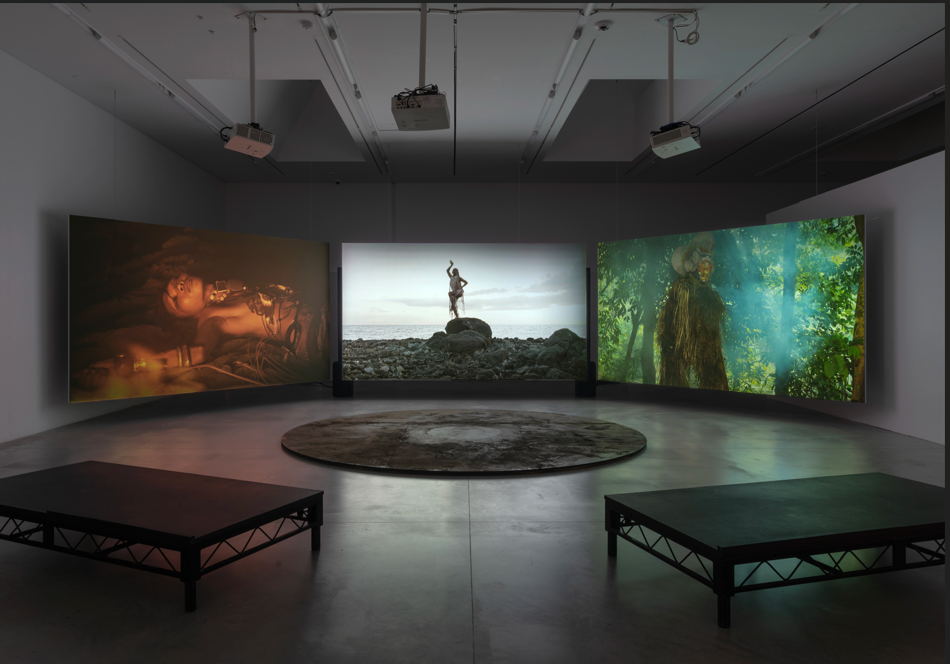
Joshua Serafin, Creation Paradigm, three-screen video installation presented at the Amant Foundation.
Joshua Serafin: The Body Between Migration, Memory and Identity
For the opening of KANAL, Joshua Serafin will present Whispering pleas of the eternal echoes, a video installation specially conceived for the museum.
Moving between the Philippines and Belgium, the artist brings together several generations and different narratives to explore questions of origin, migration and belonging.
At the crossroads of choreography, cinema, installation, sculpture and sound, Joshua Serafin’s practice considers the body as a territory in constant transformation. It becomes both the place where family and collective legacies are inscribed and the point from which new identities can be constructed.
The installation is likely to offer one of the most physical and immersive experiences in the inaugural programme.
From 28 November 2026 to 29 March 2027.
Support independent publishing! Subscribe to ART MAG and receive each issue in advance, in both print and digital format 👉 Subcribe 6 issues / 1 year
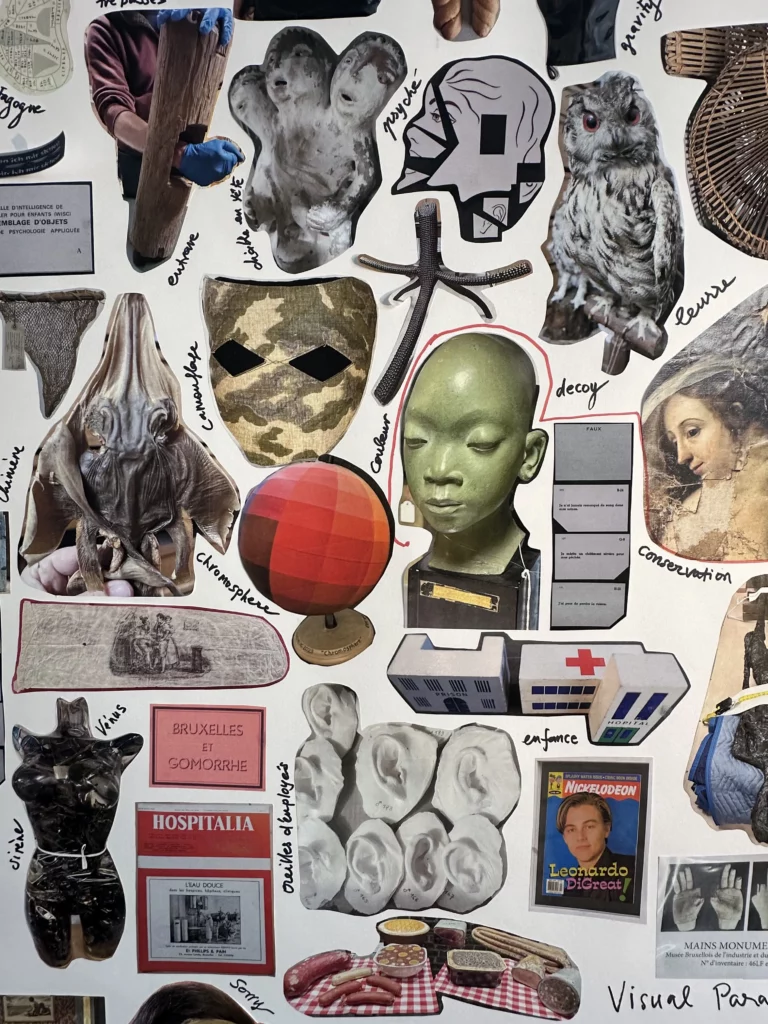
Clémentine Deliss, Département des Pièges, research diagram combining archival images, ethnographic objects and handwritten notes.
Département des Pièges: Eleven Brussels Museums Bring Their Collections Together
The title of the exhibition echoes Marcel Broodthaers’ celebrated Département des Aigles.
With Département des Pièges – Metabolic Museum-University, curator Clémentine Deliss brings together historical objects, paintings and contemporary creations around the notions of traps, decoys and trompe-l’œil.
One of the project’s defining features is the origin of the works on display. Eleven Brussels museums are participating in the exhibition, including the AfricaMuseum, Design Museum Brussels, Horta Museum and Museum of Ixelles.
Their collections will enter into dialogue with contemporary works by Guillaume Bijl, Kasper Bosmans, Aline Bouvy, Pélagie Gbaguidi, Otobong Nkanga and Valérie Mannaerts.
Beyond the visual interplay suggested by its title, the exhibition will examine the ways in which objects are classified, interpreted and presented within museums.
From 28 November 2026 to 31 May 2027.
Support independent publishing! Subscribe to ART MAG and receive each issue in advance, in both print and digital format 👉 Subcribe 6 issues / 1 year
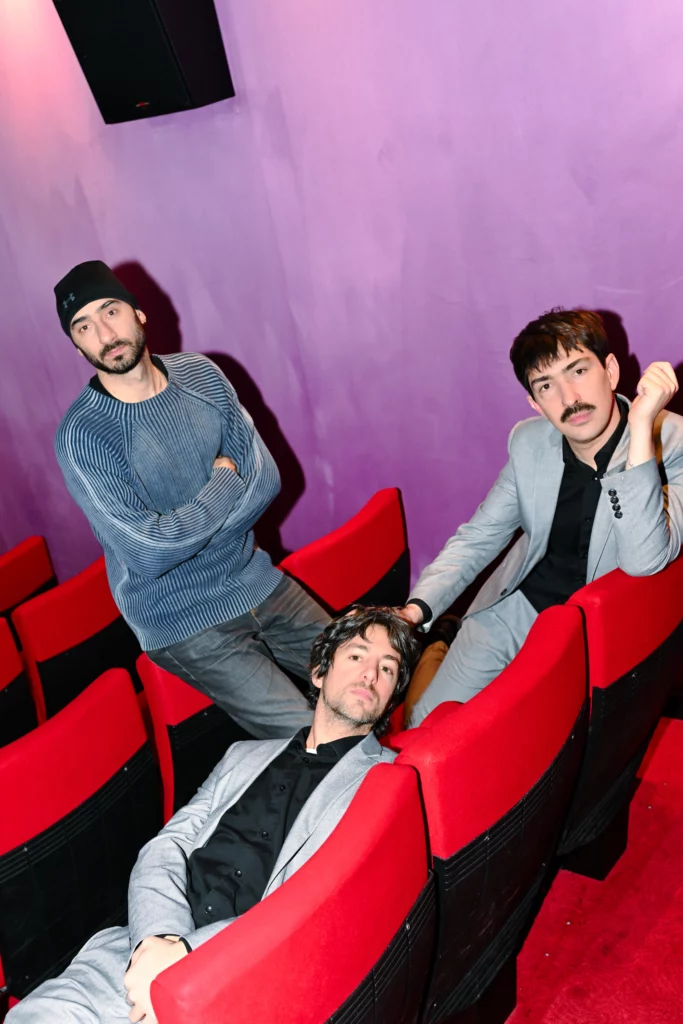
The artists of No Show, photographed by Sepideh Farvardin in an auditorium with red seats.
NO SHOW: Does a Museum Necessarily Have to Entertain?
Can an exhibition still exist without giving in to the logic of spectacle? This is the question posed by Deborah Bowmann, Maoupa Mazzocchetti and around twenty Brussels-based artists invited to occupy five spaces within KANAL.
Art, light, sound and performance will form a journey that deliberately blurs the boundaries between exhibition and spectacle, reality and fiction.
The question has particular resonance in a museum of monumental proportions that is set to become one of Brussels’ major new cultural centres. How can it attract a broad audience without turning the artistic experience into mere entertainment? And how can it preserve a place for experimentation within an institution facing high expectations in terms of visitor numbers?
Behind its apparent playfulness, NO SHOW may therefore prove to be one of the opening programme’s most critical propositions.
From 28 November 2026 to 18 January 2027.
Banu Cennetoğlu: Staging the Fragility of Human Rights
With right?, Banu Cennetoğlu transforms the thirty articles of the Universal Declaration of Human Rights into bouquets of golden letter-shaped balloons.
For the opening of KANAL, the thirty articles will be presented simultaneously for the first time. The work is nevertheless designed to change over time. The balloons will gradually deflate, their surfaces will lose their shine and the letters will eventually become distorted.
The fragile, almost festive materiality of the installation contrasts with the seriousness of its subject. It reminds us that fundamental rights, even when they appear to be universally recognised, can weaken when they are no longer defended.
Presented in Brussels, at the heart of the European institutions, the work takes on a particularly powerful political significance.
Otobong Nkanga: A Collective Work in Perpetual Construction
Otobong Nkanga will transform one of KANAL’s large open spaces into a place of encounter, transmission and collective creation.
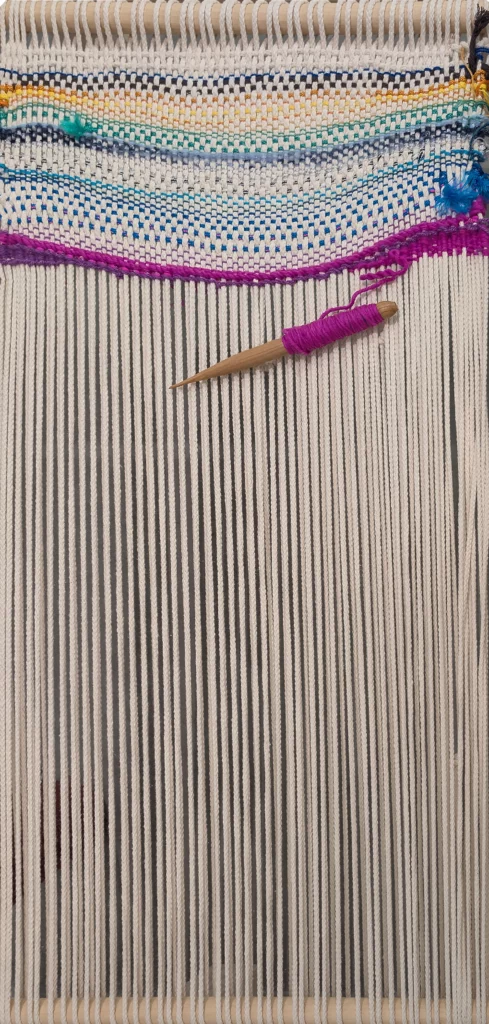
Gathered around wooden looms, specially trained participants will work together to produce a piece that will continue to evolve throughout the exhibition. The threads will intertwine like the experiences, gestures and stories of those taking part in the project.
Weaving thus becomes a means for the artist to examine labour, the use of resources, knowledge-sharing and the social responsibilities of a cultural institution.
By placing collective action at the heart of the museum, Otobong Nkanga moves beyond the customary separation between artists, artworks and the public. Her project may become one of KANAL’s liveliest and most accessible spaces.
Admission to the installation will be free of charge.
From 28 November 2026 to 19 April 2027.
Support independent publishing! Subscribe to ART MAG and receive each issue in advance, in both print and digital format 👉 Subcribe 6 issues / 1 year
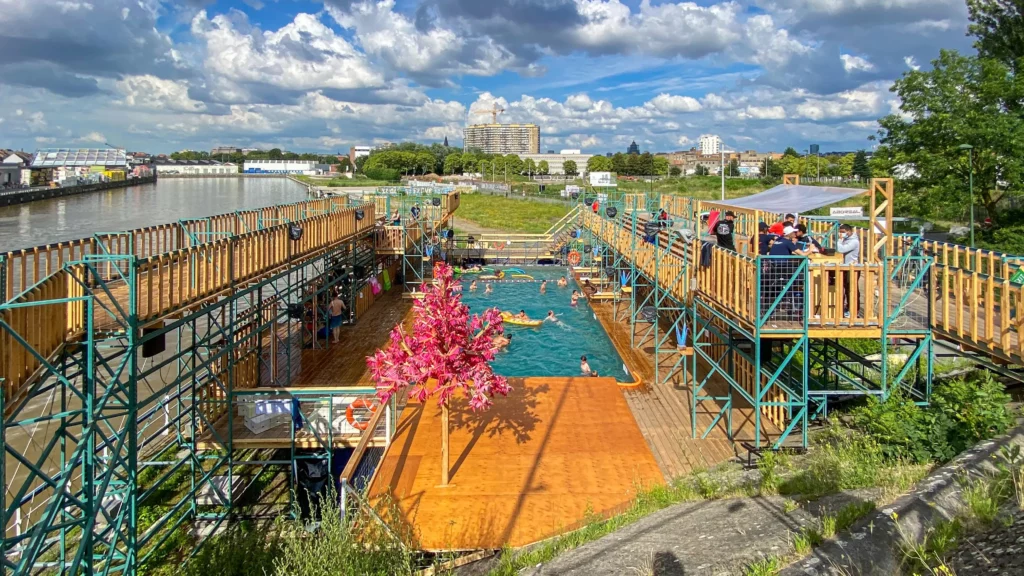
Right to the City, Right to the Future, architectural project and temporary bathing area created beside the Brussels canal.
Right to the City – Right to the Future: Imagining the Future of Brussels
Architecture forms the tenth part of the inaugural programme.
Organised by KANAL Architecture, Right to the City – Right to the Future will connect the history of the surrounding neighbourhoods with several contemporary issues: the climate crisis, circularity, gender and the legacies of colonialism.
The exhibition will combine documents from the CIVA’s historical collections with new research and eight contemporary commissions. It will be extended through a programme of approximately fifty events, as well as workshops designed for a range of audiences.
More than a presentation of architectural projects, the exhibition considers the city as a shared political space. In particular, it raises the question of how residents can participate in the transformation of Brussels and exercise their right to imagine its future.
From 28 November 2026 to 14 March 2027.
Support independent publishing! Subscribe to ART MAG and receive each issue in advance, in both print and digital format 👉 Subcribe 6 issues / 1 year
Which Exhibitions Should You See First at KANAL–Centre Pompidou?
With these ten propositions, KANAL is not simply seeking to showcase the scale of its new spaces or the richness of the Centre Pompidou’s collections. From the outset, the museum is asserting an identity of its own, closely connected to Brussels, its industrial and colonial history, and contemporary political and social debates.
Given its scale, A truly immense journey is likely to attract the largest audiences. It will provide the best starting point for discovering the museum and understanding the dialogue KANAL intends to establish between modern collections and contemporary creation.
Visitors interested in colonial history may then wish to prioritise An infinite woman, while the installations by Banu Cennetoğlu and Otobong Nkanga are likely to offer two of the opening’s most socially and politically engaged experiences. The more experimental projects by Joëlle Tuerlinckx and Manon de Boer will provide alternative ways of approaching architecture, time and perception.
From 28 November 2026, KANAL will face a dual challenge: establishing itself as an international cultural destination while preserving a genuinely Brussels-based identity. Its inaugural programme already demonstrates that the new museum intends to be far more than an extension of the Centre Pompidou.
Support independent publishing! Subscribe to ART MAG and receive each issue in advance, in both print and digital format 👉 Subcribe 6 issues / 1 year
The Bayeux Tapestry opens to the public at the British Museum in London on 10 September 2026. Even before its inauguration, the exhibition has already generated around £2.5 million in ticket revenue, with more than one million visitors expected. Behind this spectacular success lies a broader phenomenon: how can a single work become a cultural event, an economic driver and an instrument of diplomacy all at once?
The Bayeux Tapestry takes centre stage at the British Museum
Nearly a thousand years after its creation, the Bayeux Tapestry is crossing the Channel once again.
From 10 September 2026, the British Museum in London will present this monumental work depicting the events that led to William the Conqueror’s conquest of England and the Battle of Hastings in 1066.
Measuring approximately 70 metres in length, this 11th-century embroidery is one of the most celebrated surviving works of medieval Europe. Listed as a historic monument in France since 1842 and included in UNESCO’s Memory of the World Register since 2007, it belongs to the French State and is usually housed at the Bayeux Tapestry Museum, currently closed for renovation.
Its arrival in London carries particular significance: the work is being presented in the United Kingdom for the first time in nearly a thousand years.
Yet even before visitors have had the opportunity to see it, the exhibition has already become a phenomenon.
Support independent publishing! Subscribe to ART MAG and receive each issue in advance, in both print and digital format 👉 Subcribe 6 issues / 1 year
£2.5 million before the exhibition even opens
The opening of ticket sales revealed the extraordinary level of public interest.
When the first tickets went on sale on 1 July, tens of thousands of people connected to the British Museum’s website. The online queue exceeded 80,000 people, while traffic to the museum’s website rose to several times its usual daily level.
The result was remarkable: around £2.5 million in ticket revenue was generated before the exhibition had even opened.
According to Reuters, it is already the fastest-selling exhibition in the British Museum’s history. More than one million visitors are expected before it closes in July 2027.
The figures are striking. More importantly, however, they reveal something significant: a single work can now generate the kind of public response usually associated with major retrospectives devoted to the world’s most celebrated artists.
The Bayeux Tapestry therefore offers a compelling case study in the economics of blockbuster exhibitions.
When a single artwork becomes a destination
Major international exhibitions generally rely on an accumulation of masterpieces: retrospectives, exceptional collections or dialogues between artists.
Here, the model is reversed.
A single work is the event.
Its rarity partly explains its extraordinary appeal. The Bayeux Tapestry almost never travels. According to the French Ministry of Culture, it had left Normandy on only two occasions, in 1804 and 1944, before its transfer to London in July 2026.
Its rarity is compounded by a history deeply intertwined with that of the United Kingdom. The embroidery recounts the Norman Conquest of England and the Battle of Hastings, one of the defining episodes in British history.
Seeing the Tapestry in London is therefore about more than simply visiting an exhibition. The event carries the symbolic power of a return.
Rarity, history, the exceptional nature of the journey and symbolic significance combine to create something major cultural institutions increasingly seek to achieve: turning the museum itself into a destination.
Support independent publishing! Subscribe to ART MAG and receive each issue in advance, in both print and digital format 👉 Subcribe 6 issues / 1 year
Moving the irreplaceable: the hidden cost of a blockbuster
The £2.5 million already generated may suggest an extremely lucrative operation. The economic reality is more complex.
Ticket revenue is not profit.
Transporting a work that is almost a thousand years old requires a considerable technical, scientific and security infrastructure.
The transfer to London required more than a year of preparation involving the French authorities, the British Museum, heritage institutions and specialist professionals.
The Tapestry travelled in a custom-built climate-controlled, anti-vibration crate, under high security and subject to particularly stringent conservation protocols.
Its installation also requires a display specifically adapted to its fragility and exceptional dimensions. At the British Museum, the work is presented along its full length within a specially designed installation intended both to ensure its conservation and to accommodate very large numbers of visitors.
Specialist transport, security, preventive conservation, technical equipment, exhibition design, scientific teams, visitor services and communications: behind a blockbuster exhibition lies an economy far more complex than ticket revenue alone.
British Museum director Nicholas Cullinan has also indicated that the exhibition represents a significant investment for the institution and that ticket income will help offset part of its costs.
This distinction is fundamental: the £2.5 million reported represents revenue, not profit generated by the museum.
Support independent publishing! Subscribe to ART MAG and receive each issue in advance, in both print and digital format 👉 Subcribe 6 issues / 1 year
What does a blockbuster exhibition really bring to a museum?
Ticket sales are only one part of the equation.
An exhibition capable of attracting hundreds of thousands of visitors can have significant indirect economic effects: museum shop sales, food and beverage revenue, memberships, merchandise and increased international visibility for the institution.
These general mechanisms must, of course, be distinguished from the specific financial results of the Bayeux Tapestry exhibition, which are not yet known.
But the stakes extend beyond immediate revenue.
In an increasingly competitive international cultural landscape, visitor numbers have become a strategic indicator. Major institutions must conserve, research and transmit knowledge, but they must also attract new audiences, develop their own sources of revenue and maintain their international profile.
The event exhibition therefore plays an increasingly important role.
Vermeer at the Rijksmuseum, Leonardo da Vinci at the Louvre, and major retrospectives devoted to Van Gogh, Picasso or David Hockney have all demonstrated the ability of certain names to inspire international travel.
The Bayeux Tapestry takes this logic one step further: it is no longer an artist creating the event, but a single work.
Support independent publishing! Subscribe to ART MAG and receive each issue in advance, in both print and digital format 👉 Subcribe 6 issues / 1 year
An exceptional loan at the heart of Franco-British diplomacy
Economics, however, does not explain everything.
The journey of the Bayeux Tapestry is also part of a wider act of cultural diplomacy between France and the United Kingdom.
The loan was announced as part of the 37th Franco-British Summit in July 2025. In return, the British Museum is expected to lend several major works to French institutions, including objects from the celebrated Anglo-Saxon Sutton Hoo treasure, as well as pieces from the Lewis Chessmen.
On 2 September 2026, French President Emmanuel Macron and King Charles III viewed the exhibition together ahead of its public opening.
The image alone encapsulates the political dimension of the event.
A work depicting the Norman conquest of England has become, nearly a thousand years later, a symbol of cooperation between the two countries.
Here, cultural heritage functions as an instrument of soft power: lending a masterpiece is also a diplomatic gesture whose media impact extends far beyond the walls of a museum.
Support independent publishing! Subscribe to ART MAG and receive each issue in advance, in both print and digital format 👉 Subcribe 6 issues / 1 year
Transport, insurance and security: what lies behind the loan of a masterpiece
The Bayeux Tapestry also highlights the complexity of major international museum loans.
Before an artwork can leave a collection, numerous questions must be resolved. Is its condition stable enough for transportation? Under what conditions should it travel? How can its security be guaranteed? Who assumes the financial risk in the event of damage? What environmental conditions must be maintained during transportation and display?
For heritage objects of exceptional importance, these issues can involve conservators, restorers, registrars, specialist art transport companies, insurers and public authorities.
The financial value of an artwork is not always the most meaningful measure of this complexity.
How can the true value of an object regarded as irreplaceable be determined?
This is precisely where museum lending differs from the art market. An artwork may sit outside the market in both legal and heritage terms while still representing a considerable economic risk when it travels.
The London exhibition therefore reveals an entire economy that usually remains invisible to visitors.
A priceless work can generate considerable economic value
The art market has accustomed us to measuring value through auction results.
€10 million. €50 million. €100 million.
The Bayeux Tapestry belongs to a different economy.
It is not for sale, and its cultural significance cannot be reduced to a market valuation. Yet its journey alone has been sufficient to generate millions of pounds in ticket revenue before the exhibition has even opened.
The paradox is revealing.
A work can have no market price and still possess considerable economic power.
That value lies in its ability to attract visitors, generate international travel, produce revenue, command worldwide media attention and strengthen the profile of an institution.
It is measured not only in money, but also in visitor numbers, visibility and influence.
The Bayeux Tapestry as a laboratory for museum economics
The British Museum exhibition therefore extends far beyond the boundaries of a heritage event.
It brings together almost every issue facing major cultural institutions today: the conservation and circulation of masterpieces, exhibition funding, international attractiveness, cultural diplomacy and audience development.
The Bayeux Tapestry becomes simultaneously masterpiece, event, destination and diplomatic instrument.
Its success is also a reminder that there are several ways of measuring the value of an artwork.
On the market, value may be expressed through a price.
In a museum, it can be measured differently: through its ability to transmit history, mobilise institutions, bring countries together and draw hundreds of thousands of people into its presence.
Nearly a thousand years after its creation, the Bayeux Tapestry continues to generate value — historical, symbolic, political and now economic.
Because the economic power of an artwork is not necessarily measured by its price, but also by the number of people it can move to come and see it.
Bayeux Tapestry at the British Museum: practical information
Exhibition:The Bayeux Tapestry Venue:British Museum, London Opens to the public: 10 September 2026 Closes: July 2027 Work: Bayeux Tapestry, 11th century Length: approximately 70 metres Expected attendance: more than one million visitors Ticket sales: approximately £2.5 million generated during the initial sales period.
Support independent publishing! Subscribe to ART MAG and receive each issue in advance, in both print and digital format 👉 Subcribe 6 issues / 1 year
The 2026 Paris gallery season opens with a programme bringing together major figures in contemporary art, emerging voices and reflections on the very role of galleries. From David Zwirner and the legacy of Yvon Lambert to Annette Messager at Marian Goodman, Jennifer Guidi at Gagosian, Pierre Bellot at Art : Concept, Emma Prempeh at Perrotin and Clément Cogitore at Nathalie Obadia, ART MAG has selected six exhibitions that set the tone for Paris’s new art season.
September occupies a particular place in the contemporary art calendar in Paris.
After the summer break, galleries reopen their doors, unveil new exhibitions and reconnect with artists, collectors, institutions and art-market professionals.
This gallery season begins just a few weeks before the international calendar accelerates with Art Basel Paris, which will once again place the French capital at the centre of the art market in October.
Yet before the fairs and the hundreds of exhibitions that will shape the autumn, September offers another way of looking at Paris’s artistic ecosystem: entering its galleries and observing the choices they make to open their season.
Those choices are never entirely neutral.
They reveal the artists a gallery wants to champion, the new directions it intends to pursue and, sometimes, the way it revisits its own history.
Here are six exhibitions to discover in Parisian galleries in September 2026 — and above all, six ways of understanding what is currently shaping the Paris art scene.
David Zwirner and Yvon Lambert: When Galleries Help Write Art History
This is probably one of the most symbolic exhibitions of the Paris gallery season 2026.
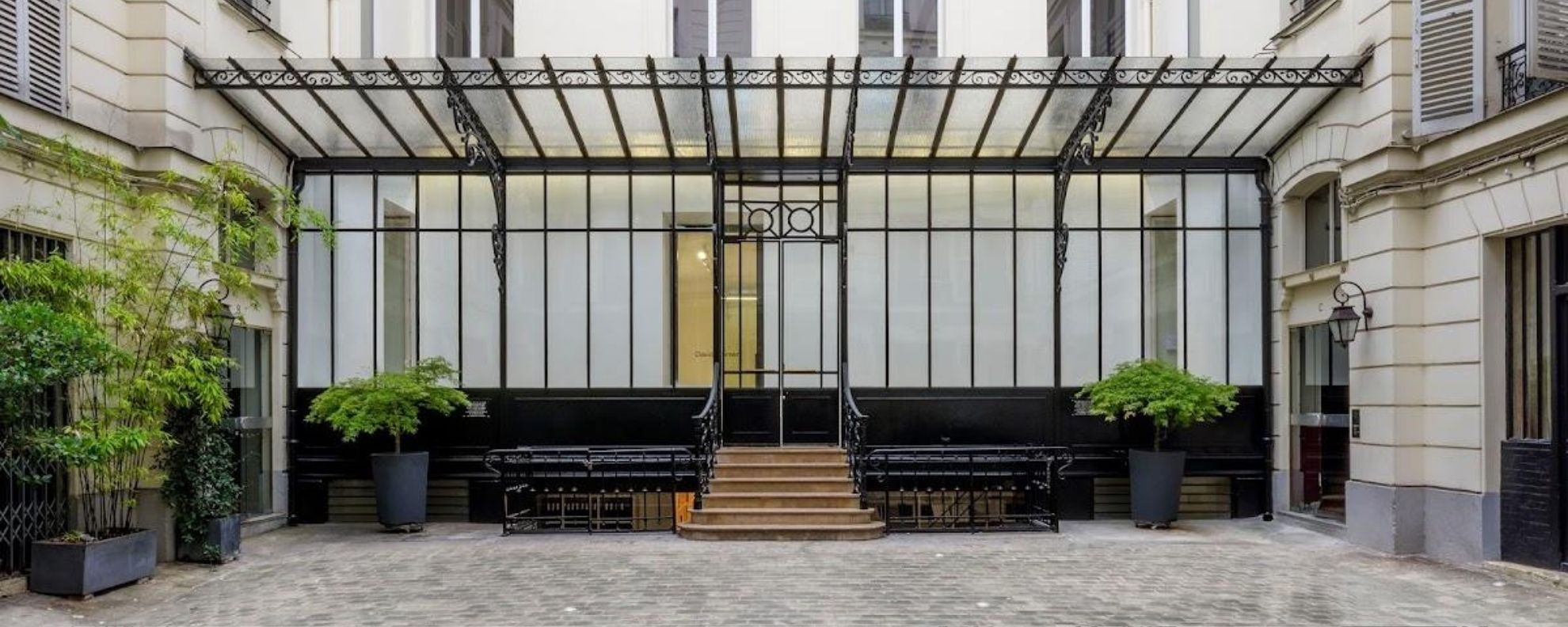
From 8 September, David Zwirner presents Au 108 rue Vieille du Temple: A Shared Legacy with Galerie Yvon Lambert at its Paris space.
The address is far from incidental.
In September 1986, Yvon Lambert opened his gallery in this very space, becoming a major figure in the exchanges between the French and American art scenes. Forty years later, David Zwirner, which has occupied the address since 2019, revisits this history.
The exhibition brings together thirty-two international artists connected with Yvon Lambert and/or David Zwirner, including Jean-Michel Basquiat, Christian Boltanski, Nan Goldin, Anselm Kiefer, Barbara Kruger, Bruce Nauman, Richard Serra and Cy Twombly.
But the real interest of the exhibition lies elsewhere.
It raises an essential question:
What role does a gallery play in building an artist’s career and, in turn, in shaping art history?
A gallery does not simply present works. It identifies artists, supports them over time, organises exhibitions, builds relationships with collectors, curators and institutions, and contributes to the recognition of their work.
This is how collections are built over several decades.
Through Yvon Lambert’s history, the exhibition offers a broader reflection on the role galleries play in writing contemporary art history.
Support independent publishing! Subscribe to ART MAG and receive each issue in advance, in both print and digital format 👉 Subcribe 6 issues / 1 year
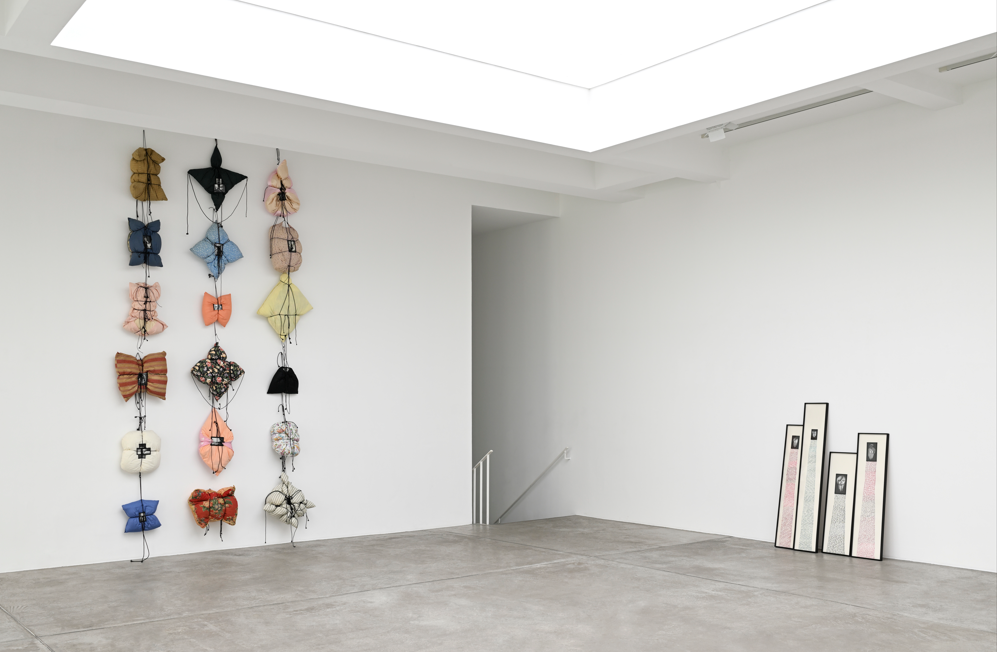
Annette Messager, Histoires des oreillers, vue de l’exposition, Galerie Marian Goodman, Paris, 2026. Photo : Rebecca Fanuele. Courtesy Galerie Marian Goodman.
Annette Messager at Marian Goodman: Intimacy as a Territory for Creation
With Histoires des oreillers, on view until 26 September 2026, Marian Goodman Gallery brings together a selection of historical and emblematic works by Annette Messager, some of which are rarely shown to the public. Spanning from 1972 to the present, the presentation highlights several recurring threads in her practice: intimacy, the body, words, romantic imagery and representations of femininity.
Messager transforms the most familiar objects and gestures to expose their ambiguities. In Histoire des oreillers III (1995–2026), the pillow leaves the domestic sphere to evoke sleep, confidences and the presence of an absent body. In Les Amoureux (2016), two embracing couples suspended from a butcher’s hook shift the image of romantic intimacy towards something more unsettling, poised between attachment, fragility and confinement.
This intimate dimension never excludes a critical perspective. As early as Les Qualificatifs donnés aux femmes (1972), Messager used embroidery to expose stereotypes associated with women; almost forty years later, Just Married (2011) ironically confronts a bridal veil with an ordinary broom. Objects, words and materials thus become instruments for questioning assigned roles, desire and relations between the feminine and masculine.
The presentation takes on particular resonance alongside Une Hirondelle ne fait pas le printemps, simultaneously on view at the Musée de la Chasse et de la Nature until 20 September, where more than eighty works engage with the museum’s collections. While the museum exhibition notably explores animality, Marian Goodman focuses on romantic narratives and intimate confidences: two complementary perspectives on an oeuvre that, for more than fifty years, has transformed everyday life in order to question our representations.
Jennifer Guidi at Gagosian: When Landscape Becomes an Inner Experience
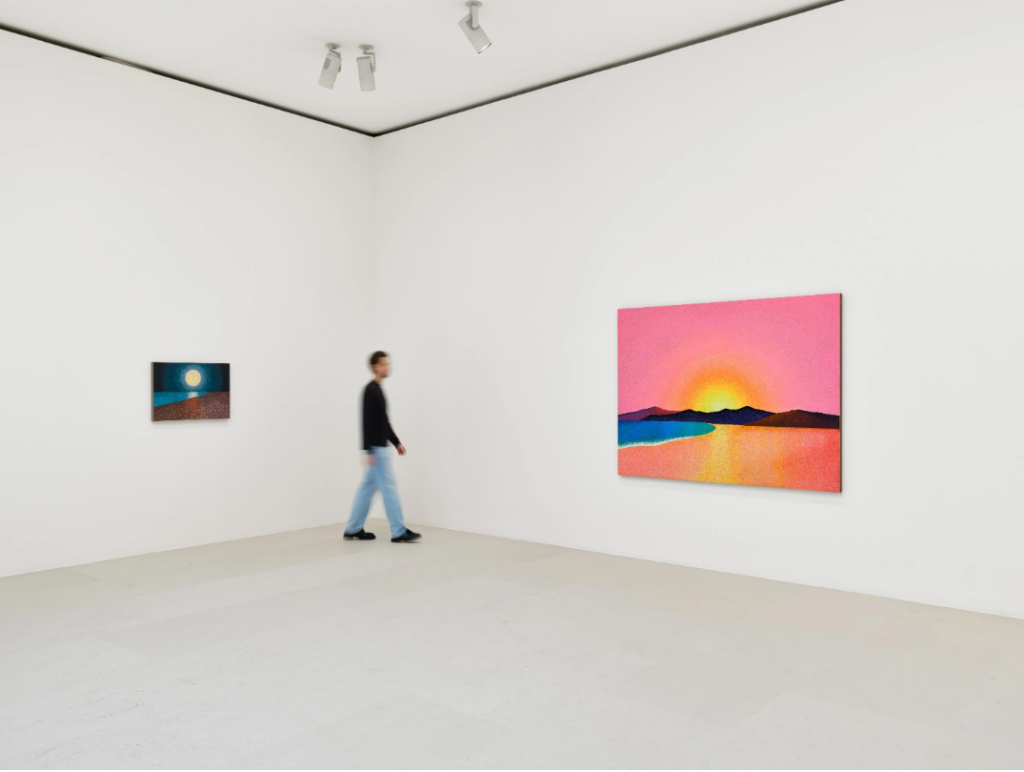
With Waterfall, presented at Gagosian Paris from 3 September to 10 October 2026, Jennifer Guidi continues her exploration of colour and painting, light and states of perception.
In her new works, the American artist once again turns her attention to nature.
Cascades, mountains, colours, sunlight and the movements of the landscape become the starting points for a profoundly sensory experience of painting.
Nature is no longer merely a subject.
The surface itself becomes essential. Repeated circular motifs, sand embedded in the paint and the materiality of colour transform the canvas into an almost meditative space.
These geometric compositions evoke both the capacity of painting to capture a memory and the way landscape, light and colour can act on our emotions and become part of our psychological experience.
For Jennifer Guidi, looking at a landscape is therefore no longer simply about observing it.
It is also about traversing it through light, rhythm and sensation.
Support independent publishing! Subscribe to ART MAG and receive each issue in advance, in both print and digital format 👉 Subcribe 6 issues / 1 year
9/22 Vue d’exposition / Installation view Pierre Bellot, Les objets parlent, Art : Concept, Paris, 2022. Courtesy the artist and Art : Concept, Paris. Photo Romain Darnaud.
Pierre Bellot at Art : Concept: When the Image Emerges After the Painting
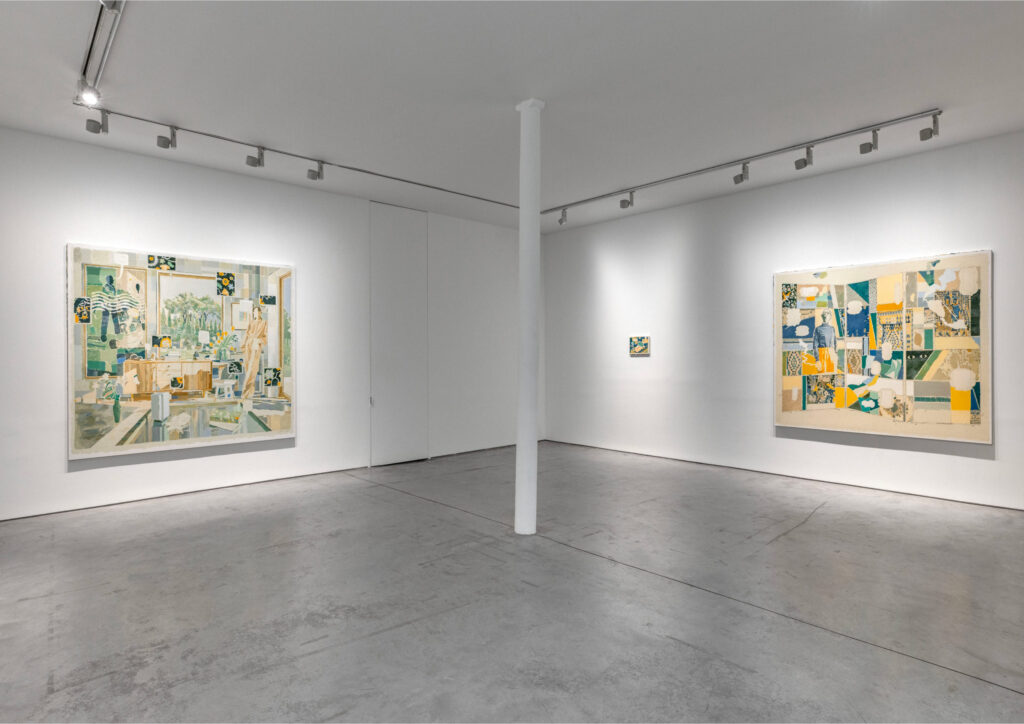
With Vallée FM, Pierre Bellot adopts an approach that may seem almost counterintuitive for those looking for a recognisable subject in his paintings.
The artist begins without one.
For Vallée FM, presented at Art : Concept in September 2026, the exhibition starts with a simple idea: painting without trying to produce an image.
Colours, formats, fragments, accidents and repetitions gradually become the starting point.
Certain surfaces appear almost geological, built through successive layers.
It is only after the painting process that forms may evoke landscapes, mountains, architecture or imaginary maps.
The image therefore emerges only after the painting.
This approach makes the exhibition particularly interesting today.
At a time when we are surrounded by instantly produced and endlessly circulated images, Pierre Bellot’s painting questions another temporality: painting as a slow construction, in which the artist cannot entirely anticipate the final result.
The image no longer precedes the painting. It ultimately emerges through the material and the gesture.
Emma Prempeh at Perrotin: A New Stage in an International Career
The gallery season can also mark a decisive moment for artists whose careers are still taking shape.
At only thirty years old, British artist Emma Prempeh presents her first solo exhibition at Perrotin Paris.
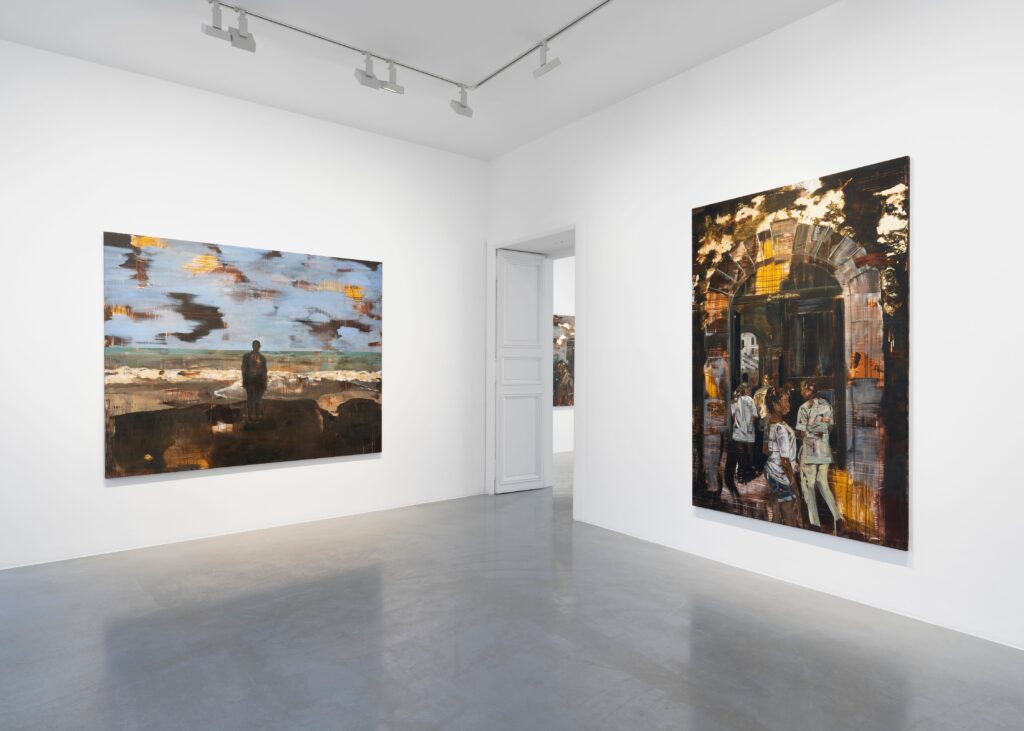
The exhibition The Domain of the Stranger brings together new works in which memory, identity, temporality and the exploration of territories occupy a central place.
Her work examines how images emerge, disappear or transform as our individual and collective memories evolve.
This exhibition therefore represents a particularly important milestone, as the artist enters a new relationship with an international gallery while continuing to develop a highly personal visual language.
It also illustrates one of the fundamental roles of a gallery: supporting an artist at a moment when their work and career can take on a new public and critical dimension.
For ART MAG, such moments are valuable to observe because they sometimes reveal the trajectories that will shape tomorrow’s contemporary art landscape.
Support independent publishing! Subscribe to ART MAG and receive each issue in advance, in both print and digital format 👉 Subcribe 6 issues / 1 year
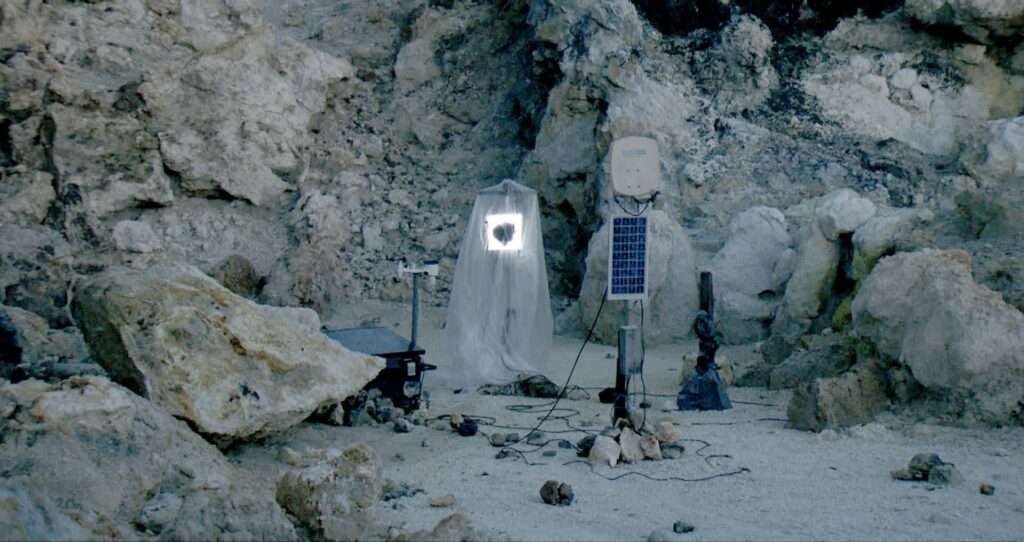
Ferdinandea : Incertitudes, 2022 HD Video, Colour Courtesy de l’artiste et de la Galerie Nathalie Obadia, Paris/Bruxelles.
Clément Cogitore at Nathalie Obadia: The Image Beyond Its Boundaries
The sixth exhibition in our selection takes us to Clément Cogitore at Galerie Nathalie Obadia.
A French artist and filmmaker, Clément Cogitore has spent several years exploring the boundaries between cinema, photography, video and contemporary art.
His works examine how images, narratives and rituals are constructed and how they influence our individual and collective representations.
His presence in this selection is important because it reflects another transformation in the way art is perceived today: the increasingly porous boundaries between artistic disciplines.
Contemporary art is no longer defined solely by a medium but by an artist’s ability to activate several visual languages at once.
Clément Cogitore’s work therefore continues a reflection particularly relevant to the contemporary art world: how can we think about images when they constantly circulate between different media?
Support independent publishing! Subscribe to ART MAG and receive each issue in advance, in both print and digital format 👉 Subcribe 6 issues / 1 year
What Does the Paris Gallery Season 2026 Reveal?
Looking at these six exhibitions together reveals several significant trends.
The first concerns awareness of generations.
The same city can host major historical figures, artists from the post-war period, internationally recognised artists and a new generation, such as Emma Prempeh, represented here by Perrotin.
This coexistence of generations is one of the strengths of the Parisian art scene.
The second concerns the role of galleries themselves.
The David Zwirner/Yvon Lambert exhibition demonstrates that a gallery does not merely present and sell works. It can also preserve archives, reactivate an artistic history and transmit the memory of a particular moment.
Finally, the third concerns the internationalisation of Paris.
The presence of major international galleries, the circulation of artists between several countries and the proximity of Art Basel Paris all contribute to positioning the French capital within an increasingly open artistic and economic ecosystem.
Why Does Paris Continue to Attract the Art Market?
The dynamism of Parisian galleries should also be considered in the context of the French art market’s growing importance.
In 2025, France accounted for around 8% of the global art market, with sales of approximately $4.5 billion, an increase of 9% over the previous year.
It therefore strengthened its position as the leading art market within the European Union.
This development is not solely due to Paris’s major international fairs.
It also depends on a dense network of galleries, auction houses, museums, foundations, fairs and collectors that contribute to the vitality of the market throughout the year.
The gallery season in September is one of the most visible manifestations of this vitality.
Before Art Basel Paris, Rediscovering the Time of Galleries
In just a few weeks, the art market will accelerate.
Art Basel Paris will bring together galleries, collectors, institutions and art-market professionals from around the world for several days in the French capital.
But September offers a different experience.
It is a period when many galleries and artists can still be discovered away from the intensity of a major international fair.
In a gallery, the exhibition can take the time to unfold.
A visitor can spend more time with a work.
An artist can offer a more complete body of work.
A gallery can construct a more ambitious curatorial narrative.
At a time when the economic model of major fairs is increasingly questioned by certain galleries, this dimension deserves particular attention.
The gallery remains one of the fundamental places where the relationship between an artist, an artwork and an audience is built.
A Gallery Season That Reasserts the Essential Role of Galleries
Just a few weeks before Art Basel Paris, this new season is a reminder that the vitality of the Paris art scene cannot be measured solely by the strength of its major international events. It is also built throughout the year inside galleries, through direct encounters between artists, artworks and audiences.
From Yvon Lambert’s legacy to a new generation represented by Emma Prempeh, these six exhibitions portray a Paris in which art history, emerging creation and the art market continue to intersect.
FAQ – Paris Gallery Season 2026
What are the must-see gallery exhibitions in Paris in September 2026?
Among the key exhibitions of the Paris gallery season are David Zwirner’s Au 108 rue Vieille du Temple: A Shared Legacy with Galerie Yvon Lambert, Annette Messager’s Histoires des oreillers at Marian Goodman, Jennifer Guidi’s Waterfall at Gagosian, Pierre Bellot’s Vallée FM at Art : Concept, Emma Prempeh’s The Domain of the Stranger at Perrotin, and Clément Cogitore’s Ferdinandea at Galerie Nathalie Obadia.
Why is September an important month for Paris galleries?
September marks the reopening of galleries after the summer break and the launch of their new exhibition programmes. It is also a strategic moment in the art calendar, just a few weeks before Art Basel Paris brings collectors, galleries and art professionals from around the world to the French capital.
Which contemporary art galleries should you visit in Paris in September 2026?
This selection includes David Zwirner, Marian Goodman, Gagosian, Art : Concept, Perrotin and Galerie Nathalie Obadia, offering a broad perspective on both established and emerging contemporary art.
Where can you see Annette Messager in Paris in September 2026?
Annette Messager’s Histoires des oreillers is on view at Marian Goodman Gallery, 79 rue du Temple, until 26 September 2026. At the same time, the Musée de la Chasse et de la Nature is presenting Une Hirondelle ne fait pas le printemps, bringing together more than eighty of her works.
How does the Paris gallery season relate to Art Basel Paris?
The September gallery season offers a more intimate way to experience contemporary art before the intensity of Art Basel Paris. Visitors can discover complete exhibitions, spend more time with individual works and observe the artistic choices galleries are making at the beginning of the season.
Manage consent
We use cookies to understand how visitors use Art Mag International and to display external content, including YouTube videos.
You can accept, reject, or customize their use. You can change your preferences at any time.
Functional
Always active
These cookies are essential for the website to function properly and cannot be disabled.
Préférences
L’accès ou le stockage technique est nécessaire dans la finalité d’intérêt légitime de stocker des préférences qui ne sont pas demandées par l’abonné ou l’internaute.
Statistics
These cookies help us to understand how visitors use the magazine so that we can improve its content.Le stockage ou l’accès technique qui est utilisé exclusivement dans des finalités statistiques anonymes. En l’absence d’une assignation à comparaître, d’une conformité volontaire de la part de votre fournisseur d’accès à internet ou d’enregistrements supplémentaires provenant d’une tierce partie, les informations stockées ou extraites à cette seule fin ne peuvent généralement pas être utilisées pour vous identifier.
Marketing
Technical access or storage is required to create user profiles for the purpose of sending adverts, or to track the user across a website or across several websites with similar marketing purposes.