Categories
Painting - Women artists

Flo Muliardo, “Les Enfants Rois”: When Art Restores the Dignity of Childhood

Portrait en noir et blanc de l’artiste contemporaine Flo Muliardo, regard tourné vers la lumière. Photographie illustrant son engagement auprès des enfants et la série Les Enfants Rois, présentée dans ART MAG.
Gilles Piel

Powerful portraits of children — not decorative ones

Crowns, bold colors, black outlines: in her series “Les Enfants Rois”, artist Flo Muliardo places the child at the center. Her paintings do not seek cuteness but dignity. Direct gazes, tight framing, vibrant backgrounds — everything is designed to create a true encounter.

👉 In ART MAG, she explains why she chose this frontal format and how drawing remains beneath the layers of paint.

Flo Muliardo surrounded by children in Nepal during a visit with the association Les Enfants de Manasté. Photograph illustrating her human and artistic commitment for the series The Child Kings, featured in ART MAG.
Flo Muliardo surrounded by the children of the Namasté orphanage in Nepal

A journey to Nepal that nourishes her work

In November, Flo Muliardo will return to Nepal to work with the association Les Enfants de Namasté, which she has supported for several years. This month-long stay will allow her to paint “from life,” in close contact with the children.

👉 In the magazine, she reveals how this experience in the field directly shapes her pictorial series.

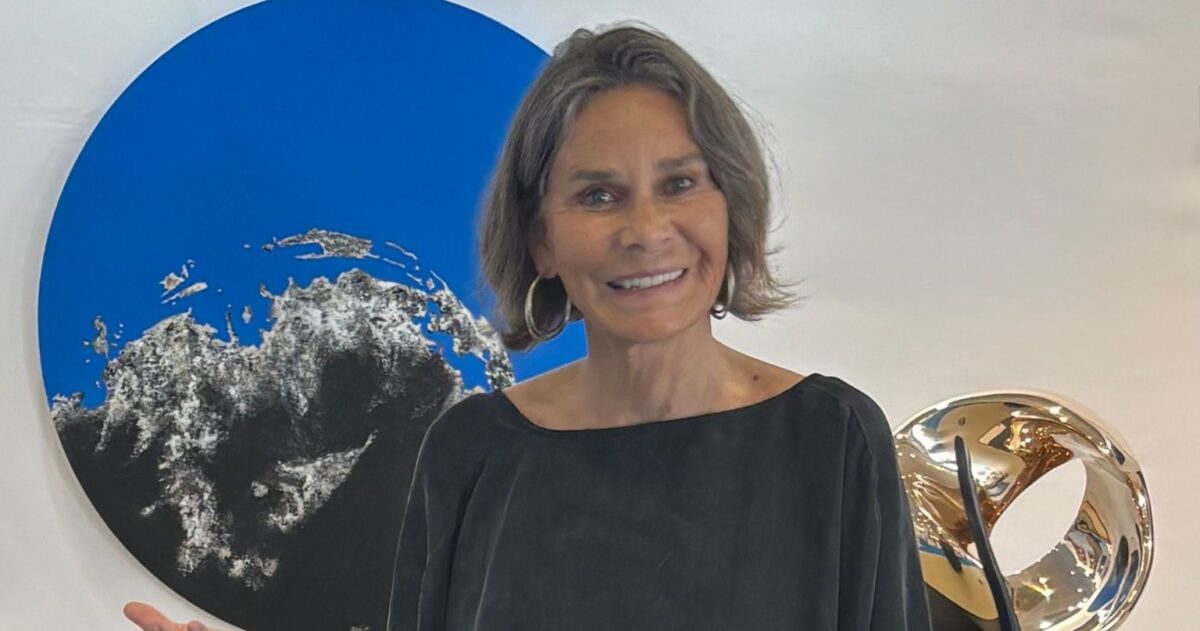
Artist Flo Muliardo poses beside one of her paintings from the series The Child Kings, depicting a young child with large blue eyes surrounded by vivid, contrasting colors — red, yellow, pink, and blue — crowned with the golden words LOVE and QUEEN. The scene reflects the artist’s expressive and colorful universe, celebrating the dignity and strength of childhood. ART MAG.
Flo Muliardo – 2025 © Gilles Piel

Crowns, tattoos, colors — a visual language

Crowns (a nod to Basquiat), tattoos, and a bright palette (pink, orange, blue) frequently appear in her work. These are not graphic effects — they are identity markers.

👉 Their origin, their intimate meaning, and their connection to her personal story are explored in detail in the full article in ART MAG.

A more intimate story emerges

Behind these proud portraits of children lies something deeply personal, which the artist evokes with great modesty. She does not display it on social media — and neither do we.
That discretion gives the series its truth: painting childhood as something to be protected.

👉 This emotional dimension is revealed only in the full version published in ART MAG.

Why we’re talking about it in ART MAG

Because this series coincides with her departure for Nepal, because it unites creation and commitment, and because it questions how we represent children today.
It’s a clear, essential, and contemporary body of work.

📩 Find the full article, exclusive interview, and visuals in ART MAG n°29.

Want to see more ?
👉 Order ART MAG N°29
👉 Subscribe to 6 issues / 1 year
👉 Give ART MAG as a gift

Categories
Calendar - News - Painting

Eugène Leroy at the MUba (1980–2000): Painting as an Experience of Light

Peinture épaisse et vibrante d’Eugène Leroy, L’Été (1999) : strates d’ocres, rouges et bleus où la figure affleure dans la lumière MUba Tourcoing art_mag
ACMHDF / Franck Boucourt

3 October 2025 – 5 April 2026 — MUba Eugène Leroy, Tourcoing

The MUba presents more than 80 works tracing the last two decades of Eugène Leroy’s career (1980–2000). It is a dense journey where colour—laid down in strata—brings forth the figure, the season, the hour: light as destiny.

a large Eugène Leroy painting with heavy impasto hanging on a white wall (MUba, Tourcoing). Art Mag Magazine
Eugène Leroy, Femme, 1981, oil on canvas © Boris Rogez / LaM

Want to see more ?
👉 Subscribe to 6 issues / 1 year
👉 Give ART MAG as a gift

Why this exhibition matters

Long “outside fashion,” Leroy achieved international recognition in the 1980s–1990s (Ghent, Paris, Eindhoven, Cologne; documenta 1992; Venice Biennale 1995). Returning to these late years reveals the radicality of a painting that refuses effect in order to reach the “right image.”

Painting light rather than the motif

In the Wasquehal studio—windows to the north and south, “light in front, light behind”—model, reflection and landscape are subjected to changing illumination. Leroy seeks “the trace of lived experience” and buries anecdote: detail matters less than luminous sensation.

Eugène Leroy landscape (1982): earthy green impasto, unmixed touches, a shifting atmospheric sensation.
Exhibition MUba Tourcoing art mag
Eugène Leroy, Landscape, 1982, oil on canvas, private collection. © Florian Kleinefenn

1990–2000: the nude, verticality, economy

From 1990 onward, the female nude becomes the site of reduction. Formats rise; matter proliferates yet the figure grows lighter, as if spiritualised by verticality. Touches—often applied straight from the tube or with a knife—break up the polychromy and set the surface to rhythm.

Reclining nude sketched in charcoal and wash by Eugène Leroy: swift line, white reserves acting as light. Exhibition MUba Tourcoing article art mag
Eugène Leroy, Untitled (reclining nude after Giorgione’s Sleeping Venus), 1980–1990, charcoal, wash and white chalk on paper, MUba Eugène Leroy. © Florian Kleinefenn

Dialogues with art history: Mondrian, Poussin, Rembrandt

Leroy’s gaze toward Mondrian is not about grids but about the rhythm of unmixed colour areas; Poussin inspires two Seasons cycles, where painting is tuned to cosmic time; Rembrandt and Giorgione remain long-standing companions.

Drawing to “catch the gesture”

Never merely preparatory, drawing is an autonomous field: charcoal, red chalk, gouache, watercolour… The aim is to “catch” movement—sometimes without looking at the sheet—leaving reserves of white as active light.

Charcoal sheet: summary lines, suggested volumes, large white reserves.
MUba Tourcoing Art Mag
Untitled, 1980–1990, charcoal (MUba). © Florian Kleinefenn

Highlights not to miss

  • Seasons cycles and canvases “indexed” to light (Done in Winter, L.M. in the Evening).
  • Vertical nudes of the 1990s: “grainy” surfaces, surges of matter.
  • Large 1980s gouaches and series in charcoal.
“Eugène Leroy seated in his Wasquehal studio circa 1990, thickly painted canvases leaning against the wall, side light 
exhibition MUba
Article Art Mag
Marina Bourdoncle, Eugène Leroy in his Wasquehal studio, c. 1990, gelatin silver print, MUba Eugène Leroy. © ACMHDF / Franck Boucourt

Want to see more ?
👉 Subscribe to 6 issues / 1 year
👉 Give ART MAG as a gift

Practical information

MUba Eugène Leroy, 2 rue Paul Doumer, 59200 Tourcoing
Dates: 3 October 2025 → 5 April 2026
Hours: Daily 1–6 pm (closed Tuesdays and public holidays)

FAQ

Who is Eugène Leroy?
A painter born in Tourcoing (1910) and deceased in Wasquehal (2000), he built a major body of work where the thickness of paint serves light rather than effect.

What does the MUba exhibition show?
Over 80 paintings and drawings from 1980–2000: vertical nudes, self-portraits, seasons, large gouaches and charcoals.

Which influences does Eugène Leroy claim?
Mondrian for the rhythm of pure colours; Poussin for the time of the seasons; as well as Rembrandt and Giorgione.

Why is the paint so thick?
It results from long reworking until the “right image” appears; impasto is never an end in itself.

Want to see more ?
👉 Subscribe to 6 issues / 1 year
👉 Give ART MAG as a gift

Categories
Painting - Women artists

Odette Pauvert (1903–1966): A Classical Modernity in the Age of Art Deco

Portrait photographique d’Odette Pauvert, artiste peintre française, posant en manteau clair et chapeau à motifs géométriques devant un mur de pierre, années 1920.

The first woman painter to win the Grand Prix de Rome (1925), Odette Pauvert forged a sober, frontal modernity, nourished by the Quattrocento and conceived for large-scale decorative schemes. From the Villa Medici to the intimate scenes of the postwar years, her path sheds light on another history of the interwar period.

Biographical Landmarks

Trained at the École des Beaux-Arts in Paris, Pauvert stayed at the Villa Medici (1926–1929), where her clean contours, matte colors, and portrait-landscape approach were refined. Back in Paris, she set her sights on mural painting (the Église du Saint-Esprit, school decorations, Sèvres, 1937 International Exposition). In 1934, the Casa de Velázquez liberated her drawing (charcoal, red chalk). After 1945, material constraints and family life led her toward smaller formats without renouncing her initial ambition.

Style & Key Works

  • Promotion 1926 (1927) — a signature of the Roman period.
  • Invocation à Notre-Dame-des-Flots (1925) — inhabited classicism.
  • Habib Benglia (1931), Paris 1932 (Yvonne Pesme) — commanding frontality.
  • Le Torero (1934) — stylization and tension of line.
  • Odile, Yves et Rémy at the Rond-Point des Champs-Élysées (1946) — a domestic postwar turn.

Legacy

Long overshadowed by the avant-gardes, Pauvert embodies an alternative modernity: clarity, calibrated scale, and a disciplined gaze. Recent reassessments place her among the major women artists of the 20th century, at the crossroads of Art Deco and Renaissance tradition.

Want to see more?
👉 Subscribe — 6 issues / 1 year
👉 Gift ART MAG

FAQ — Odette Pauvert (1903–1966)

Who is Odette Pauvert?
Odette Pauvert was a French Art Deco painter and the first woman painter to win the Grand Prix de Rome (1925). Her work advances a sober, frontal modernity informed by the Quattrocento and conceived for large-scale decorative schemes.

Why is she important in Art Deco history?
She embodies a classical modernity as an alternative to the avant-gardes: clarity of form, clean contours, matte colors, a strong sense of mural scale, and disciplined looking.

Where did she train?
At the École des Beaux-Arts in Paris, then at the Villa Medici (1926–1929), where her frontal style and portrait-landscape approach matured. A stay at the Casa de Velázquez (1934) further liberated her drawing (charcoal, red chalk).

What does “classical modernity” mean in her work?
A pursuit of balance and legibility derived from the Italian Renaissance (Quattrocento), applied to contemporary subjects—portraits, scenes, and mural painting.

What are her key works to know?

  • Promotion 1926 (1927) — a signature of the Roman period.
  • Invocation à Notre-Dame-des-Flots (1925) — inhabited classicism.
  • Habib Benglia (1931), Paris 1932 (Yvonne Pesme)commanding frontality.
  • Le Torero (1934) — stylization and line tension.
  • Odile, Yves et Rémy at the Rond-Point des Champs-Élysées (1946) — domestic postwar turn.

What is meant by “portrait-landscape” in her practice?
A frontal framework where the sitter is set within an architectured space (decor, city, sea), creating a dialogue between figure and environment.

Did she produce monumental works?
Yes. She pursued large-scale decoration: the Église du Saint-Esprit, school murals, collaborations with Sèvres, and participation in the 1937 International Exposition.

How does her style evolve after 1945?
Material and family constraints led to smaller formats, without abandoning the initial ambition for clarity, frontality, and calibrated scale.

How does she differ from the avant-gardes?
She favors measure, structure, and legibility over radical formal rupture—an alternative modernity of the interwar years.

Where can I see the Odette Pauvert exhibition in Roubaix?
At La Piscine – Museum of Art and Industry, Roubaix, October 11, 2025 to January 11, 2026 (useful dates for visit planning and local SEO).

What techniques does she favor?
Drawing (charcoal, red chalk), painting with matte color fields, a clear line, and controlled modeling in support of frontality.

Why rediscover her today?
Recent reassessments place Pauvert among the major women artists of the 20th century, at the crossroads of Art Deco and Renaissance tradition.

Categories
News - Painting - Women artists

Odette Pauvert at La Piscine Roubaix — Art Deco Exhibition

Portrait collectif peint par Odette Pauvert, montrant plusieurs personnages de face et de profil, dont une jeune femme coiffée d’un bonnet coloré et un homme vêtu d’un foulard jaune.

ExhibitionOdette Pauvert at La Piscine (Roubaix): the first woman painter to win the Grand Prix de Rome presents a classical modernity nourished by Italy and the monumental language of Art Deco. A rich itinerary — Rome, Paris, Brittany, Spain — that reframes the interwar years. October 11, 2025 – January 11, 2026.

Self-portrait of Odette Pauvert wearing a red headscarf tied around her head, facing forward, in a figurative and expressive style.
Alain Leprince

Why this exhibition is unmissable

  • First woman painter to win the Grand Prix de Rome (1925) — a milestone in the history of French art.
  • A fresh lens on Art Deco — Pauvert’s painting combines frontal compositions, matte palettes, and the portrait-landscape formula rooted in the Quattrocento.
  • A rich itineraryRome (Villa Medici); Paris and the ambition of the grand décor; Brittany; Spain (Casa de Velázquez); then the domestic intimacy of the postwar years.
Photographic portrait of Odette Pauvert, French painter, wearing a light coat and a geometric patterned hat, posing in front of a stone wall in the 1920s.

Who is Odette Pauvert?

Born in 1903, Odette Pauvert trained at the École des Beaux-Arts (Paris) and won the Grand Prix de Rome in 1925, becoming the first woman painter to receive the prize. As a resident at the Villa Medici (1926–1929), she forged a distinctive style: crisp contours, matte color, decorative clarity, and the signature “portrait-landscape.”
Returning to Paris, she asserted an ambition for mural painting (Église du Saint-Esprit; a Paris school; a Sèvres nursery; Exposition of 1937) even if public commissions remained scarce in a highly competitive environment.

Portrait of actor Habib Benglia by Odette Pauvert, holding an African mask in front of his face, surrounded by carved traditional masks.
Alain Leprince

Exhibition itinerary (highlights)

  1. Rome, the “intoxication” (1926–1929) — Italian revelation: frontality, matteness, references to Renaissance fresco and 15th-century masters.
  2. Paris & the grand décor (1930–1937) — The mural ideal takes shape: building sites and public projects; painting conceived at architectural scale.
  3. Brittany — Landscapes, figures, and legends: a current anchored in regional traditions.
  4. Spain (1934) — Stay at the Casa de Velázquez: large charcoal and red chalk drawings; the energy of Castilian and Andalusian landscapes.
  5. Postwar & the intimate — Marriage (1937), children, material constraints: smaller formats and domestic scenes.

Must-see works

  • Promotion 1926 (1927), Villa Medici — a signature work from the Roman period.
  • Invocation to Our Lady of the Waves (1925) — the breadth of an inhabited classicism.
  • Habib Benglia (1931) and Paris 1932 (Yvonne Pesme) — portraits with assertive frontality.
  • The Torero (1934) — taut lines and stylized volumes.
  • Odile, Yves and Rémy at the Rond-Point des Champs-Élysées (1946) — a domestic turn without renunciation.
Full-length portrait of a Spanish bullfighter by Odette Pauvert, dressed in a green and gold traje de luces, holding his sword and wearing a black montera.
Alain Leprince

Practical info & context

  • Dates: October 11, 2025 → January 11, 2026. Opening: Friday, October 10, 2025, from 6 pm (open to all).
  • Venue: La Piscine – Musée d’art et d’industrie André Diligent, 23 rue de l’Espérance, 59100 Roubaix.
  • Part of the Art Deco centenary and La Piscine’s commitment to women artists.
Painting by Odette Pauvert showing three blond children in blue outfits with their toys, in a lively garden near the Rond-Point des Champs-Élysées.

FAQ

Who was Odette Pauvert ?
A French painter (1903–1966), the first woman painter to win the Grand Prix de Rome (1925) and a resident at the Villa Medici (1926–1929). She developed a classical modernity informed by the Quattrocento, spanning portraits, landscapes, and mural projects.

What are the exhibition dates in Roubaix ?
October 11, 2025 – January 11, 2026 at La Piscine – Roubaix.

Which key works can visitors see?
Promotion 1926 (1927), Invocation to Our Lady of the Waves (1925), Habib Benglia (1931), Paris 1932 (Yvonne Pesme), The Torero (1934), Odile, Yves and Rémy at the Rond-Point des Champs-Élysées (1946).

Why is the exhibition linked to Art Deco ?
It aligns with the Art Deco centenary and shows how, in the Art Deco era, Pauvert proposed an alternative modernity grounded in tradition and decorative ambition.

Pour lire la suite, téléchargez ART MAG N°29
Categories
Calendar - International - Painting

Frida Kahlo at Tate Modern (London) — 25 June 2026 → 3 January 2027

peinture de frida Kalho autoportrait exposé au tate Moderne Londre

Tate Modern presents a major event : Frida: The Making of an Icon. Over 130 works—including key paintings—plus photographs, documents and personal items illuminate how a modern artist became a global icon, shown in dialogue with 80+ artists across generations.

Why go ?

  • A critical journey through the “making” of Frida’s image: landmark paintings, photographs, documents and personal objects.
  • A wider cultural lens with works by contemporaries and artists inspired by Kahlo, mapping her lasting influence.

Practical info

  • Dates: 25 June 2026 → 3 January 2027
  • Venue: Tate Modern, Bankside, London
  • Organisers & supporters: Museum of Fine Arts, Houston, in collaboration with Tate Modern.
  • Lead Global Supporter: Bank of America, with support from John J. Studzinski, CBE, the Frida patron circle and Tate Members.

FAQ

What are the exhibition dates?
25 June 2026 to 3 January 2027.

Where is it held?
At Tate Modern, Bankside, London (UK).

What will I see?
More than 130 works by Frida Kahlo (including key paintings) plus documents, photographs and mementos from her archives, shown alongside works by 80+ artists.

Who organises and supports the show ?
Organised by the Museum of Fine Arts, Houston (MFAH) in collaboration with Tate Modern. Bank of America is Lead Global Supporter, with support from John J. Studzinski, CBE, the Frida patron circle and Tate Members.

Is this part of a tour ?
Yes. It debuts at MFAH (Houston) before travelling to London.

How do I book tickets ?
Book directly on the Tate Modern website (advance booking recommended).

Do Tate Members get benefits ?
Yes. Tate Members enjoy free, unlimited exhibition entry.

Is there a youth offer ?
Ages 16–25 can join Tate Collective for £5 tickets on many shows.

Nearest Tube stations ?
Southwark (Jubilee line) and Blackfriars.

How long should I allow for a visit ?
60–90 minutes for a first pass; up to 2 hours if you explore the archive sections in depth.

Categories
News - Painting

Gerhard Richter at Fondation Louis Vuitton (Paris): the retrospective of the year

Gerhard Richter, Gudrun (1987) — abstraction rouge et gris au racloir, textures stratifiées.
Fondation Louis Vuitton, Paris Gerhard Richter 2025

From 17 October 2025 to 2 March 2026, Fondation Louis Vuitton devotes its entire building to Gerhard Richter. Bringing together 270 works (1962–2024)—oil paintings, works in glass and steel, pencil and ink drawings, watercolours and overpainted photographs—the exhibition offers the first full panorama of six decades.

Gerhard Richter, Lesende, 1994 © Gerhard Richter 2025
Gerhard Richter, Lesende, 1994 © Gerhard Richter 2025

Why it matters ?

Richter’s art dismantles certainty. From photo-based paintings with signature blur to squeegee abstractions, colour charts, glass pieces and digitally generated Strip images, he has continually reprogrammed the way painting can think. The show’s scale—spanning early family portraits to late abstractions and paper works—makes it a landmark for Paris.

Gerhard Richter, Onkel Rudi [Uncle Rudi], 1965 (CR 85). Oil on canvas, 87 × 50 cm. Lidice Memorial Collection, Czech Republic. © Gerhard Richter 2025.

The exhibition at a glance — 6 key chapters

  1. 1962–1970 — After photographs
    Family portraits such as Onkel Rudi and press images like Bombers become unstable memories through blur; early Colour Charts and Glass Panes shift focus from motif to method.
  2. 1971–1975 — Crisis of representation
    The 48 Portraits (Venice Biennale, 1972) scrutinise the encyclopaedia of male knowledge; Grey Paintings and Vermalung (smearing/dragging) test the limits of depiction.
  3. 1976–1986 — Laboratory of abstraction
    Enlarged watercolour studies and the Strich series make the brushstroke a subject. Tension with figuration persists in works like Betty, landscapes and still lifes.
  4. 1987–1995 — The dark decade
    The cycle 18. Oktober 1977 (on the Red Army Faction—exceptionally on loan from MoMA) adopts an ethical distance; dense, sombre abstractions and Sabine mit Kind deepen the question of how images bear history.
  5. 1996–2009 — Chance and system
    From mineral Silikat to 4900 Colors, colour is distributed by combinatory rules; the Cage Paintings turn the squeegee into a musical dramaturgy of layers, erasures and reprises.
  6. 2009–2017 — Thresholds & last paintings
    Glass works and digitally generated Strip extend painting beyond the stretcher. With Birkenau (2014), photographs from Auschwitz-Birkenau are overpainted to the edge of visibility. Richter completes his final abstract canvases in 2017 and continues with drawing.
Gerhard Richter, Selbstportrait [Self-Portrait], 1996 (CR 836-1). Oil on linen, 51 × 46 cm. © Gerhard Richter 2025.

Works not to miss

  • 48 Portraits (1971–72) — a cool encyclopedia of the 20th century.
  • 18. Oktober 1977 (1988) — responsibility and distance in history painting.
  • 4900 Colors — colour as a rule-based field.
  • Cage Paintings — gravity and lyricism of the squeegee.
  • Birkenau (2014) — abstraction as an ethical veil.
Gerhard Richter, Möhre (Carrot), 1984 — green, grey and blue squeegee abstraction with yellow and red streaks.
Gerhard Richter, Möhre [Carotte], 1984 Oil on Canva, 200 x 160 cm Fondation Louis Vuitton, Paris © Gerhard Richter 2025 

Visit info

  • Dates: 17 Oct 2025 → 2 Mar 2026
  • Venue: Fondation Louis Vuitton, 8 Avenue du Mahatma Gandhi, 75116 Paris
  • Curators: Dieter Schwarz & Nicholas Serota
  • Scope: 270 works (1962–2024)

FAQ

Who is Gerhard Richter?
A major German painter (b. 1932, Dresden), based in Cologne, whose work spans photorealism, abstraction, glass and digital processes.

What does the show cover?
Six decades: oil paintings, glass/steel works, drawings, watercolours, overpainted photographs.

Does Richter still paint?
He stopped painting in 2017; recent years focus on drawing and works on paper.

Are there exceptional loans?
Yes—18. Oktober 1977 is on loan from MoMA, New York.

Categories
International - Modern art - News - Painting

Theatre Picasso at Tate Modern (2025–2026): A Staged Encounter with the Artist as Performer

Détail coloré d’une œuvre de Pablo Picasso projetée à la Tate Modern, représentant des personnages stylisés en costumes, dans un style libre et expressif — exposition Théâtre Picasso, Londres 2025

To mark the 100th anniversary of The Three Dancers (1925), Tate Modern unveils a bold new exhibition: Theatre Picasso. Running from 15 September 2025, this immersive event explores the performative dimension of Picasso’s work, shedding light on the artist not just as a painter, but as a master of identity, drama, and presence.

Immersive room at the Theatre Picasso exhibition, Tate Modern, featuring video projections and The Three Dancers (1925) by Picasso.
© Tate

An exhibition centred around The Three Dancers (1925)

The painting The Three Dancers — a key work of Picasso’s surrealist period — sets the stage for this retrospective. More than 50 artworks (paintings, drawings, sculptures, collages, textiles) portray painting as a dramatic act, where each stroke becomes a performance.

The Three Dancers (1925) by Pablo Picasso, surrealist masterpiece featured at Theatre Picasso exhibition, Tate Modern, London 2025.
The Three Dancers (1925) Tate. © Succession Picasso DACS, London 2025

Curated by Wu Tsang and Enrique Fuenteblanca

Artist Wu Tsang and curator-writer Enrique Fuenteblanca bring a contemporary vision to the show. Their aim: to reactivate Picasso’s works through live performances, dance, flamenco, and theatrical embodiment, turning the museum into a living theatre.

Pablo Picasso’s Weeping Woman (1937), seen at the Tate Modern during the Theatre Picasso exhibition in autumn 2025.
Weeping Woman (1937) Tate. © Succession Picasso DACS, London 2025

Picasso, the performer of his own myth

Throughout the exhibition, Picasso emerges as a self-mythologising artist, consciously building his public persona — part genius, part outsider. Works like Weeping Woman (1937), Nude Woman in Red Armchair (1932), and the Minotaur tapestry (1935, on loan from Musée Picasso Antibes) reflect this dramatic duality.

Pablo PICASSO Tapisserie

Want to see more ?
👉 Subscribe to 6 issues / 1 year
👉 Give ART MAG as a gift

A cast of outsiders and icons

Theatre Picasso offers a gallery of characters: circus performers, flamenco dancers, matadors, models. Some were close to Picasso; others symbolic. They appear in works like Girl in a Chemise (1905), Horse with a Blue Youth (1906), Corrida Scene (1960), and Acrobat (1930, from Musée Picasso Paris).

Practical information

General view of the Theatre Picasso exhibition at Tate Modern: three female portraits by Pablo Picasso being observed by a visitor.

Why Theatre Picasso matters

  • A fresh reading of Picasso through the lens of performance
  • A critique of the artist as brand and spectacle
  • A cross-disciplinary experience blending visual and performing arts
  • Celebrates both the 100th anniversary of The Three Dancers and Tate Modern’s 25th birthday
Woman observing Weeping Woman (1937) by Pablo Picasso at Tate Modern during the Theatre Picasso exhibition, autumn 2025

Want to see more ?
👉 Subscribe to 6 issues / 1 year
👉 Give ART MAG as a gift

FAQ – Theatre Picasso at Tate Modern

🎨 What is the centrepiece of the exhibition?

Picasso’s The Three Dancers (1925), a surrealist masterpiece, anchors the entire show.

🕺 Will there be live performances?

Yes. Throughout the season, artists will activate the exhibition with dance, flamenco, and live installations.

📍 Where is the exhibition located?

At Tate Modern in London.

💡 Why should I visit?

To experience Picasso as performer, explore the tension between image and identity, and engage with his legacy in a bold new way.

📅 How long is it running?

From 15 September 2025 through Spring 2026.

Want to see more ?
👉 Subscribe to 6 issues / 1 year
👉 Give ART MAG as a gift

Categories
International - Modern art - News - Painting

Picasso and Klee in Madrid: 50 Masterpieces in Dialogue at the Thyssen-Bornemisza Museum

Portrait cubiste d'une femme assise en buste, vêtue d'un pull jaune à motifs graphiques, signé Picasso 1939 — huile sur toile, collection Heinz Berggruen Silhouette épurée d’un visage féminin sur fond ocre, traits noirs minimalistes et lèvres rouges — œuvre poétique et abstraite signée Paul Klee 1932

A must-see this autumn in Madrid: from October 28, 2025 to February 1, 2026, the Thyssen-Bornemisza Museum presents an exceptional exhibition featuring 50 major works by Picasso and Klee, from the renowned Heinz Berggruen Collection (Berlin).
A rare artistic dialogue between two 20th-century masters, set within an immersive journey through modern art

Cubist portrait of a seated woman wearing a patterned yellow sweater, painted by Picasso in 1939 — oil on canvas from the Heinz Berggruen Collection

An Unprecedented Dialogue Between Two Modern Masters

The exhibition “Picasso and Klee in the Heinz Berggruen Collection” brings together in Madrid fifty major works by Pablo Picasso and Paul Klee, from the prestigious collection of art dealer and philanthropist Heinz Berggruen. A rare opportunity to discover, outside Berlin, some of the most iconic pieces held by the Museum Berggruen, currently closed for renovation.

Combining poetic abstraction with radical modernity, the selected works establish a subtle visual and conceptual dialogue between two distinct yet complementary artistic visions: Picasso’s political intensity and Klee’s inner symbolism.

Stylized female figure with pink face, red and yellow hat, large black eyes, in a warm-toned abstract setting — watercolor by Paul Klee, 1924"

🔍 Why You Shouldn’t Miss This Exhibition

  • A legendary private collection: Built with passion over decades, Berggruen’s collection is now part of Germany’s national heritage.
  • A curated dialogue, not just a comparison: The exhibition creates a dynamic interplay of forms, emotions, and contrasts between the two artists.
  • A major European art event: After Japan and China, this stop in Madrid marks a key European milestone in the touring exhibition.
  • A tribute to the collector’s vision: Berggruen’s personal and intellectual connection with both artists shines through every room of the exhibition.

Two Modernities in Conversation

While both Picasso and Klee sought artistic freedom, their paths diverged. Picasso deconstructed reality to reflect the brutality of the world; Klee crafted symbolic, dreamlike universes. Together, they shaped a century marked by artistic and philosophical revolutions.

Cubist still life with open window overlooking the Mediterranean Sea, pastel-toned interior scene painted by Picasso in Saint-Raphaël, 1919

📸 Highlights of the Exhibition

  • Picasso’s collages and prints
  • Klee’s poetic and architectured paintings
  • An immersive scenography curated by Paloma Alarcó and Gabriel Montua

📌 Practical Information

  • 📍 Venue: Museo Nacional Thyssen-Bornemisza, Madrid
  • 🗓️ Dates: October 28, 2025 – February 1, 2026
  • 💻 Official website: museothyssen.org
  • 🎟️ Tickets: Online booking strongly recommended
Abstract painting by Paul Klee made up of thousands of small square shapes forming wave-like geometric patterns in beige, brown and ochre tones — 1929

❓FAQ – About the Picasso / Klee Exhibition (Thyssen-Bornemisza)

🔸 Who was Heinz Berggruen?

Heinz Berggruen (1914–2007) was a major German art dealer and collector. After founding a famous gallery in Paris in 1950, he built one of the most significant collections of 20th-century art, now housed in the Museum Berggruen in Berlin.

🔸 Why Picasso and Klee?

They were Berggruen’s two favorite artists. This exhibition stages a visual and conceptual dialogue between their works, highlighting unexpected connections between form, symbolism, and emotion.

🔸 Where is this collection usually located?

The works come from the Museum Berggruen in Berlin, which is currently undergoing renovation. This traveling exhibition shares highlights of the collection worldwide.

🔸 Should I book in advance?

Yes, online booking is highly recommended, especially during holidays and peak tourist periods in Madrid.

🔸 Are there French or English tours available?

Yes, multilingual audio guides (including English and French) are available. Guided tours can also be arranged in advance.

🔸 Is the exhibition family-friendly?

Yes, the museum offers family activities and educational content tailored for children, especially through the whimsical universe of Paul Klee.

Categories
Interview - Painting

Nicole Azoulay : Painting as an Act of Freedom and Resilience

Nicole Azoulay devant son tableau

A self-taught artist revealed by ART MAG

In recent years, the name Nicole Azoulay has been making its way into the world of contemporary art. A self-taught painter, she works with acrylics and a palette knife on large canvases where color takes on a luminous, almost incandescent power. Her works, balancing between abstraction and raw emotion, captivate viewers with their intensity and authenticity.

First introduced by ART MAG in September 2024, Nicole Azoulay moves audiences with a singular life story marked by silence and hardship. Painting has become her vital language: a space of freedom where the urgency to create meets the necessity to exist.

Painting by Nicole Azoulay titled Tropical Bursts, acrylic with palette knife on canvas, featuring vivid and contrasting colors inspired by tropical atmosphere
Tropical Bursts, acrylic with palette knife on canvas

A vibrant and instinctive palette

Her paintings are not meant to depict the visible world but to convey an inner vibration. Deep blues, symbols of calm and horizon, collide with bright reds and bursts of light. Each canvas is a cry, a revenge against absence and invisibility—an invitation to feel rather than to analyze.

Painting by Nicole Azoulay titled Summer Glow, acrylic with palette knife on canvas, 80 x 80 cm, featuring vibrant and luminous colors.
Summer Glow, acrylic with palette knife on canvas, 80 x 80 cm

Nicole Azoulay does not build her works as images to simply contemplate; she lives them, releases them, and lets color speak. This raw sincerity is perhaps what touches the viewer most, beyond artistic codes and trends.

An exclusive interview in ART MAG

In an exclusive interview with ART MAG, Nicole Azoulay opens up for the very first time about her journey, her struggles, and her way of painting “to exist.” She shares her relationship with color, her quest for freedom, and the way each canvas becomes an act of resilience.

👉 To discover her full testimony and immerse yourself in her artistic universe, don’t miss the latest issue of ART MAG.

Pour lire la suite, téléchargez ART MAG N°28
Categories
Painting

Laurence Simon : the Art of Ruins and Memory

portrait de Laurence Simon Peintre Paris

A painter who reveals traces and the invisible

For Laurence Simon, it is not flamboyant subjects that capture the eye, but forgotten traces: knotted bags, worn scaffolding drapes, bunkers, haystacks, or rusty drums.
Her patient, sensual painting embodies a form of resistance, transforming fragments of everyday life into timeless poetry—always without depicting the human figure.

Empreinte 146 x 114 cm

A vocation born very early

“I said I wanted to be a painter when I was five years old.”
This childhood confession illustrates Laurence Simon’s determination. Coming from a lineage of artists dating back to the 17th century, her vision was shaped by the Fine Arts, by Rome, the former Yugoslavia, Normandy, and more recently Mexico.
A painter against the grain, she rejects spectacle in favor of detail and fragments.

Dante à Kyiv 65 x 50 cm

The beauty of the discarded

Laurence Simon’s universe often begins with fascination:

  • the shine of metal,
  • the strange mechanism of garbage wheels,
  • the straw of hay bales,
  • forgotten bags and walls eroded by time.

These discarded, ordinary objects become universal archetypes in her work: a drum turns into a still life, a drape into an allegory, a haystack into an installation.
She does not reproduce—she reveals.

Beethoven & bourdelle au Luco 200 x 150 cm

An art infused with ruins and memory

Her work draws from the ancient ruins of Rome, the war-scarred villages of Montenegro, Norman silos, centenary olive trees, and dreamlike Mexican landscapes.
Abandoned objects turn into pictorial poetry, while landscapes devastated by war carry a universal memory.

Laurence Simon openly claims the legacy of Dürer (for the drapery), of Patinir (for discreet details in his Virgins), and pays tribute to Bourdelle and Beethoven in her monumental charcoal works.

Offrande

A painting of resistance and slowness

Now working between Paris and the French coast, she continues her solitary, humble yet powerful journey. Her monumental black charcoal drawings—almost musical in their depth—gather fragments of past and present.
In a world driven by speed, Laurence Simon takes the time to look. And teaches us to see.

📖 Read more in the next issue of ART MAG (print or digital)

Pour lire la suite, téléchargez ART MAG N°28