Categories
Edito

Editorial — ART MAG 29 Autumn 2025 : Art on a Human Scale

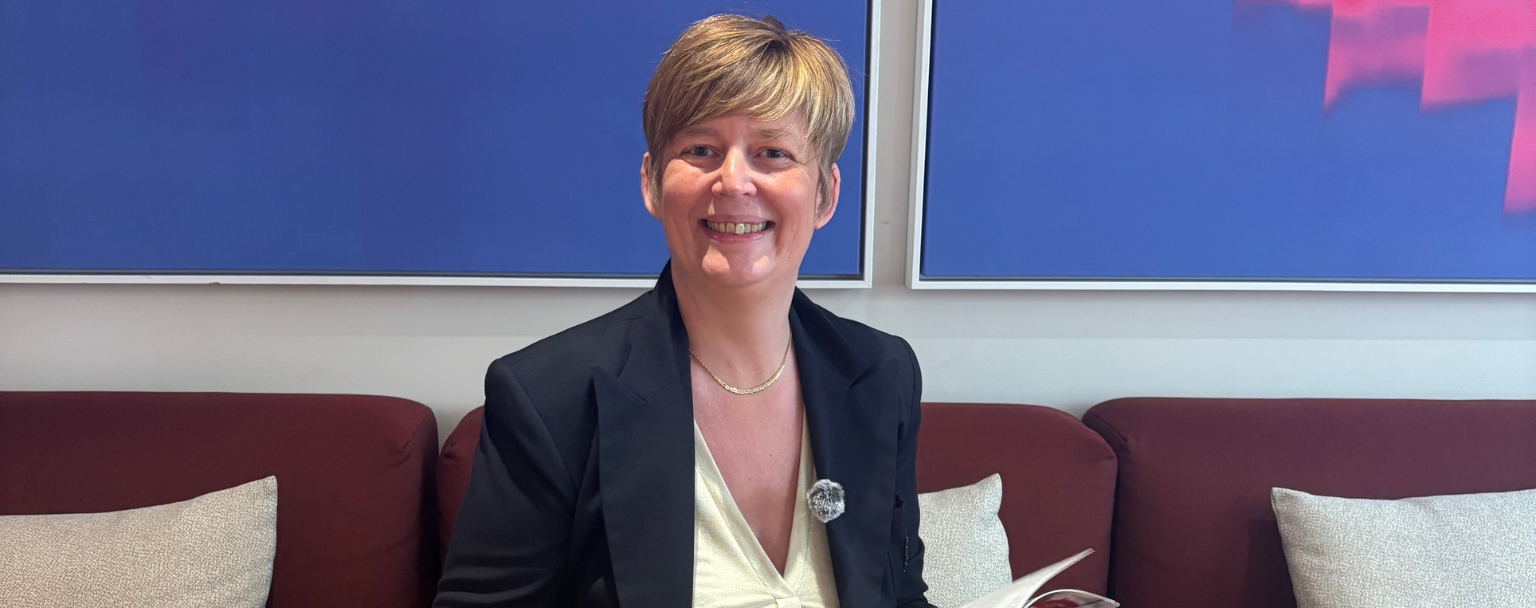
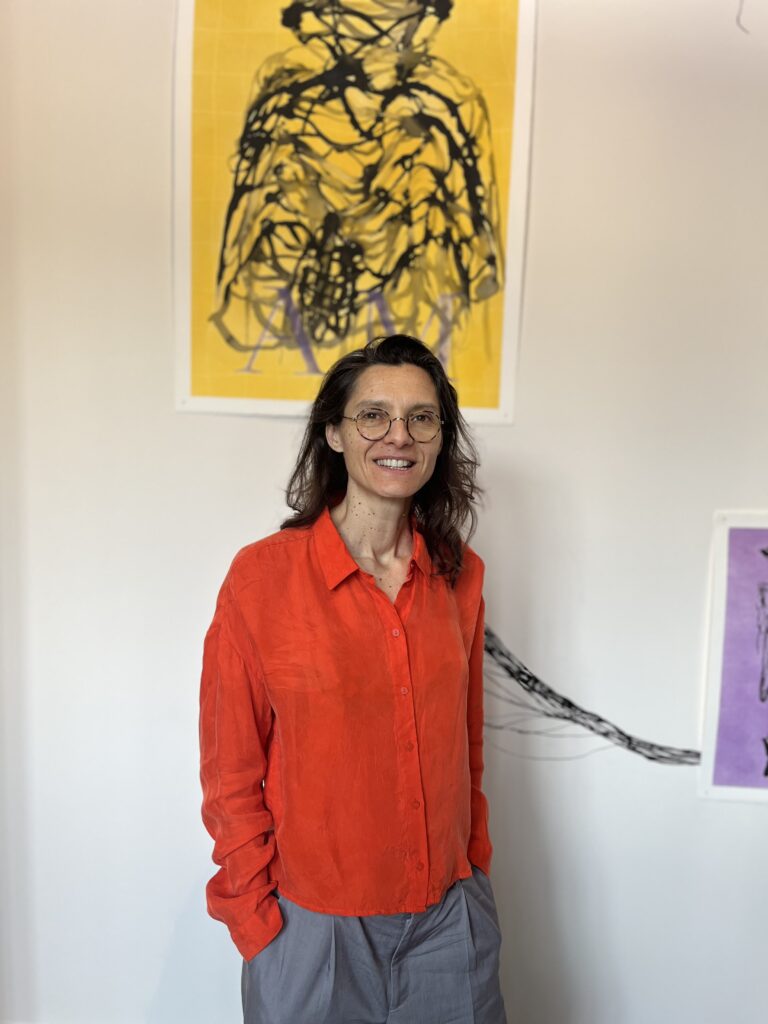
Delphine Jonckheere _ art mag EDITO

This autumn issue keeps a simple promise: to look at art on a human scale, without losing the reference points that help us understand it.
At the heart of the magazine, Flo Muliardo’s series Les Enfants Rois asserts one clear truth — the dignity of childhood — through direct portraits, bold colors, and a restrained, precise pictorial language. Her commitment to the Enfants de Manasté foundation is not a backdrop but a grounding force: here, painting becomes encounter, responsibility, and care.

To read more, download ART MAG N°29
Categories
International - News

Waiting for Barbarians – Montresso* Marrakech : Edorh, Wildenboer, Tilt

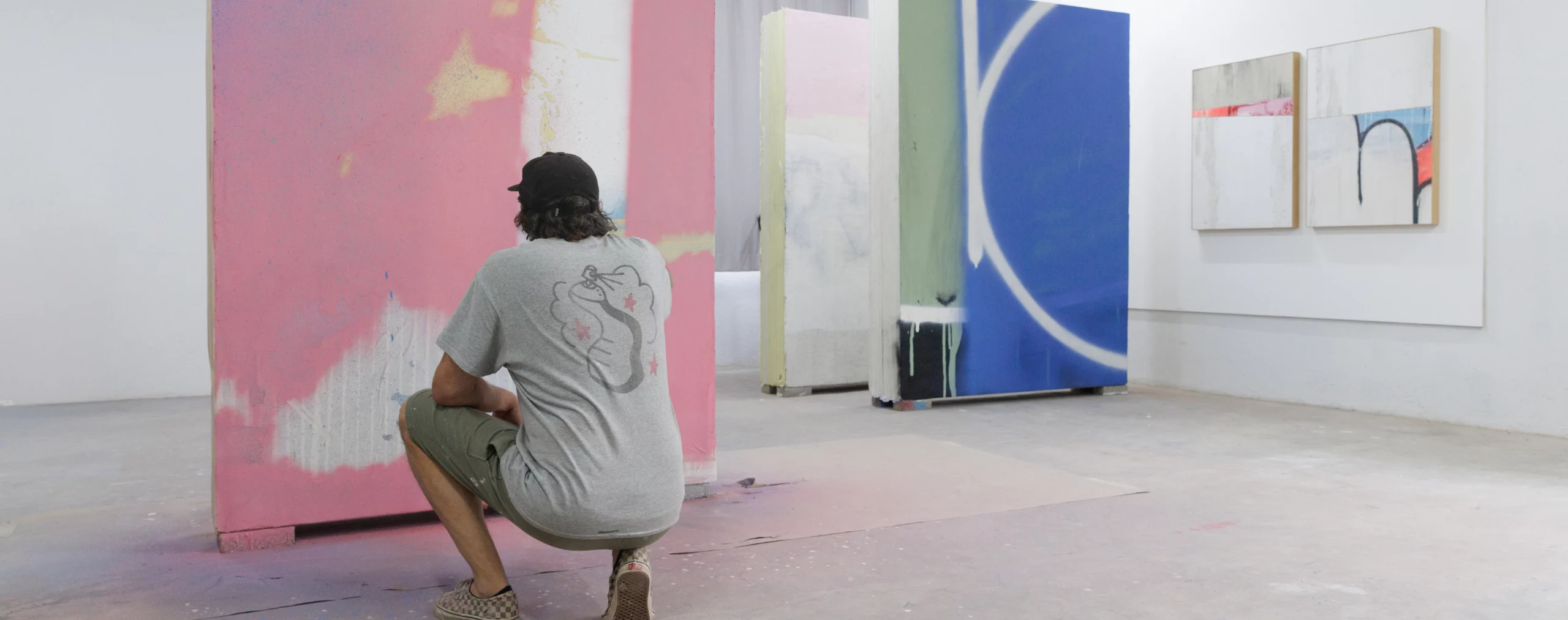
L’artiste Tilt en résidence à Jardin Rouge, Marrakech (2025), peignant un grand panneau abstrait rose, bleu et noir pour l’exposition Waiting for Barbarians à la Fondation Montresso*. magazine art mag
Mourad Boulhana

In Marrakech, Montresso* Art Space brings together Sokey Edorh, Barbara Wildenboer, and Tilt for a manifesto exhibition that revisits our myths — from the Paleolithic to today’s cities.
Dates: November 1, 2025 → January 24, 2026. Far from the cliché of the “barbarian,” this exhibition calls for new symbols, new signs.

Sokey Edorh in his studio in Jardin Rouge, Marrakech (2025), preparing his canvases for the Waiting for Barbarians exhibition at the Montresso Foundation*. Art mag magazine
Sokey Edorh à l’Atelier Rouge © Mourad Boulhana

Why You Should See It

  • A powerful theme – The “Other” as a catalyst for aesthetic and political renewal (a nod to Cavafy).
  • A trio of artists – Earth & ideograms (Edorh), hybrid altars & altered books (Wildenboer), urban palimpsests (Tilt).
  • A unique venue – Montresso* Foundation, the beating heart of artistic creation in Marrakech (Jnan Al’ahmar).

Sokey Edorh — Earth as Archive, Gesture as Alphabet

Trained by Paul Ahyi, Edorh works with lateritic soils from West Africa, transforming them into a primordial script — ideograms and invocations — that weave a continuum between generations.
Recent works include Termite Mound, Symbol of Freedom (2025) and The Creation of the World (2025).
His works are part of collections such as :

  • Fondation H (Madagascar),
  • National Museum of Mali,
  • Palais de Lomé,
  • Internationally at the Blachère Foundation,
  • Heinrich Böll Foundation,
  • Newark Museum of Art.

Want to see more ?
👉 Subscribe to 6 issues / 1 year
👉 Give ART MAG as a gift

Barbara Wildenboer in residence at Jardin Rouge, Marrakech (2025), assembling wood and porcelain sculptures inspired by organic forms for the exhibition Waiting for Barbarians. art mag magazine
Barbara Wildenboer à l’Atelier Rouge © Mourad Boulhana

Barbara Wildenboer — Altars of Alliance and Speculative Ecologies

Working with wood, porcelain, bronze, and altered books, the South African artist creates hybrid altars where beauty meets grotesque, and multispecies ecologies come to life (echoing Donna Haraway and M.J. Rubenstein).
Her torn maps and threaded embroideries form fragmented yet symmetrical geographies.
Featured works: Breathing into Bones I (2025) and She Who Wears Time As Adornments XV (2025).
She is represented by :

  • Everard Read
  • This is Not a White Cube,
  • Fondation H,
  • Blachère Foundation,
  • Montresso*,
  • and MACAM.

See olso : Barbara Wildenboer: When art weaves a link between science, intuition and mystery

Artist Tilt in residence at Jardin Rouge, Marrakech (2025), painting a large abstract panel in pink, blue and black for the Waiting for Barbarians exhibition at the Montresso Foundation*. Art Mag magazine
Artist Tilt in residence at Jardin Rouge © Mourad Boulhana

Want to see more ?
👉 Subscribe to 6 issues / 1 year
👉 Give ART MAG as a gift

Tilt — Concrete Palimpsests, Archaeology of the Future

A figure of graffiti counterculture, Tilt turns the wall into a living memory: layers of lettering, erasures, and overpainting become contemporary hieroglyphs on concrete panels.
Between abstraction and figuration, his work documents collective experience and dramatizes the insubordination of language.
Exhibitions include :

  • Les Abattoirs (Toulouse)
  • MMVI (Rabat);
  • collections: Mucem,
  • Pera Museum,
  • and Montresso*.

Practical Information

  • Title: Waiting for Barbarians — Sokey Edorh, Barbara Wildenboer, Tilt
  • Dates: November 1, 2025 → January 24, 2026
  • Venue: Montresso* Art Space, Montresso* Foundation — Jnan Al’ahmar, Ouidane Douar Ouled Zbir, Marrakech (Morocco)
  • Socials : Instagram @montressoartfoundation — Agenda & newsletter at montresso.com

FAQ

Why “Waiting for Barbarians”?
It references Cavafy — welcoming the “other” as a necessity to reinvent our shared stories.

What unites the three artists?
The sign and the trace: earthen ideograms (Edorh), multispecies alliances (Wildenboer), urban palimpsests (Tilt).

Key works to look for?
Termite Mound, Symbol of Freedom (Edorh, 2025); Breathing into Bones I (Wildenboer, 2025); and Tilt’s untitled concrete reliefs (2025).

Do I need to book tickets?
Check the Montresso* website for updates and access information.

Is the exhibition family-friendly?
Yes, with multiple layers of interpretation and guided tours available on selected dates.

Want to see more ?
👉 Subscribe to 6 issues / 1 year
👉 Give ART MAG as a gift

Categories
News

Jonathan Bertin photo exhibition in Paris | Porte B Gallery

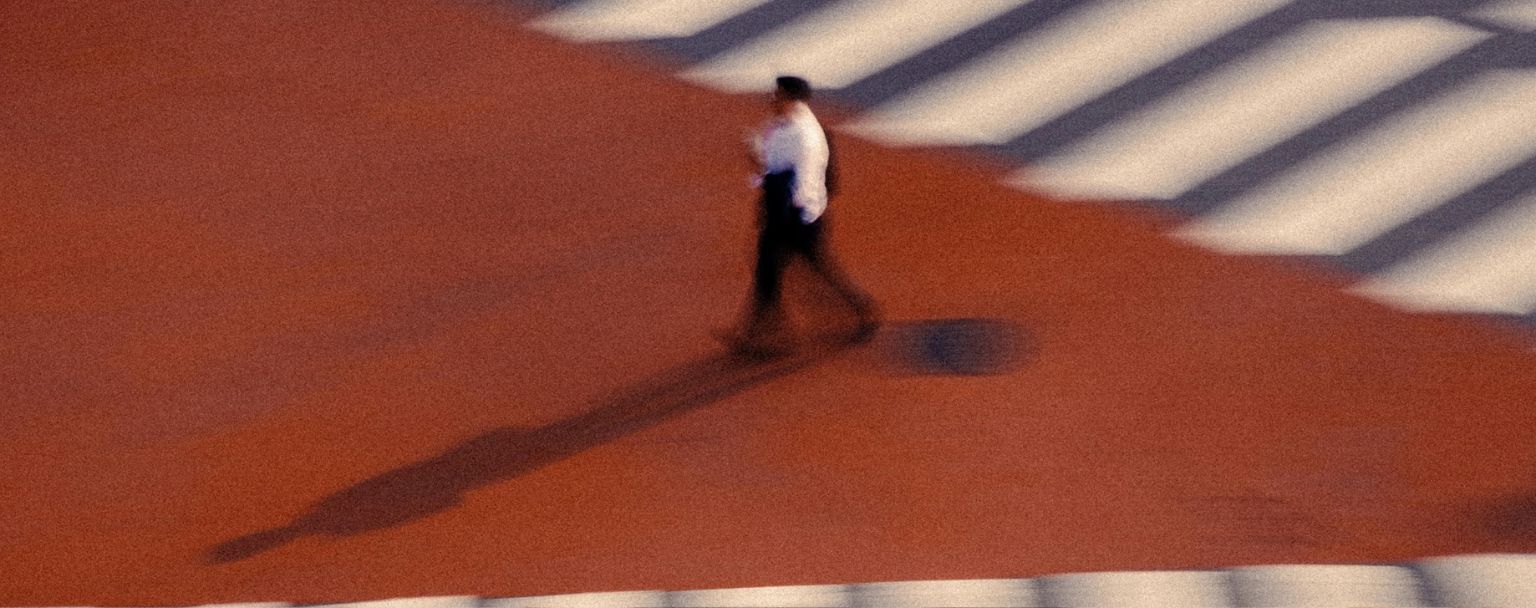
Piéton flou traversant un carrefour rouge avec zébrures blanches, effet de filé à Séoul. Art mag

From 15 November to 20 December 2025, Galerie Porte B (Paris 10th) presents Impressionism, Resonances, a solo show where colour, blur, and movement shift photography toward a pictorial sensation. Public opening on 15 November (4–9 pm).

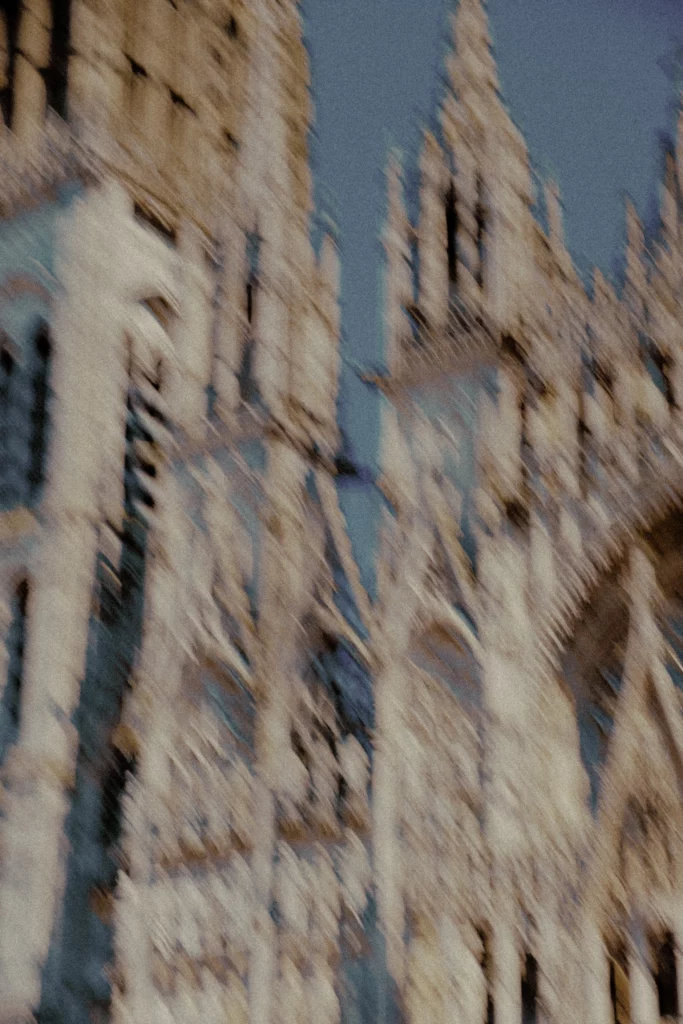
Cathedral façade vibrating in motion blur, impressionist reference in Normandy.
Rouen Cathedral, Normandy

Photography that feels before it describes

In this exhibition, Jonathan Bertin explores the impressionist legacy without pastiche. The compositions remain legible (chromatic masses, supple lines), yet the artist embraces an oscillation between photography and painting: motion blur, textures, and overlays bring the image to life through vibration rather than contour. The eye gropes, then settles into a cadence—the cadence of an instant that lasts. Rooted in Normandy (2023–2024), the project revisits emblematic sites of impressionism to capture everyday scenes, landscapes, and watery reflections, aiming to “give movement back to photography.”

Want to see more ?
👉 Subscribe to 6 issues / 1 year
👉 Give ART MAG as a gift

Resonances : from Normandy to Seoul

The cycle opens onto a new topography with Seoul Impressionism, shown for the first time in this solo show: an urban, vibrant series paced by speed and colour planes. The city becomes a laboratory of flows—streaked silhouettes, neon sheets, circulating lines of sight. The visual vocabulary carried over from Normandy’s landscapes accelerates without disowning itself, meeting other lights and densities.

Blurred figure moving before horizontal bands, city neon ambience.
Escape, Seoul 2025

A recognised trajectory

In October 2025, Bertin’s works entered the Fondation Hermès contemporary photography collection—a milestone that underscores the singularity of a practice at “the crossroads” of art, image, and digital culture. The Paris solo show marks a hinge moment where homage, reinterpretation, and emancipation converge.

Blurred crowd casting long shadows, sense of urban flow.
Passing crowd, Seoul

Why go

  • Reactivate impressionism in the age of moving images: colour thinks form; blur sculpts time.
  • Experience perception itself: the artist “disorients without losing,” leaving room for your own intimate resonance.
  • Discover “Seoul Impressionism”: its first gallery presentation, extending the cycle into the city.

Practical information

  • Dates: 15 novembre au 20 décembre 2025
  • Venue: Galerie Porte B, 52 rue Albert-Thomas, 75010 Paris
  • Opening hours: Wed–Fri 2–7 pm, Sat 11 am–7 pm, and by appointment

Want to see more ?
👉 Subscribe to 6 issues / 1 year
👉 Give ART MAG as a gift

FAQ

What is Impressionism, Resonances?
A solo exhibition by Jonathan Bertin probing the impressionist legacy through photography: movement, blur, colour, and a perception poised between painting and image.

What is “Seoul Impressionism”?
An urban chapter born of residencies in Korea: streaked silhouettes and neon planes—its first gallery presentation within this solo show.

Why is this exhibition significant in 2025?
It coincides with the works entering the Fondation Hermès collection and consolidates an evolving language between homage and autonomy.

Want to see more ?
👉 Subscribe to 6 issues / 1 year
👉 Give ART MAG as a gift

Categories
Calendar - News - Painting

Eugène Leroy at the MUba (1980–2000): Painting as an Experience of Light

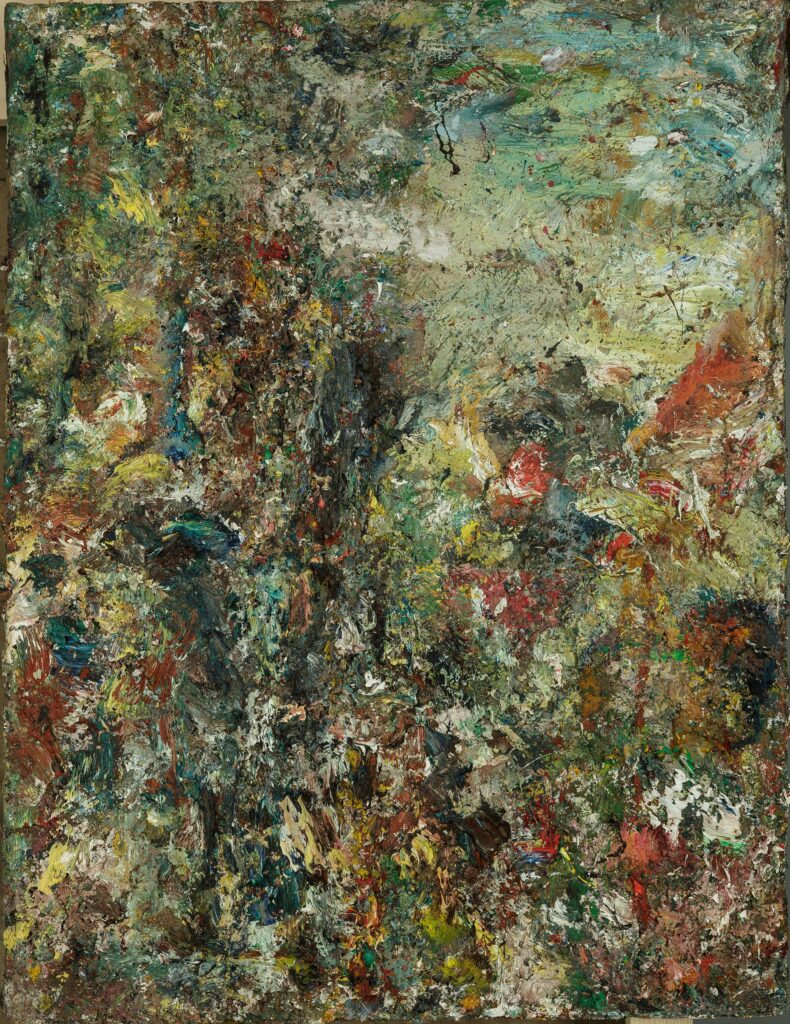
Peinture épaisse et vibrante d’Eugène Leroy, L’Été (1999) : strates d’ocres, rouges et bleus où la figure affleure dans la lumière MUba Tourcoing art_mag
ACMHDF / Franck Boucourt

3 October 2025 – 5 April 2026 — MUba Eugène Leroy, Tourcoing

The MUba presents more than 80 works tracing the last two decades of Eugène Leroy’s career (1980–2000). It is a dense journey where colour—laid down in strata—brings forth the figure, the season, the hour: light as destiny.

a large Eugène Leroy painting with heavy impasto hanging on a white wall (MUba, Tourcoing). Art Mag Magazine
Eugène Leroy, Femme, 1981, oil on canvas © Boris Rogez / LaM

Want to see more ?
👉 Subscribe to 6 issues / 1 year
👉 Give ART MAG as a gift

Why this exhibition matters

Long “outside fashion,” Leroy achieved international recognition in the 1980s–1990s (Ghent, Paris, Eindhoven, Cologne; documenta 1992; Venice Biennale 1995). Returning to these late years reveals the radicality of a painting that refuses effect in order to reach the “right image.”

Painting light rather than the motif

In the Wasquehal studio—windows to the north and south, “light in front, light behind”—model, reflection and landscape are subjected to changing illumination. Leroy seeks “the trace of lived experience” and buries anecdote: detail matters less than luminous sensation.

Eugène Leroy landscape (1982): earthy green impasto, unmixed touches, a shifting atmospheric sensation.
Exhibition MUba Tourcoing art mag
Eugène Leroy, Landscape, 1982, oil on canvas, private collection. © Florian Kleinefenn

1990–2000: the nude, verticality, economy

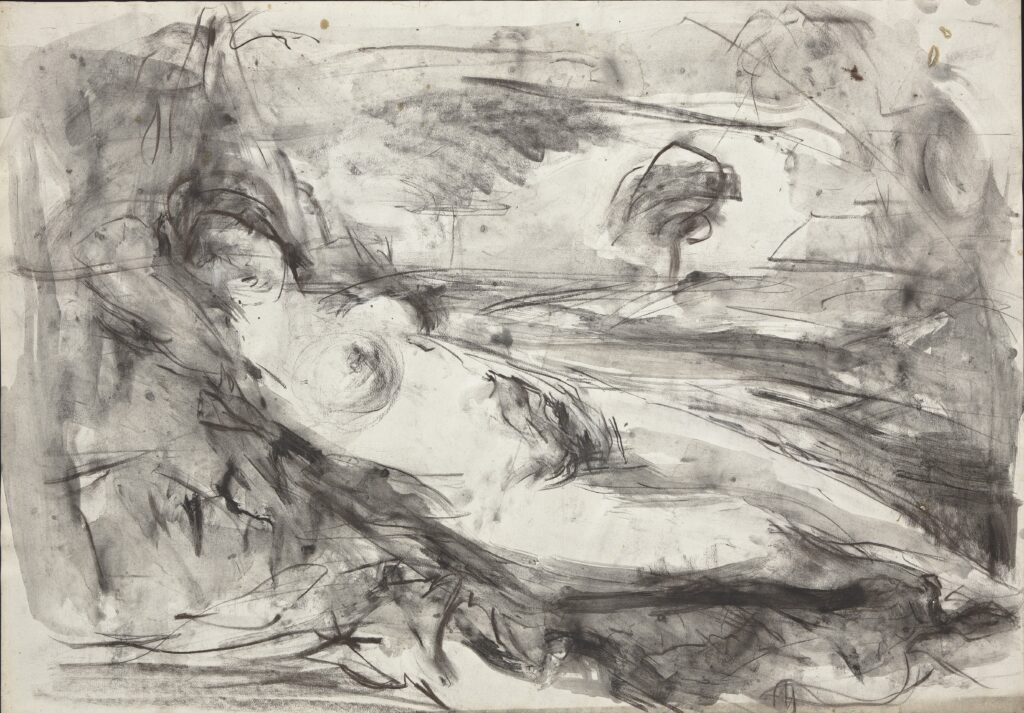
From 1990 onward, the female nude becomes the site of reduction. Formats rise; matter proliferates yet the figure grows lighter, as if spiritualised by verticality. Touches—often applied straight from the tube or with a knife—break up the polychromy and set the surface to rhythm.

Reclining nude sketched in charcoal and wash by Eugène Leroy: swift line, white reserves acting as light. Exhibition MUba Tourcoing article art mag
Eugène Leroy, Untitled (reclining nude after Giorgione’s Sleeping Venus), 1980–1990, charcoal, wash and white chalk on paper, MUba Eugène Leroy. © Florian Kleinefenn

Dialogues with art history: Mondrian, Poussin, Rembrandt

Leroy’s gaze toward Mondrian is not about grids but about the rhythm of unmixed colour areas; Poussin inspires two Seasons cycles, where painting is tuned to cosmic time; Rembrandt and Giorgione remain long-standing companions.

Drawing to “catch the gesture”

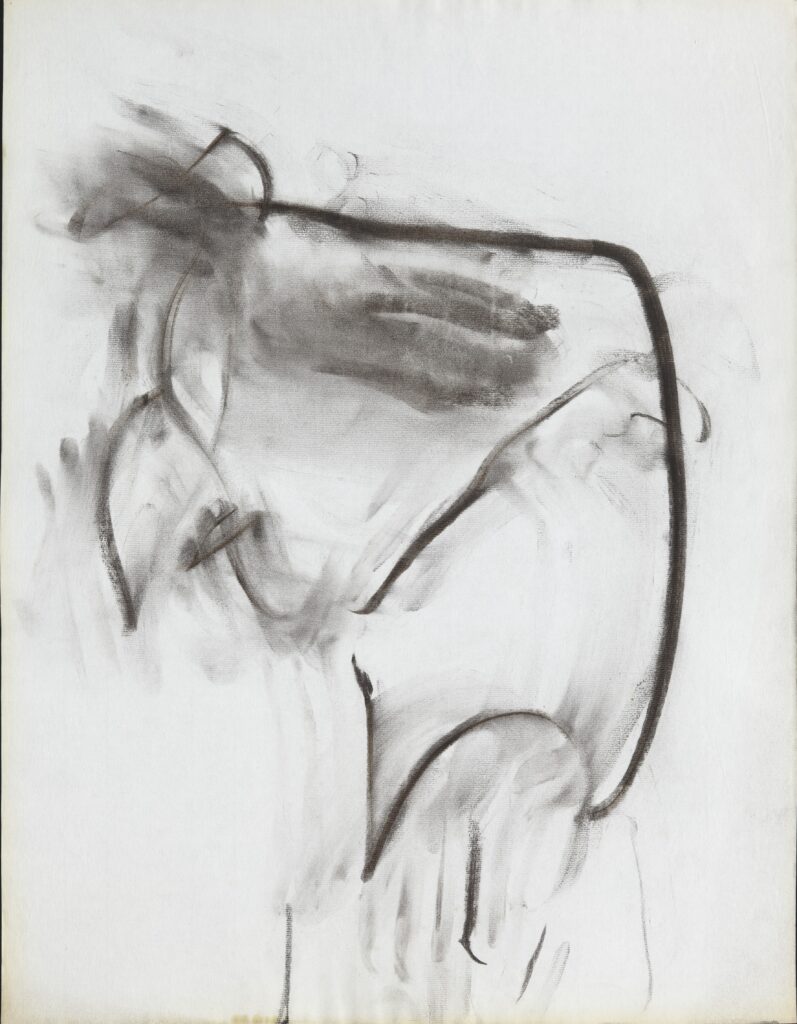
Never merely preparatory, drawing is an autonomous field: charcoal, red chalk, gouache, watercolour… The aim is to “catch” movement—sometimes without looking at the sheet—leaving reserves of white as active light.

Charcoal sheet: summary lines, suggested volumes, large white reserves.
MUba Tourcoing Art Mag
Untitled, 1980–1990, charcoal (MUba). © Florian Kleinefenn

Highlights not to miss

  • Seasons cycles and canvases “indexed” to light (Done in Winter, L.M. in the Evening).
  • Vertical nudes of the 1990s: “grainy” surfaces, surges of matter.
  • Large 1980s gouaches and series in charcoal.
“Eugène Leroy seated in his Wasquehal studio circa 1990, thickly painted canvases leaning against the wall, side light 
exhibition MUba
Article Art Mag
Marina Bourdoncle, Eugène Leroy in his Wasquehal studio, c. 1990, gelatin silver print, MUba Eugène Leroy. © ACMHDF / Franck Boucourt

Want to see more ?
👉 Subscribe to 6 issues / 1 year
👉 Give ART MAG as a gift

Practical information

MUba Eugène Leroy, 2 rue Paul Doumer, 59200 Tourcoing
Dates: 3 October 2025 → 5 April 2026
Hours: Daily 1–6 pm (closed Tuesdays and public holidays)

FAQ

Who is Eugène Leroy?
A painter born in Tourcoing (1910) and deceased in Wasquehal (2000), he built a major body of work where the thickness of paint serves light rather than effect.

What does the MUba exhibition show?
Over 80 paintings and drawings from 1980–2000: vertical nudes, self-portraits, seasons, large gouaches and charcoals.

Which influences does Eugène Leroy claim?
Mondrian for the rhythm of pure colours; Poussin for the time of the seasons; as well as Rembrandt and Giorgione.

Why is the paint so thick?
It results from long reworking until the “right image” appears; impasto is never an end in itself.

Want to see more ?
👉 Subscribe to 6 issues / 1 year
👉 Give ART MAG as a gift

Categories
Sculpture

Régis Sinoquet — The Animal Revealed : Sculpture of a World on the Brink

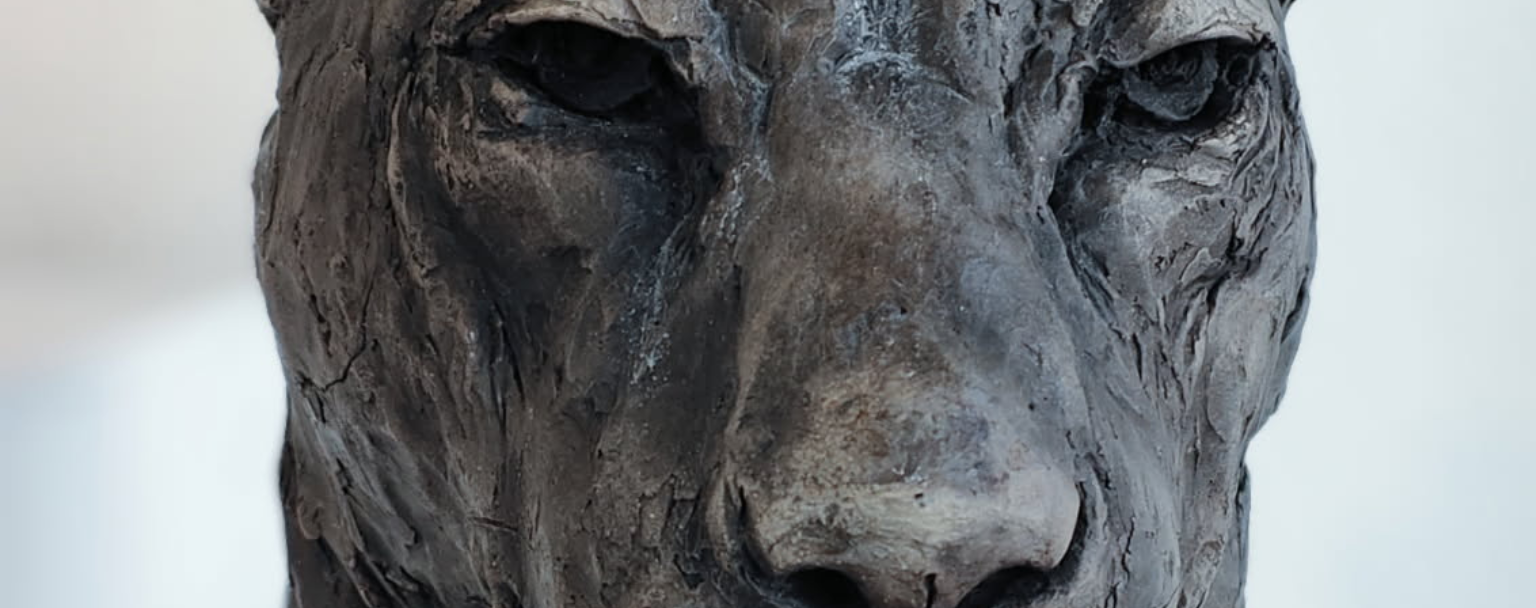
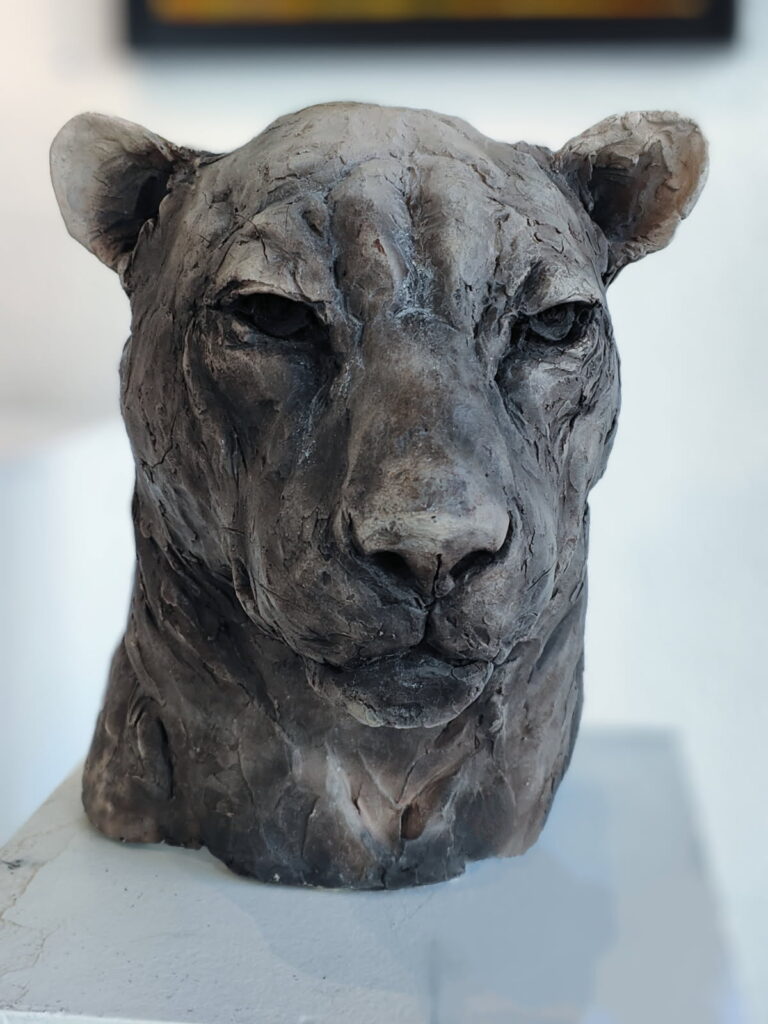
Sculpture animalière de Régis Sinoquet — buste de panthère en céramique, modelé nerveux, vue frontale.

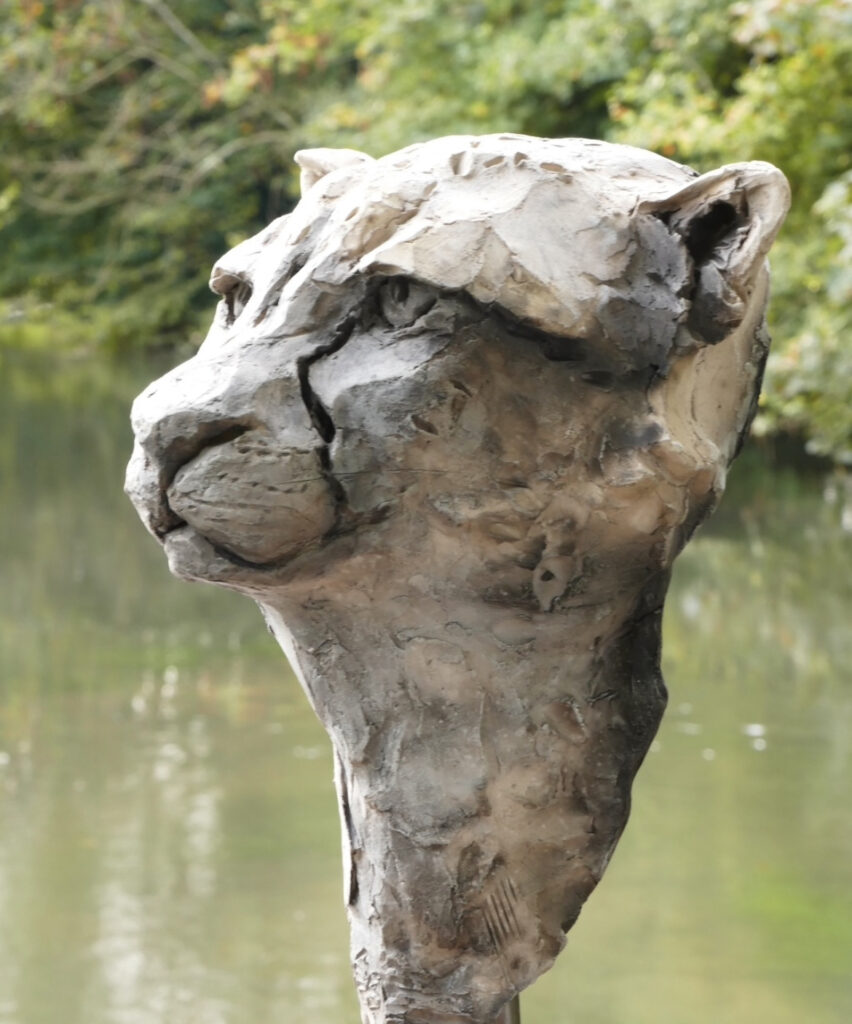
Animal sculpture, smoked ceramic, a living gaze: Régis Sinoquet restores nobility to the animal and confronts us with the fragility of the world. A rare encounter with a sculptor who embodies the very breath of life.

Régis Sinoquet animal sculpture — ceramic cheetah head, expressive texture by the riverside

The animal : memory and presence

Some artists give shape to ideas. Others give flesh to emotion. Régis Sinoquet sculpts presence. For him, the animal is not a motif—it is memory, breath, otherness. His ceramics do not imitate; they incarnate. They look at you, question you, and reconnect you with that part of the living we too often forget to see.

Régis Sinoquet animal sculpture — ceramic panther bust with textured modeling, front view.
Panther

Clay as memory of the gesture

Clay is a living material; it retains impulses, hesitations, the speed of the hand. Sinoquet embraces the trace—that nervy modeling, that textured skin—as a form of writing. The posture emerges, precise, before the firing fixes the tension. Through high-temperature carbon smoking, contrasts of matte and sheen reveal musculature and movement. Bronze sometimes beckons, as do wood and stone, yet everything returns to ceramic—earth transfigured by fire.

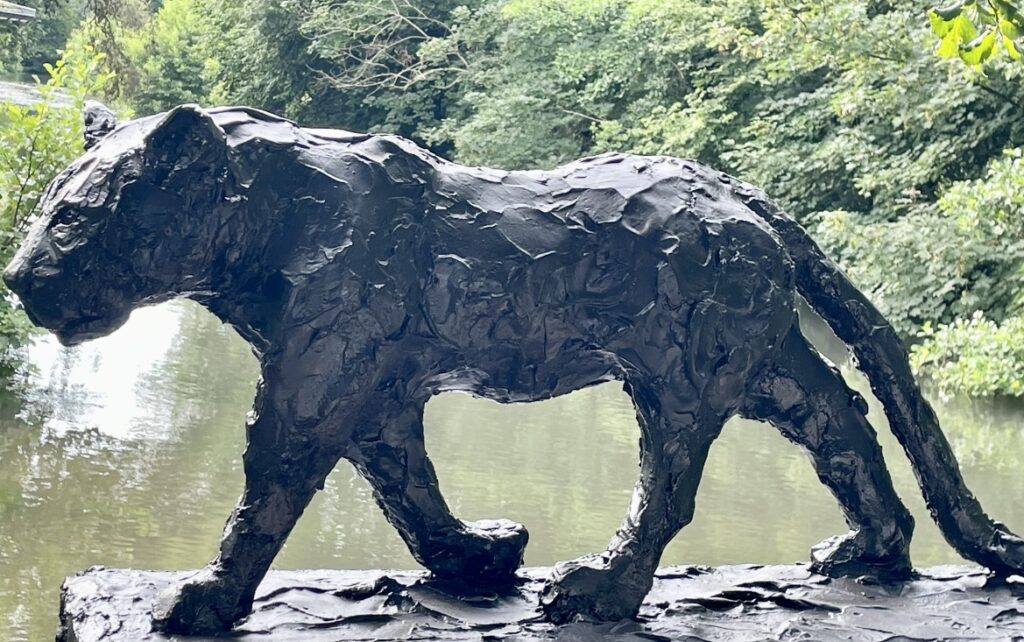
Animal sculpture in smoked ceramic by Régis Sinoquet — black panther, raw texture, natural background.
Black Panther

Panther : the majestic shadow

A totemic figure in the artist’s work, the panther becomes the majestic shadow of a world that is contracting. Restored to its wild, fragile truth, it crystallizes the message: a precise gaze, two orbits like planets, a silent face-off that lets emotion settle in. The sculpture observes you as much as you observe it.

Fidelity without academicism

No showy virtuosity, no stylistic tricks. Sinoquet seeks inhabited accuracy: a pricked ear, a lifted paw, an arching spine—everything balanced between tension and grace. Knowledge of animal anatomy is matched by a vibrant expressiveness. His signature is unmistakable: living matter, grain, breath.

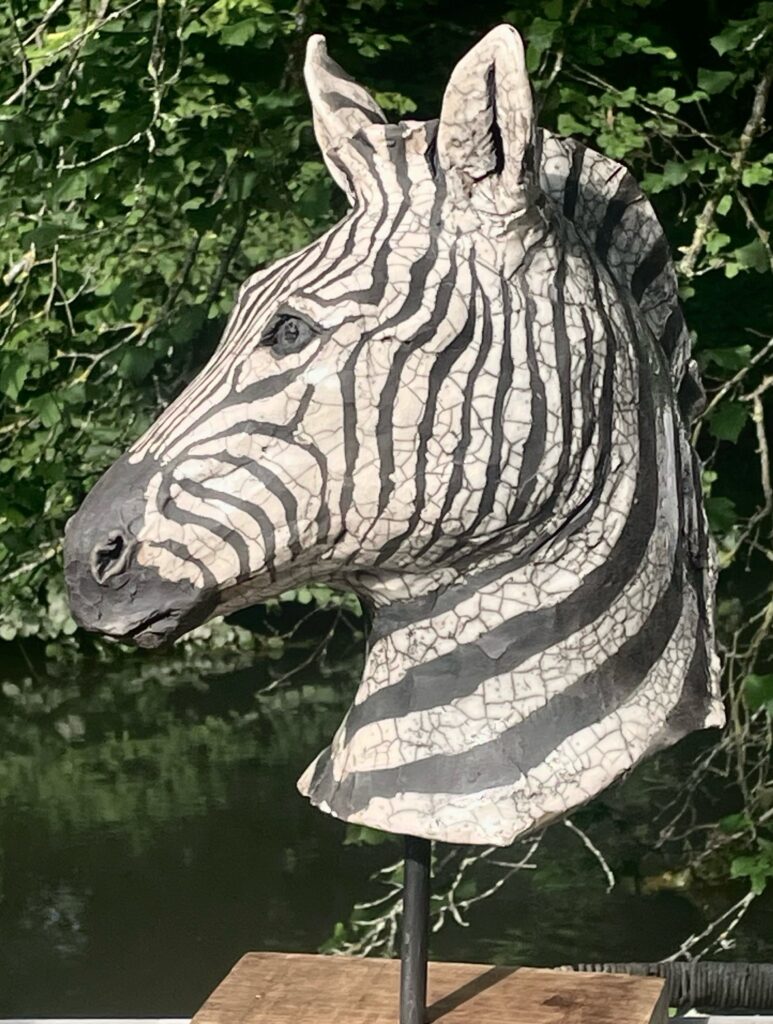
Animal sculpture by Régis Sinoquet — crackled ceramic zebra head, profile view, natural background.
Zebra

An art of vigilance

Restoring the animal’s nobility also names what our species threatens, abandons, or forgets. The sculpture becomes watchful, a discreet yet powerful homage to a world on the brink. Looking is no longer enough: we must recognize and defend. Sometimes, a panther in clay says more than a thousand speeches.

Want to see more?
👉 Order the current ART MAG issue
👉 Subscribe — 6 issues / 1 year
👉 Gift ART MAG

FAQ

Who is Régis Sinoquet ?
A contemporary sculptor whose animal-focused practice—primarily in ceramic—explores the presence of the living through matter and gaze. magazine-art-mag.fr-Régis Sinoq…

What techniques does he use ?
Clay modeling, firing, and carbon smoking that produces matte/gloss contrasts; occasional dialogues with bronze, wood, and stone. magazine-art-mag.fr-Régis Sinoq…

Why does the panther recur so often ?
A totem and mirror of our bond with the wild—energy, discretion, fragility—an icon that prompts vigilance. magazine-art-mag.fr-Régis Sinoq…

Is ceramic animal sculpture fragile ?
The pieces are kiln-fired and stable; with proper transport and installation, they integrate durably into a collection. magazine-art-mag.fr-Régis Sinoq…

To read more, download ART MAG N°28
Categories
Sculpture

A Vibrant Retrospective in the Heart of Les Ateliers de la Morinerie

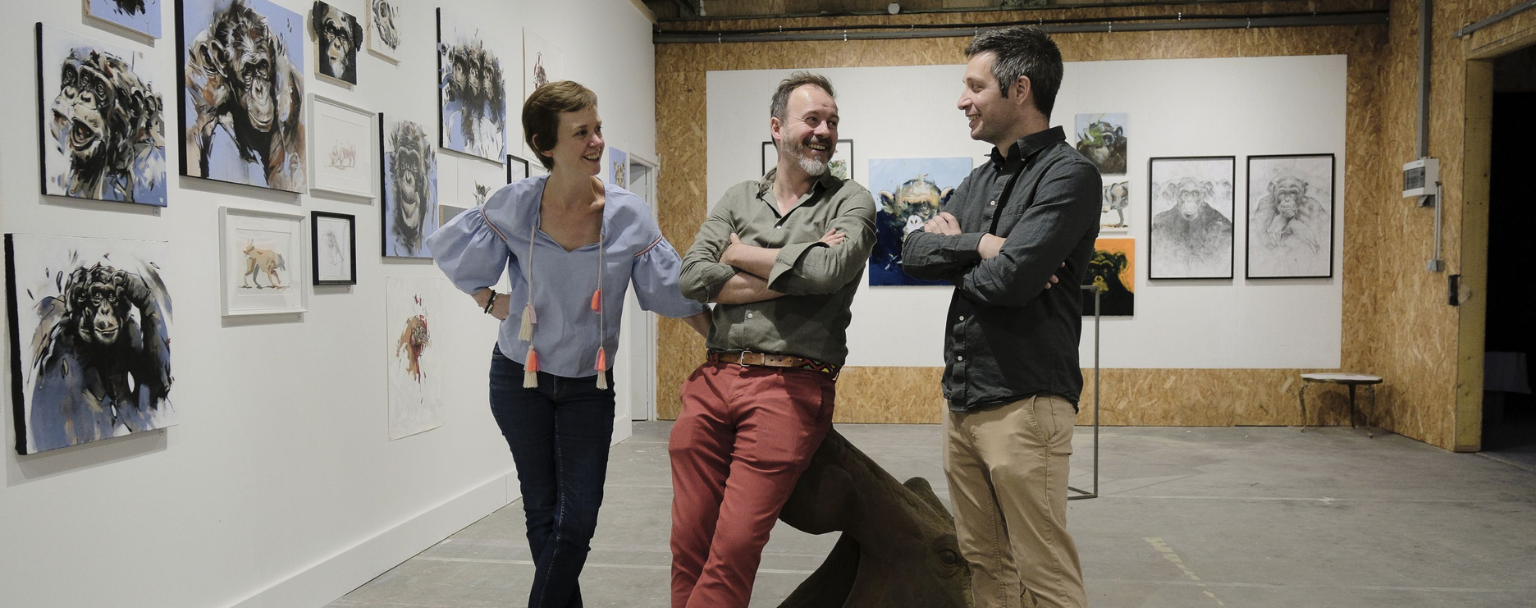
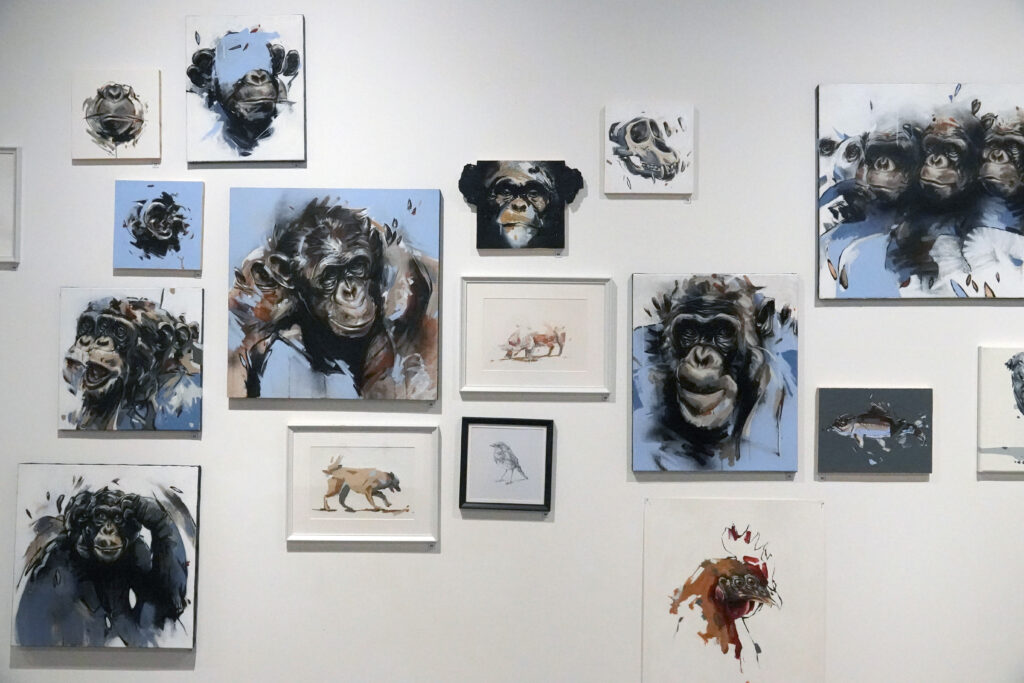
Sarah Scouarnec, Pierre-Jean Chabert et Thibault Jandot discutant devant une série d’œuvres animalières exposées aux Ateliers de la Morinerie à Saint-Pierre-des-Corps. À gauche, plusieurs peintures représentant des chimpanzés ; au centre, les trois artistes échangent dans une ambiance conviviale au cœur de l’espace d’exposition.

In Saint-Pierre-des-Corps, near Tours, Les Ateliers de la Morinerie have become a genuine laboratory for contemporary art.
Just before the open studio event, artists Pierre-Jean Chabert (animal sculptor), Sarah Scouarnec (visual artist), and Thibault Jandot (painter) unveiled an intimate yet powerful exhibition — an artistic immersion exploring the bond between material, gesture, and life itself.

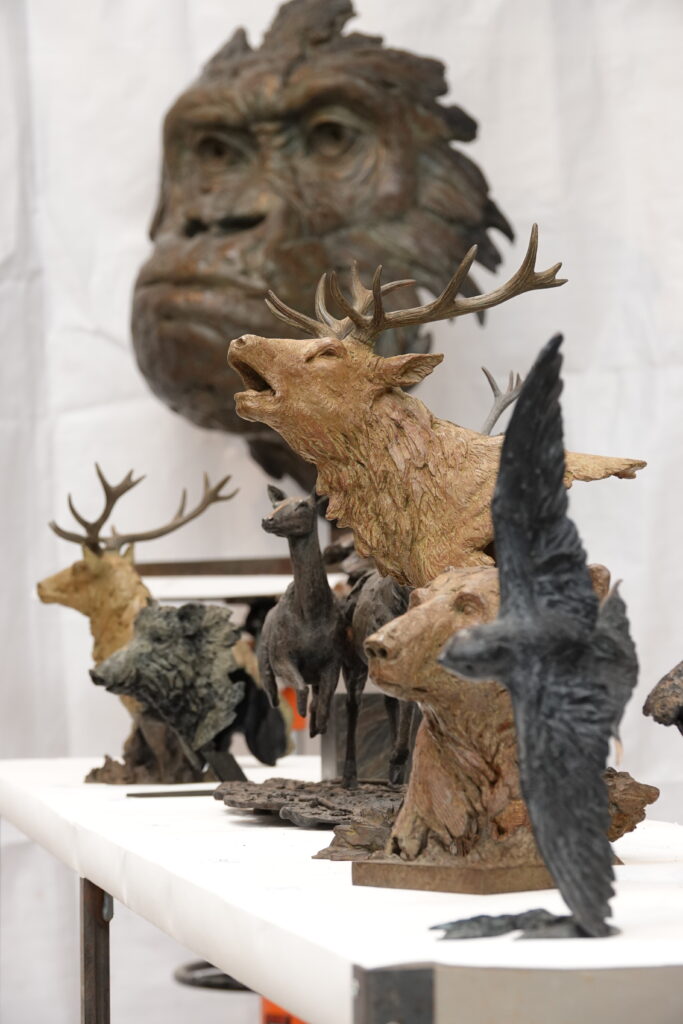
Collection of bronze animal sculptures by Pierre-Jean Chabert displayed at Les Ateliers de la Morinerie. Stags, wolves, bears and birds stand together in a dynamic composition evoking the power of contemporary bestiary and the vitality of life.

Metal, clay, and color converse here with a shared vitality, forming a dialogue where the gesture becomes language and matter becomes memory.

Pierre-Jean Chabert: The Telluric Force of the Bestiary

Sculptor Pierre-Jean Chabert introduces a strikingly raw and organic world.
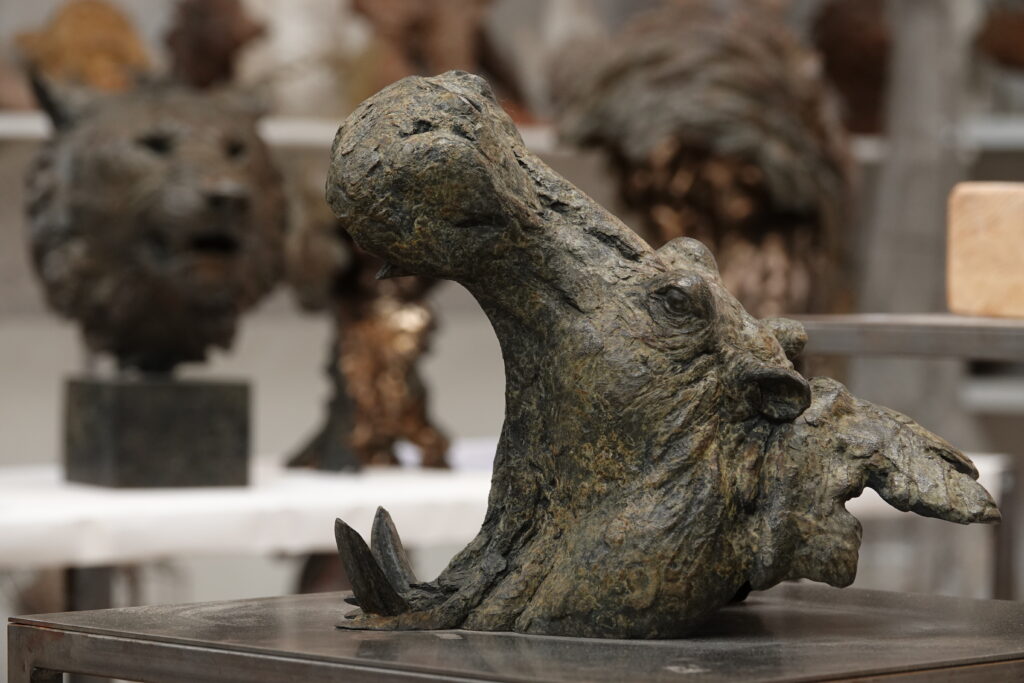
His bronze animal sculptures — rhinoceroses, gorillas, mandrills — seem frozen in suspended motion, radiating strength and vulnerability at once.

Bronze sculpture by Pierre-Jean Chabert depicting an animal head blending hippopotamus features with mythic forms. The artist captures the raw energy of the material in a powerful, expressive composition.

Chabert doesn’t represent the animal — he reveals its essence.
Each piece, cast in one of the five foundries he collaborates with, captures the tension and pulse of life, preserving the energy of the artist’s hand within the metal’s density.
It is sculpture as living matter — an elegant balance between primal power and quiet grace.

Sarah Scouarnec : The Dreamlike Feminine

In contrast, Sarah Scouarnec offers a poetic counterpoint.
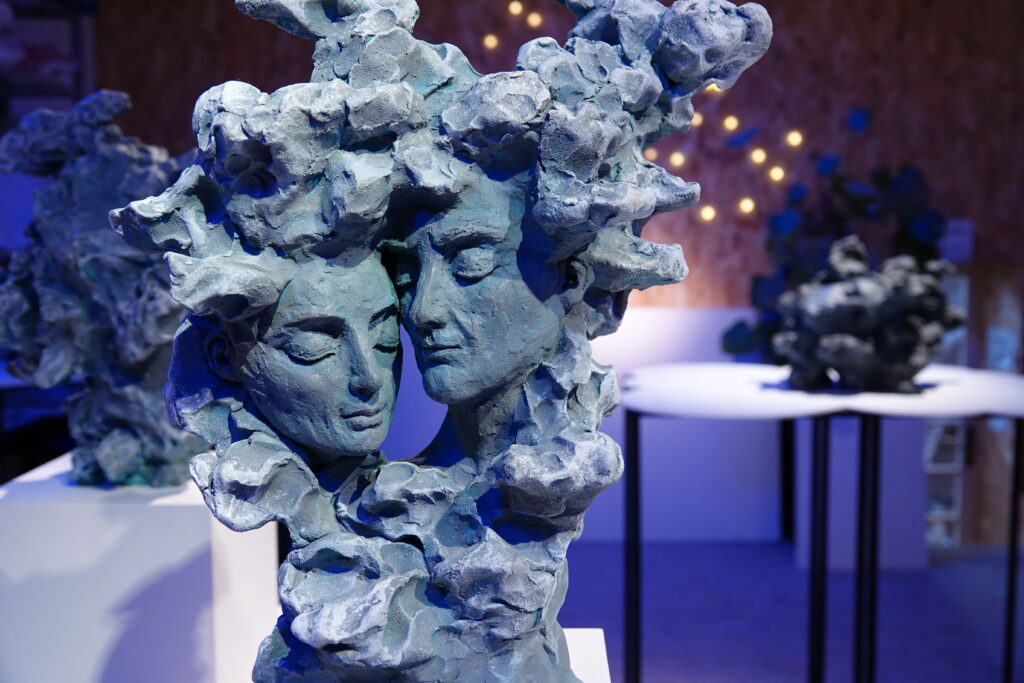
Her sculptures, inspired by mythology and surrealism, embody a dreamlike femininity rooted in nature.
Organic forms intertwine with human faces, evoking an archaic and shamanic energy.

Traces of modeling remain visible, as if the clay still breathed.
Through this tactile presence, Scouarnec explores the boundary between body and landscape, spirit and matter, in a deeply human gesture../

Thibault Jandot : Urban Energy and Instinct

A painter from the graffiti scene, Thibault Jandot infuses the space with a vibrant, urban pulse.
His canvases, charged with color and movement, echo Chabert’s animal intensity while anchoring it in the rhythm of the city.

Wall installation by Thibault Jandot at Les Ateliers de la Morinerie, Saint-Pierre-des-Corps. A series of animal portraits depicting expressive chimpanzees in blue and earthy tones, blending urban energy with instinctive brushwork.

Jandot’s expressive brushstrokes convey a sense of instinctive urgency — an electric connection between the natural and the urban, between raw emotion and artistic control.

A Symbiosis of Forces: Nature, Presence, and Creation

This three-way dialogue reveals a rare coherence.
Together, Chabert, Scouarnec, and Jandot celebrate the power of life through matter.
One sculpts the body, another sculpts the soul, the third gives both movement and color.
At Les Ateliers de la Morinerie, art becomes a sensorial experience, a meditation on presence, and a celebration of the creative energy that animates all living things.

Envie d’en voir plus ?
👉 Order the ART MAG 27
👉 Subscribe _6 issues/ 1 year
👉 Gift ART MAG

To read more, download ART MAG N°27
Categories
Painting - Women artists

Odette Pauvert (1903–1966): A Classical Modernity in the Age of Art Deco

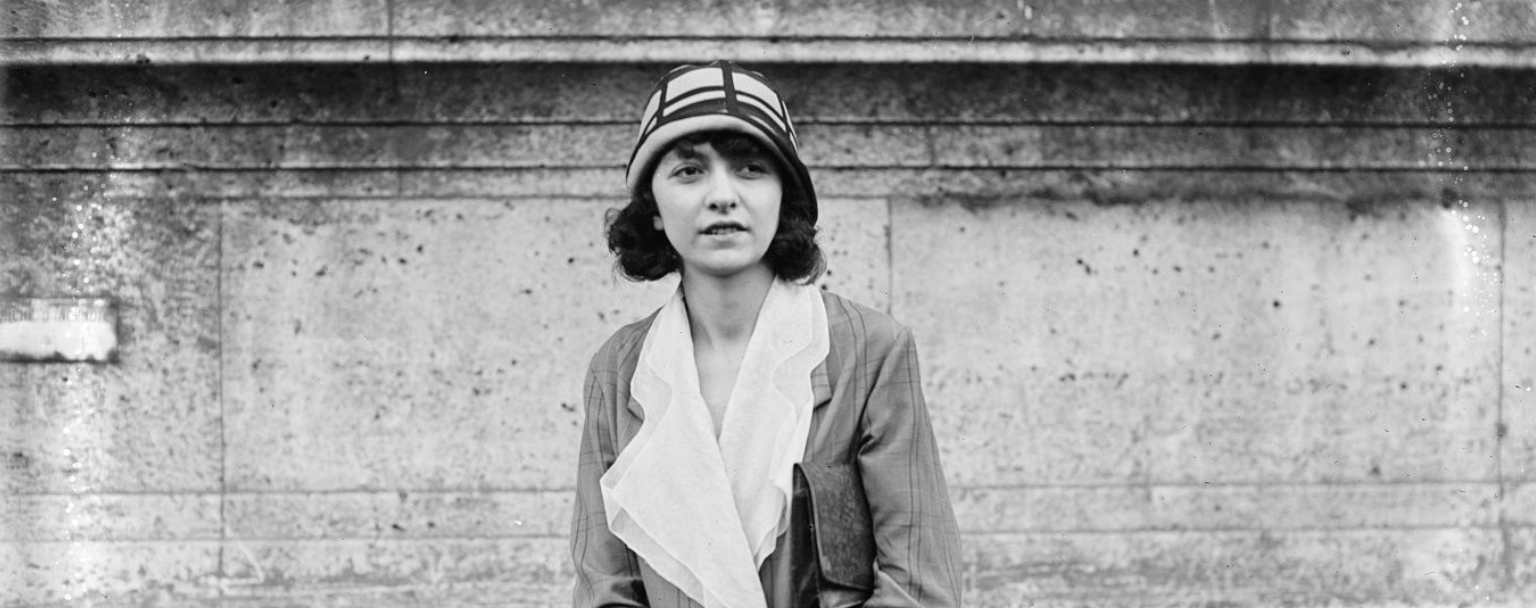
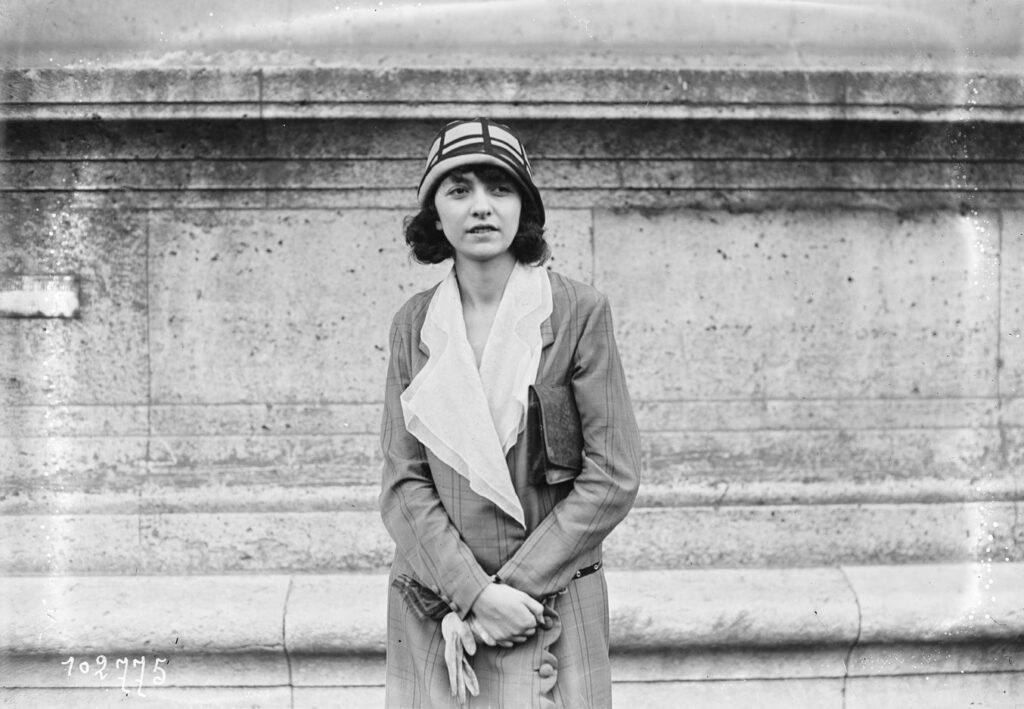
Portrait photographique d’Odette Pauvert, artiste peintre française, posant en manteau clair et chapeau à motifs géométriques devant un mur de pierre, années 1920.

The first woman painter to win the Grand Prix de Rome (1925), Odette Pauvert forged a sober, frontal modernity, nourished by the Quattrocento and conceived for large-scale decorative schemes. From the Villa Medici to the intimate scenes of the postwar years, her path sheds light on another history of the interwar period.

Biographical Landmarks

Trained at the École des Beaux-Arts in Paris, Pauvert stayed at the Villa Medici (1926–1929), where her clean contours, matte colors, and portrait-landscape approach were refined. Back in Paris, she set her sights on mural painting (the Église du Saint-Esprit, school decorations, Sèvres, 1937 International Exposition). In 1934, the Casa de Velázquez liberated her drawing (charcoal, red chalk). After 1945, material constraints and family life led her toward smaller formats without renouncing her initial ambition.

Style & Key Works

  • Promotion 1926 (1927) — a signature of the Roman period.
  • Invocation à Notre-Dame-des-Flots (1925) — inhabited classicism.
  • Habib Benglia (1931), Paris 1932 (Yvonne Pesme) — commanding frontality.
  • Le Torero (1934) — stylization and tension of line.
  • Odile, Yves et Rémy at the Rond-Point des Champs-Élysées (1946) — a domestic postwar turn.

Legacy

Long overshadowed by the avant-gardes, Pauvert embodies an alternative modernity: clarity, calibrated scale, and a disciplined gaze. Recent reassessments place her among the major women artists of the 20th century, at the crossroads of Art Deco and Renaissance tradition.

Want to see more?
👉 Subscribe — 6 issues / 1 year
👉 Gift ART MAG

FAQ — Odette Pauvert (1903–1966)

Who is Odette Pauvert?
Odette Pauvert was a French Art Deco painter and the first woman painter to win the Grand Prix de Rome (1925). Her work advances a sober, frontal modernity informed by the Quattrocento and conceived for large-scale decorative schemes.

Why is she important in Art Deco history?
She embodies a classical modernity as an alternative to the avant-gardes: clarity of form, clean contours, matte colors, a strong sense of mural scale, and disciplined looking.

Where did she train?
At the École des Beaux-Arts in Paris, then at the Villa Medici (1926–1929), where her frontal style and portrait-landscape approach matured. A stay at the Casa de Velázquez (1934) further liberated her drawing (charcoal, red chalk).

What does “classical modernity” mean in her work?
A pursuit of balance and legibility derived from the Italian Renaissance (Quattrocento), applied to contemporary subjects—portraits, scenes, and mural painting.

What are her key works to know?

  • Promotion 1926 (1927) — a signature of the Roman period.
  • Invocation à Notre-Dame-des-Flots (1925) — inhabited classicism.
  • Habib Benglia (1931), Paris 1932 (Yvonne Pesme)commanding frontality.
  • Le Torero (1934) — stylization and line tension.
  • Odile, Yves et Rémy at the Rond-Point des Champs-Élysées (1946) — domestic postwar turn.

What is meant by “portrait-landscape” in her practice?
A frontal framework where the sitter is set within an architectured space (decor, city, sea), creating a dialogue between figure and environment.

Did she produce monumental works?
Yes. She pursued large-scale decoration: the Église du Saint-Esprit, school murals, collaborations with Sèvres, and participation in the 1937 International Exposition.

How does her style evolve after 1945?
Material and family constraints led to smaller formats, without abandoning the initial ambition for clarity, frontality, and calibrated scale.

How does she differ from the avant-gardes?
She favors measure, structure, and legibility over radical formal rupture—an alternative modernity of the interwar years.

Where can I see the Odette Pauvert exhibition in Roubaix?
At La Piscine – Museum of Art and Industry, Roubaix, October 11, 2025 to January 11, 2026 (useful dates for visit planning and local SEO).

What techniques does she favor?
Drawing (charcoal, red chalk), painting with matte color fields, a clear line, and controlled modeling in support of frontality.

Why rediscover her today?
Recent reassessments place Pauvert among the major women artists of the 20th century, at the crossroads of Art Deco and Renaissance tradition.

Categories
News - Painting - Women artists

Odette Pauvert at La Piscine Roubaix — Art Deco Exhibition

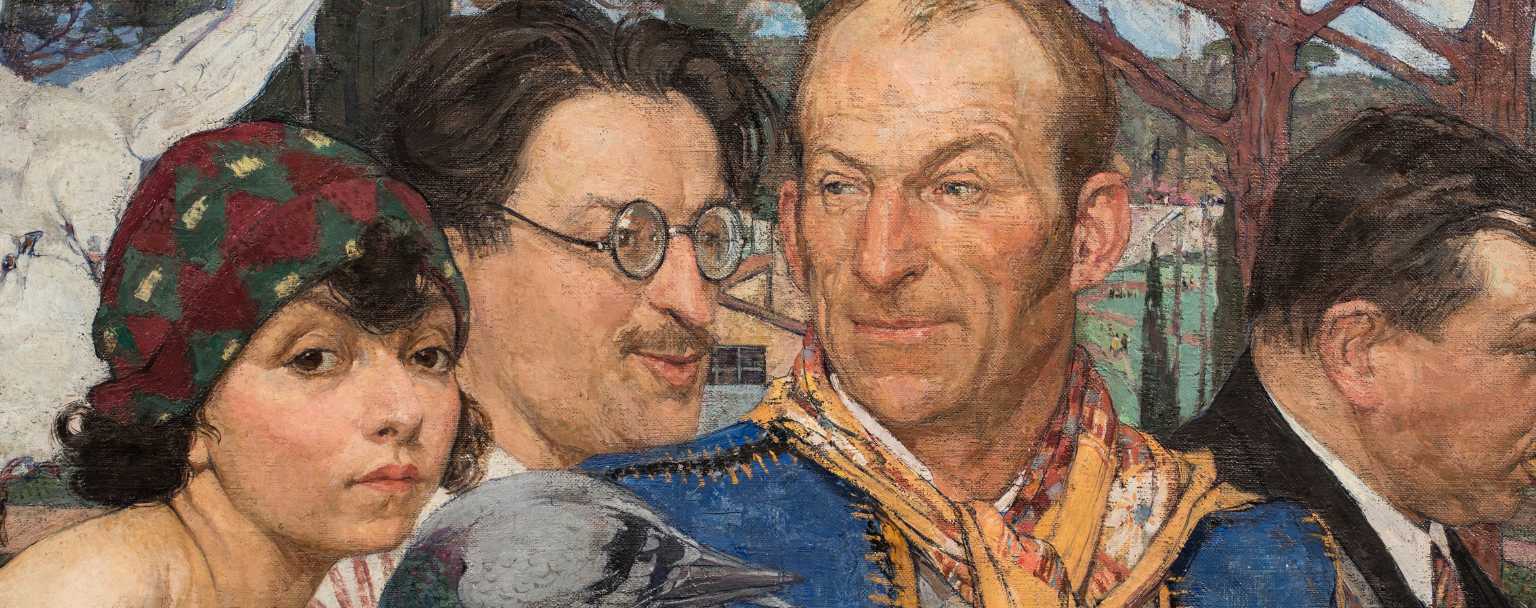
Portrait collectif peint par Odette Pauvert, montrant plusieurs personnages de face et de profil, dont une jeune femme coiffée d’un bonnet coloré et un homme vêtu d’un foulard jaune.

ExhibitionOdette Pauvert at La Piscine (Roubaix): the first woman painter to win the Grand Prix de Rome presents a classical modernity nourished by Italy and the monumental language of Art Deco. A rich itinerary — Rome, Paris, Brittany, Spain — that reframes the interwar years. October 11, 2025 – January 11, 2026.

Self-portrait of Odette Pauvert wearing a red headscarf tied around her head, facing forward, in a figurative and expressive style.
Alain Leprince

Why this exhibition is unmissable

  • First woman painter to win the Grand Prix de Rome (1925) — a milestone in the history of French art.
  • A fresh lens on Art Deco — Pauvert’s painting combines frontal compositions, matte palettes, and the portrait-landscape formula rooted in the Quattrocento.
  • A rich itineraryRome (Villa Medici); Paris and the ambition of the grand décor; Brittany; Spain (Casa de Velázquez); then the domestic intimacy of the postwar years.
Photographic portrait of Odette Pauvert, French painter, wearing a light coat and a geometric patterned hat, posing in front of a stone wall in the 1920s.

Who is Odette Pauvert?

Born in 1903, Odette Pauvert trained at the École des Beaux-Arts (Paris) and won the Grand Prix de Rome in 1925, becoming the first woman painter to receive the prize. As a resident at the Villa Medici (1926–1929), she forged a distinctive style: crisp contours, matte color, decorative clarity, and the signature “portrait-landscape.”
Returning to Paris, she asserted an ambition for mural painting (Église du Saint-Esprit; a Paris school; a Sèvres nursery; Exposition of 1937) even if public commissions remained scarce in a highly competitive environment.

Portrait of actor Habib Benglia by Odette Pauvert, holding an African mask in front of his face, surrounded by carved traditional masks.
Alain Leprince

Exhibition itinerary (highlights)

  1. Rome, the “intoxication” (1926–1929) — Italian revelation: frontality, matteness, references to Renaissance fresco and 15th-century masters.
  2. Paris & the grand décor (1930–1937) — The mural ideal takes shape: building sites and public projects; painting conceived at architectural scale.
  3. Brittany — Landscapes, figures, and legends: a current anchored in regional traditions.
  4. Spain (1934) — Stay at the Casa de Velázquez: large charcoal and red chalk drawings; the energy of Castilian and Andalusian landscapes.
  5. Postwar & the intimate — Marriage (1937), children, material constraints: smaller formats and domestic scenes.

Must-see works

  • Promotion 1926 (1927), Villa Medici — a signature work from the Roman period.
  • Invocation to Our Lady of the Waves (1925) — the breadth of an inhabited classicism.
  • Habib Benglia (1931) and Paris 1932 (Yvonne Pesme) — portraits with assertive frontality.
  • The Torero (1934) — taut lines and stylized volumes.
  • Odile, Yves and Rémy at the Rond-Point des Champs-Élysées (1946) — a domestic turn without renunciation.
Full-length portrait of a Spanish bullfighter by Odette Pauvert, dressed in a green and gold traje de luces, holding his sword and wearing a black montera.
Alain Leprince

Practical info & context

  • Dates: October 11, 2025 → January 11, 2026. Opening: Friday, October 10, 2025, from 6 pm (open to all).
  • Venue: La Piscine – Musée d’art et d’industrie André Diligent, 23 rue de l’Espérance, 59100 Roubaix.
  • Part of the Art Deco centenary and La Piscine’s commitment to women artists.
Painting by Odette Pauvert showing three blond children in blue outfits with their toys, in a lively garden near the Rond-Point des Champs-Élysées.

FAQ

Who was Odette Pauvert ?
A French painter (1903–1966), the first woman painter to win the Grand Prix de Rome (1925) and a resident at the Villa Medici (1926–1929). She developed a classical modernity informed by the Quattrocento, spanning portraits, landscapes, and mural projects.

What are the exhibition dates in Roubaix ?
October 11, 2025 – January 11, 2026 at La Piscine – Roubaix.

Which key works can visitors see?
Promotion 1926 (1927), Invocation to Our Lady of the Waves (1925), Habib Benglia (1931), Paris 1932 (Yvonne Pesme), The Torero (1934), Odile, Yves and Rémy at the Rond-Point des Champs-Élysées (1946).

Why is the exhibition linked to Art Deco ?
It aligns with the Art Deco centenary and shows how, in the Art Deco era, Pauvert proposed an alternative modernity grounded in tradition and decorative ambition.
To read more, download ART MAG N°29
Categories
News - Women artists

Lise Terdjman — “Dearest Louise” at the Museum of Picardy (Amiens)

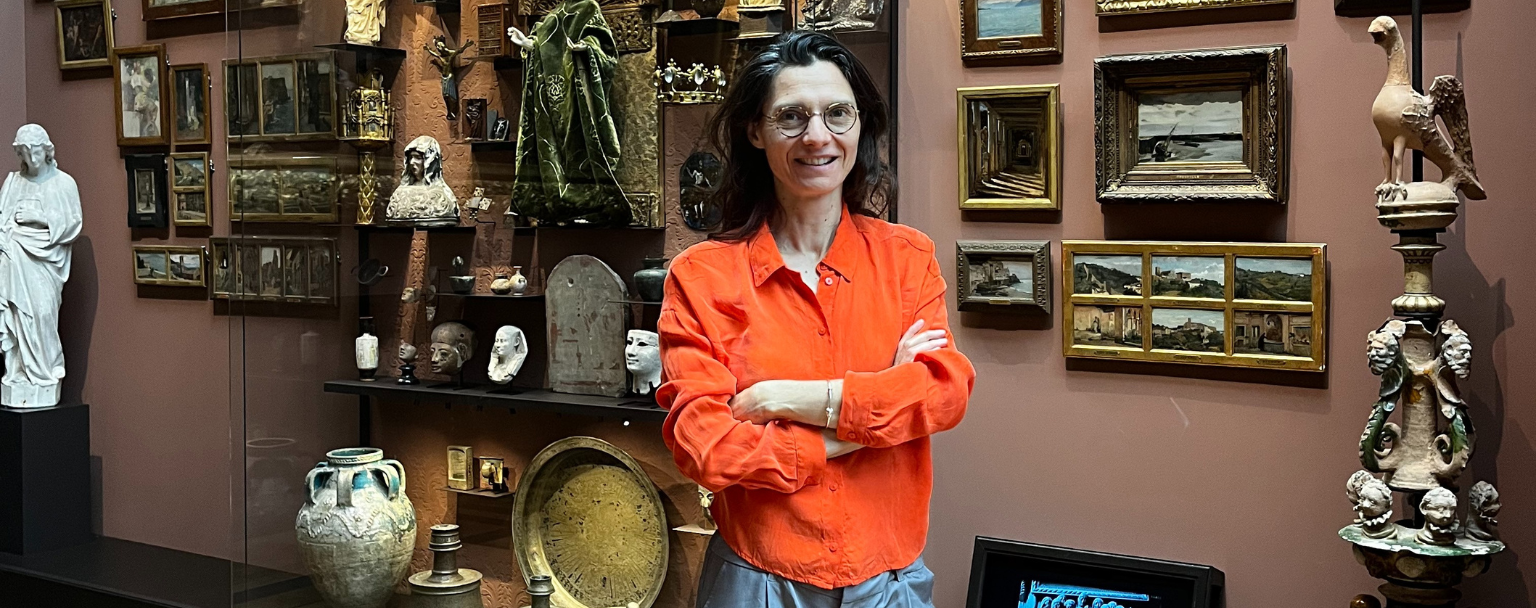
magazine Art mag ; photo de lise terjman devant le leg de Maignan Larivière au Musée de Picardie

Artist and researcher Lise Terdjman brings Louise Maignan-Larivière back to life through a journey combining drawing, ceramics, textiles, video and archives — on view from 26 August 2025 to 4 January 2026 at the Musée de Picardie in Amiens.

Why “Très chère Louise” ?

Très chère Louise, here is the dream and the fiction of your exhibition… Wherever there is a gap, there is always the possibility of fiction.” From the outset, the artist states her method: to fill the blanks of history with a poetic and critical gesture, so that Louise appears at the heart of the museum rather than at its margins.

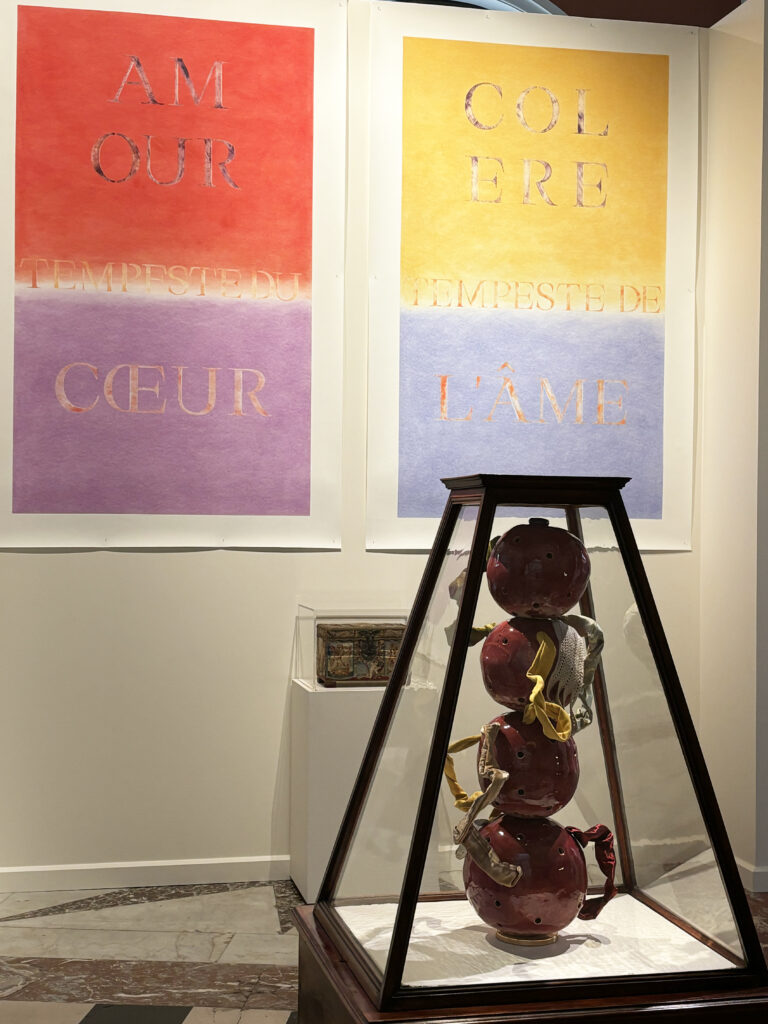
Two large typographic pastels (AM-OUR; COL-ÈRE, “Tempeste du cœur / de l’âme”) converse with the ceramic sculpture L’Énigme de Louise, bound with ribbons and shown in a pyramidal display case; in the background, an embroidered casket. Lise Terdjman’s exhibition Dearest Louise at the Musée de Picardie, Amiens (2025–2026).
AM-OUR and COL-ÈRE, L’Énigme de Louise, pastel, ceramic, Lise Terdjman © ADAGP, 2025

An embroidered casket as the catalyst

It all starts with a small embroidered casket, delicate and vividly colored, attributed to Louise Maignan-Larivière and shown at the Salon des artistes français in 1902. It bears the words: “Tempeste, bourasque, tourmente, par vertus sont faites clémentes.” This intimate fragment, turned emotional compass, inspires the large drawings AM-OUR and COL-ÈRE and nourishes the entire project.

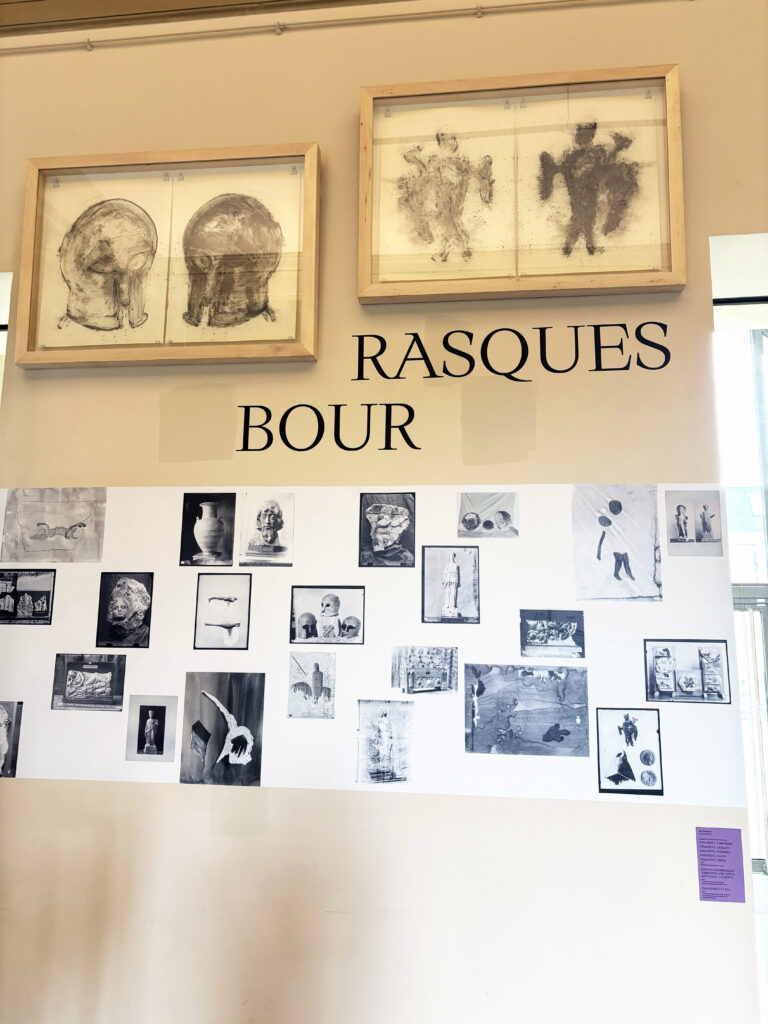
Black-and-white collage of archival images with two framed drawings of heads and figures above; partial wall typography. Exhibition Très chère Louise by Lise Terdjman, Musée de Picardie (26 Aug 2025 – 4 Jan 2026).
Hallucinating the Bequest, wall installation, © Lise Terdjman, ADAGP, 2025

A three-room itinerary, around thirty works

Drawing—“at the core of the practice,” as the artist puts it—structures an installation pathway across three rooms, with around thirty works in dialogue. The “intense, powdery” pastels—imagined echoes of Louise’s lost works—are joined by a video animating drawings and photographs, a sound piece, an image wall at the entrance, and a ceramic-and-textile sculpture, L’Énigme de Louise, suspended inside a pyramidal display case. These are “open” forms that make room for shadow, absence, and fragment.

Repairing the museum narrative

Beyond homage, the exhibition offers a critical look at museography. In the 1980s, the Maignan-Larivière collections were broken up according to an encyclopedic logic (classified by periods and disciplines), erasing the original harmony conceived by Louise. Terdjman’s project reassembles the objects “according to sensitive affinities,” breathing new life into the bequest within the museum space.

Louise as a full presence

Lise erdjman wants Louise to become familiar, “just like Albert Maignan”—not a frozen heroine, but an active presence whose spatial thinking (hanging, colors, display cases) shaped the gallery at the Musée de Picardie alongside Albert Roze, then the museum’s director.

Lise Terdjman

Who is Lise Terdjman?

A visual artist trained at the Beaux-Arts de Paris and the École des Arts Décoratifs, Lise Terdjman works across disciplines (drawing, ceramics, photography, installation, archives) to explore forgotten narratives and erased female figures. She exhibits in France and internationally (Centre Pompidou, Louvre, Carlsberg Foundation, POUSH) and teaches at ESAD Reims.

Practical information

  • Dates: 26 August 2025 → 4 January 2026
  • Venue: Musée de Picardie, Amiens

FAQ

Who is Louise Maignan-Larivière?
Wife of Albert Maignan, embroiderer and draughtswoman, she played a major role in establishing the Maignan bequest and arranging the Musée de Picardie gallery (hanging, colors, display cases).

Why the title “Très chère Louise”?
The title comes from a posthumous letter addressed by Lise Terdjman to Louise, embracing the share of fiction needed to fill history’s silences.

What is the source object of the exhibition?
An embroidered casket attributed to Louise, presented in 1902 at the Salon des artistes français, whose proverb about emotions guided the creation.

What will visitors actually see?
A three-room itinerary with around thirty pieces: large drawings, a suspended ceramic piece, video, a sound work, and an image wall—open forms that leave space for the fragment.

To read more, download ART MAG N°28
Categories
Calendar - International - Painting

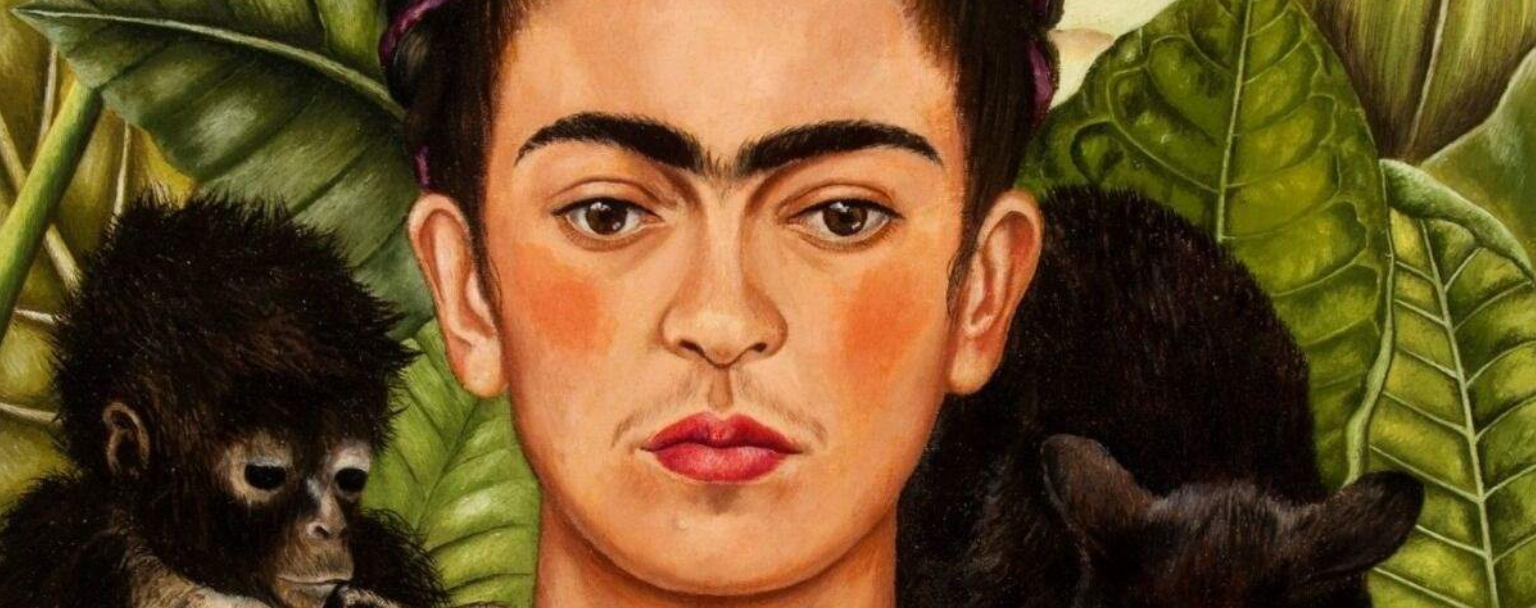
Frida Kahlo at Tate Modern (London) — 25 June 2026 → 3 January 2027

peinture de frida Kalho autoportrait exposé au tate Moderne Londre

Tate Modern presents a major event : Frida: The Making of an Icon. Over 130 works—including key paintings—plus photographs, documents and personal items illuminate how a modern artist became a global icon, shown in dialogue with 80+ artists across generations.

Why go ?

  • A critical journey through the “making” of Frida’s image: landmark paintings, photographs, documents and personal objects.
  • A wider cultural lens with works by contemporaries and artists inspired by Kahlo, mapping her lasting influence.

Practical info

  • Dates: 25 June 2026 → 3 January 2027
  • Venue: Tate Modern, Bankside, London
  • Organisers & supporters: Museum of Fine Arts, Houston, in collaboration with Tate Modern.
  • Lead Global Supporter: Bank of America, with support from John J. Studzinski, CBE, the Frida patron circle and Tate Members.
FAQ

What are the exhibition dates?
25 June 2026 to 3 January 2027.

Where is it held?
At Tate Modern, Bankside, London (UK).

What will I see?
More than 130 works by Frida Kahlo (including key paintings) plus documents, photographs and mementos from her archives, shown alongside works by 80+ artists.

Who organises and supports the show ?
Organised by the Museum of Fine Arts, Houston (MFAH) in collaboration with Tate Modern. Bank of America is Lead Global Supporter, with support from John J. Studzinski, CBE, the Frida patron circle and Tate Members.

Is this part of a tour ?
Yes. It debuts at MFAH (Houston) before travelling to London.

How do I book tickets ?
Book directly on the Tate Modern website (advance booking recommended).

Do Tate Members get benefits ?
Yes. Tate Members enjoy free, unlimited exhibition entry.

Is there a youth offer ?
Ages 16–25 can join Tate Collective for £5 tickets on many shows.

Nearest Tube stations ?
Southwark (Jubilee line) and Blackfriars.

How long should I allow for a visit ?
60–90 minutes for a first pass; up to 2 hours if you explore the archive sections in depth.