
Categories
Featured Artist - International - Sculpture

Julien Magic: When Magic Becomes Contemporary Art

julien magic publié Magazine Art Mag

From urban illusion to international museums, the portrait of an artist who unsettles reality

Globally followed magician Julien Dauphin, performing under the name Julien Magic, has crossed a decisive threshold into the world of contemporary art.
Blending urban illusion, radical installations, and political surrealism, the Franco-Swedish artist transforms magic into a fully-fledged visual language. This is the portrait of a creator who makes reality waver in order to question it.

When illusion becomes a tool for thought

When a magician enters the field of contemporary art, one might expect a simple transfer of spectacle. With Julien Magic( Julien Dauphin), the opposite occurs.
Illusion ceases to be an effect and becomes a conceptual instrument.

Based between the French Riviera and Stockholm, the artist spent more than thirty years performing on stages around the world, from Hollywood to Shanghai. From the outset, however, he distanced himself from traditional magic, favoring silence over technical display and unsettling images over demonstrative tricks.

His viral videos—a headless man in the subway, a reader seated in midair, a body drifting through the city as if detached from itself—already revealed a singular visual grammar. Through these images, Julien Magic explores our capacity for wonder, but also our collective blind spots.
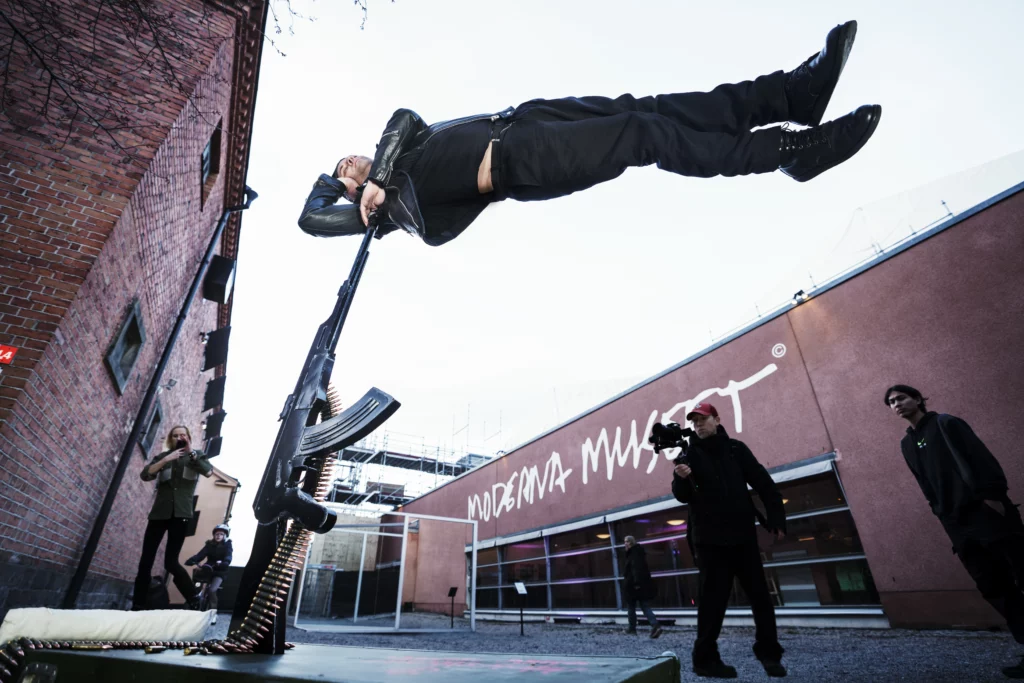
Moderna Museet (Stockholm) Photo Filip Agoo

The artistic shift: from the street to the museum

The decisive turning point came when Moderna Museet, one of Europe’s leading contemporary art institutions, invited Julien Magic to produce an installation as part of its exploration of performative and conceptual practices.

He responded with a radical gesture:
sleeping in suspension, his head resting on a Kalashnikov.

The image is both brutal and fragile. It confronts violence with surrender, innocence with war, intimacy with politics. The aesthetic shock was immediate. Audiences gathered. Cameras followed.

At that moment, the artist understood that illusion—stripped of spectacle—could become a critical tool, capable of revealing the anxieties and contradictions of our time.

A surrealism rooted in reality

In his drawings, early sculptures, and installations, Julien Magic (Julien Dauphin) develops a visual language deeply anchored in contemporary art: anonymous bodies, diverted objects, impossible situations.

Yet his surrealism is not dreamlike.
It is social and political.

He addresses climate crisis, systemic violence, and the manipulation of images. His work does not aim to deceive the viewer, but to reveal. As he states:
“Illusion is not a lie. It is a way of showing what reality prefers to hide.”

An artist of the present moment

What defines Julien Magic is his ability to move freely between worlds that seem fundamentally opposed.

  • In the streets, he confronts illusion with raw everyday life, anchoring his gestures in the unpredictability of passersby.
  • On stage, he deepens his exploration of the body and the gaze, détourning the codes of performance.
  • On social media, where he reaches more than 19 million followers, he turns platforms into real-time laboratories of perception.
  • In museums, his work gains conceptual density, asserting illusion as both a poetic and critical medium.

He belongs to a generation of artists for whom digital platforms are not a threat to artistic legitimacy, but a natural extension of vision and practice.

Toward a new chapter

His upcoming works—currently in preparation for international institutions—extend more than a decade of previously unseen sketches. They reveal an artist in full transformation, driven by a renewed urgency:
to turn wonder into a form of engagement.

Julien Magic no longer simply creates illusion.
He creates meaning.

And that may be his truest form of magic.

FAQ

Who is Julien Magic (Julien Dauphin) ?

Julien Magic is a Franco-Swedish contemporary artist known for transforming magic and illusion into a critical visual language. After more than thirty years on international stages, he now develops installations, performances, and artworks within the field of contemporary art.


Is Julien Magic (Julien Dauphin) a magician or a contemporary artist?

He is both. Julien Magic uses the tools of magic—illusion, disappearance, visual disruption—not for entertainment, but as conceptual instruments. His practice is firmly rooted in contemporary art, where illusion becomes a way to question perception, power, and reality.


What makes Julien Magic different from traditional magicians?

Unlike traditional magicians, Julien Magic avoids spectacle and technical demonstration. He favors:
– silence over explanation,
– unsettling images over virtuosity,
– reflection over surprise.
His work aligns more closely with performance art and conceptual practices than with classical magic.


What is urban illusion in Julien Magic’s work?

Urban illusion refers to interventions staged in public spaces—streets, subways, cityscapes—where illusion collides with everyday reality. These works confront passersby directly, turning the city into both stage and subject.


Has Julien Magic (Julien Dauphin) exhibited in museums?

Yes. A key turning point came when the Moderna Museet invited him to create an installation as part of its contemporary performance program. This marked his formal entry into the institutional art world.


What themes does Julien Magic explore?

His work addresses major contemporary issues, including:
– perception and the manipulation of images,
– social and political violence,
– climate anxiety,
– the limits of visibility and representation.
Illusion is used not to deceive, but to reveal hidden tensions.


Is his work connected to surrealism?

Yes, but to a realist, social form of surrealism. His works present impossible situations grounded in everyday life, producing discomfort rather than dreamlike escape.


What role do social media play in his practice?

Social media function as experimental platforms. With more than 19 million followers worldwide, Julien Magic observes how images circulate, are interpreted, and lose or gain meaning—making digital space an extension of his artistic research.


Where can Julien Magic’s work be seen today?

His work exists across multiple contexts:
– public space,
– live performance,
– digital platforms,
– and contemporary art institutions.
New projects and exhibitions are currently in development internationally.


Why is Julien Magic (Julien Dauphin) considered a contemporary artist?

Because his practice goes beyond illusion as spectacle. He uses illusion to produce meaning, challenge perception, and engage critically with the present moment—placing his work squarely within contemporary art discourse.
To read more, download ART MAG N°30
Categories
News - Painting - Paris

Don’t miss the 3 key exhibitions of the Petit Palais

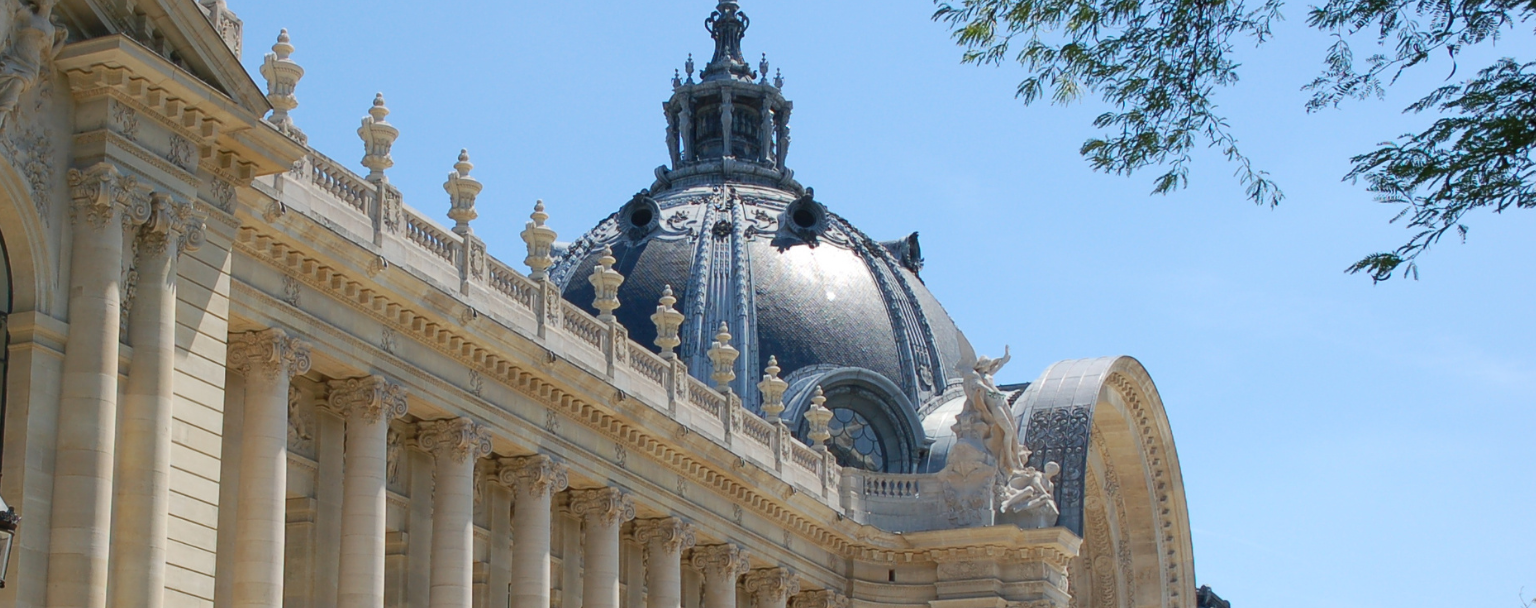
Facade of the Petit Palais in Paris, with its monumental columns and ornate dome, under a blue sky.
typhoonski de Getty Images

Le Petit Palais, the City of Paris’ Museum of Fine Arts, currently offers an exceptional journey through three major exhibitions, ranging from the 18th century to contemporary creation.
Classical painting, a modern look at the city and immersion in Nordic landscapes: these exhibitions offer a rare artistic diversity, to discover without delay.

Jean-Baptiste Greuze – Childhood in light

Until January 25, 2026

Essential painter of the 18th century, Jean-Baptiste Greuze (1725–1805) places emotion and morality at the heart of his work.

Childhood, family scenes and domestic dramas become the subjects of a deeply expressive painting.

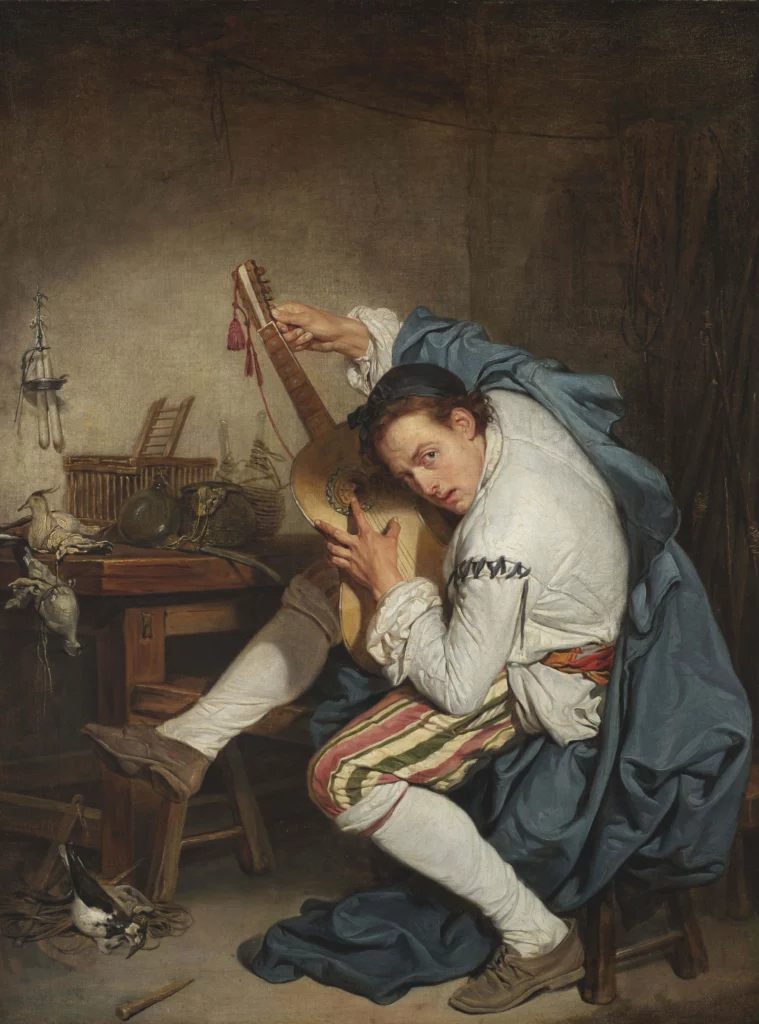
Painting by Jean-Baptiste Greuze depicting a young man sitting inside, holding a mandolin against him, in an intimate 18th century scene with moral and sentimental accents.
Jean-Baptiste Greuze, L’Oiseleur tuning his guitar., 1757.Huile sur toile, 62 × 48 cm.
Varsovie, National Museum© Varsovie National Museum / photo Krzysztof Wilczyński.

Looks, gestures, attitudes: each detail participates in a narrative full of meaning. The exhibition highlights a work that oscillates between genre painting and history painting, announcing a new sensitivity in European art.

A moving dive into the intimacy and values of the Enlightenment.

Bilal Hamdad – Paname

Until February 8, 2026

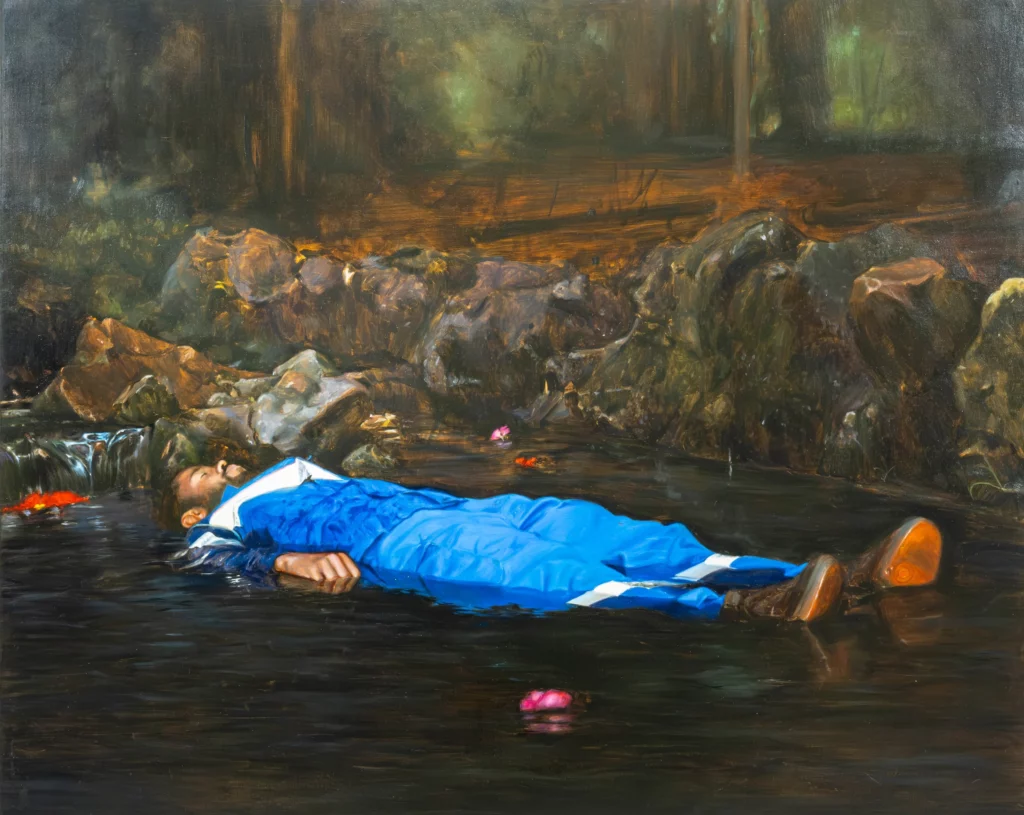
With Paname, Bilal Hamdad invests the Petit Palais with a resolutely contemporary painting.

From photographs taken on the spot, the artist composes large urban scenes: cafes, streets, subways, silent crowds.

Contemporary painting by Bilal Hamdad depicting a man lying in a stream, dressed in a bright blue, floating motionless in a dark and silent natural landscape.
Bilal Hamdad, Lost Night, 2023.Oil on canvas, 160 200 x 4,5 cm.François Schneider Foundation. © Fondation François Schneider – Wattwiller, photo Steeve Constanty © Adagp, Paris, 2025

His paintings, marked by a controlled chiaroscuro and tight framing, give to see a dense but introspective Paris, where solitude persists in the heart of the crowd. Nourished by the history of art, his painting affirms the relevance of the figurative today.

A sensitive and current look at the city and its inhabitants.

Pekka Halonen – An Anthem to Finland

Until February 22, 2026

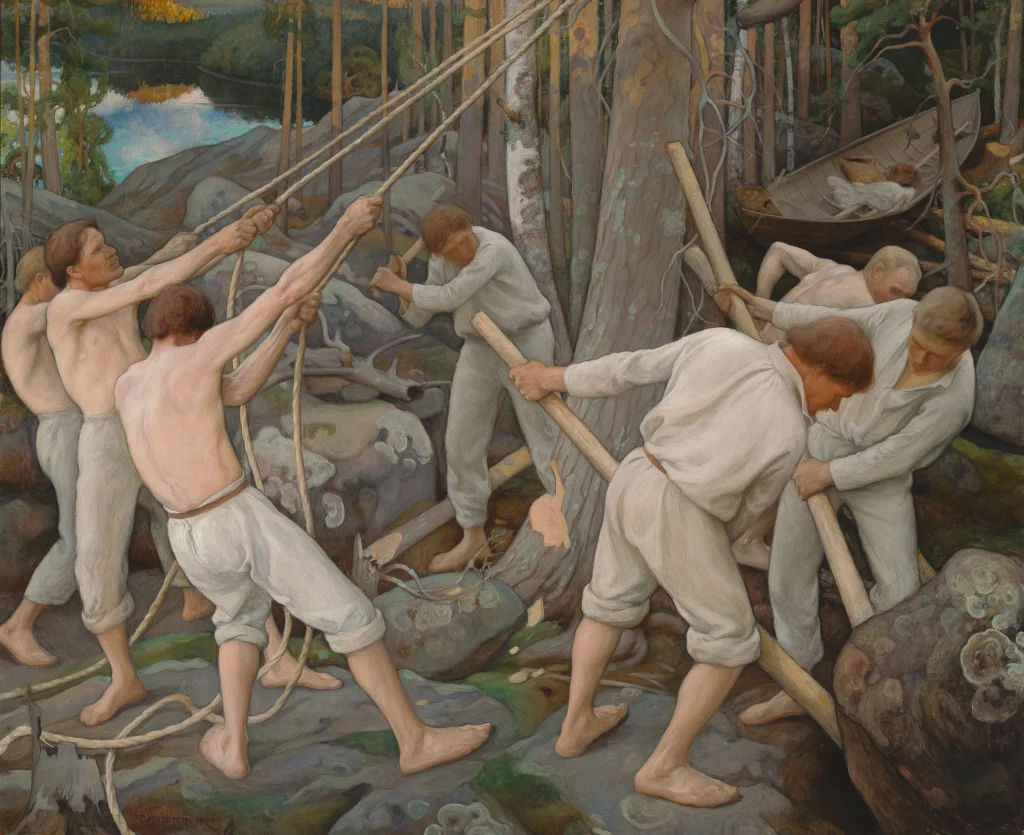
Major figure of the golden age of Finnish painting, Pekka Halonen (1865–1933) dedicates his work to Nordic nature.

Snowy forests, frozen rivers and rural scenes compose a painting of silence and long time.

Painting by Pekka Halonen showing lumberjacks working together in the forest, cutting down a tree using long poles, in a northern landscape with soft and naturalistic tones.
Pekka Halonen, Pioneers in Karelia, 1900.Oil on canvas, 200 237 cm.
Helsinki, art museum Ateneum. © Finnish National Gallery/ Aleks Talve

Through a subtle mastery of light and colour, Halonen transforms snow into real pictorial material. The exhibition highlights a deep relationship between man and his environment, imbued with contemplation and sobriety.

A poetic immersion in the landscapes of the North, between realism and spirituality.

Why visit these three exhibitions at the Petit Palais?

  • Three major epochs of art history
  • A dialogue between classical and contemporary painting
  • Programming accessible to the general public as well as art lovers
  • An exceptional heritage setting, in the heart of Paris

See also :

Support independent publishing! Subscribe to ART MAG and receive each issue in advance, in both print and digital format

👉Subcribe 6 issues / 1 year 

👉Offer ART MAG

FAQ

What are the exhibitions to see currently at the Petit Palais?

Le Petit Palais currently presents three exhibitions: Pekka Halonen, Bilal Hamdad – Paname and Jean-Baptiste Greuze.

Until when can we visit these exhibitions?

The exhibitions are visible between January and February 2026, according to the artists: Greuze until January 25, Hamdad until February 8, and Halonen until February 22, 2026.

Are these exhibitions suitable for the general public?

Yes. The courses are educational, accessible and designed for a wide audience, while offering in-depth reading for art lovers.

Is Le Petit Palais free?

The permanent collections are free. Temporary exhibitions can be paid according to the programming.

Categories
Calendar - News - Painting - Paris

Pekka Halonen at the Petit Palais: An Immersion into the Soul of Finland

pekka halonen exposition au Petit Palais article magazine Art mag
Finnish National Gallery / Aleks Talve

From 4 November 2025 to 22 February 2026, the Petit Palais – Museum of Fine Arts of the City of Paris presents the first French retrospective devoted to Pekka Halonen (1865–1933).

Entitled Pekka Halonen. A Hymn to Finland, this exceptional exhibition, organized in partnership with the Ateneum Art Museum – Finnish National Gallery (Helsinki), brings together more than 130 works from Finnish public and private collections.

👉 A rare immersion at the heart of the golden age of Finnish painting, amid snow, silence, and the quest for identity.

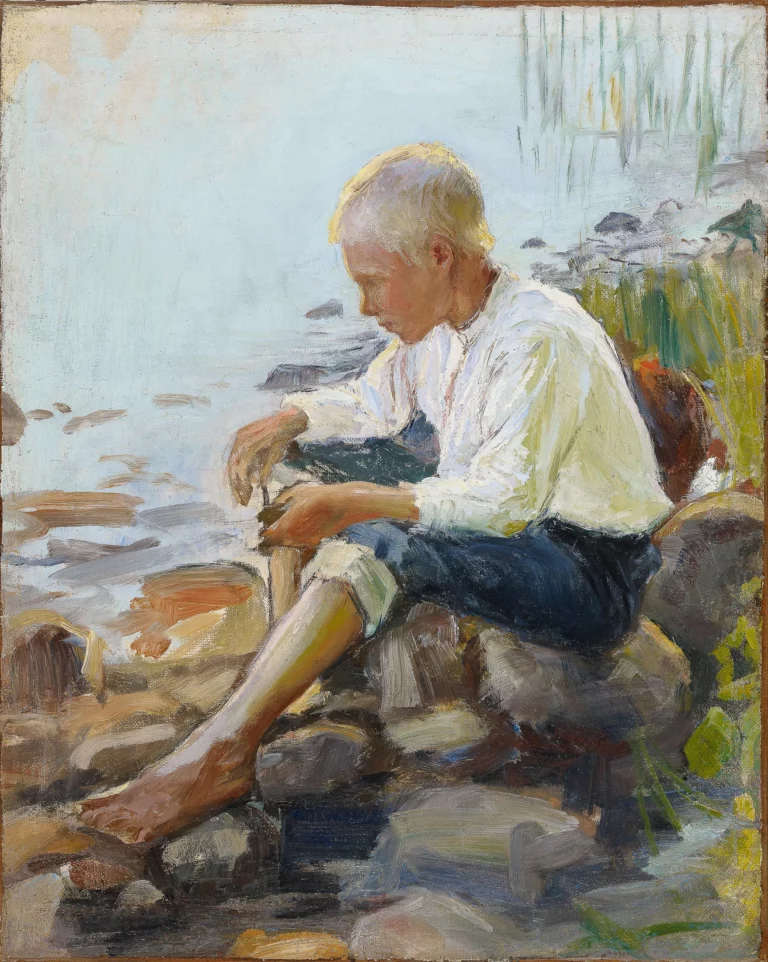
Pekka Halonen, Young Boy on the Shore, 1891–1893. Oil on canvas, 45 × 36.5 cm.
Helsinki, Ateneum Art Museum (on deposit at the Presidential Palace). © Finnish National Gallery / Hannu Pakarinen

Painting Finland: art, resistance, and modernity

At the dawn of the 20th century, Finland was under Russian rule. In this tense political context, painting became a cultural and symbolic act.

Halonen’s work is rooted in National Romanticism and Karelianism, movements that celebrate landscapes, rural traditions, and founding myths.
His participation in the Paris World’s Fair, within the Finnish pavilion, marked a turning point: painting as a manifesto of identity.

👉 Deep forests, frozen lakes, peasant scenes: each canvas becomes a fragment of collective memory.

Support independent publishing! Subscribe to ART MAG and receive each issue in advance, in both print and digital format
👉 Subcribe 6 issues / 1 year

Painting Finland, between identity and modernity

Pekka Halonen’s work belongs to the lineage of National Romanticism and Karelianism, artistic movements that exalt Finnish landscapes and traditions against a backdrop of political tension with Russian rule.

In 1900, his participation in the Paris World’s Fair, within the Finnish pavilion, took on major symbolic significance for the affirmation of Finnish national identity.

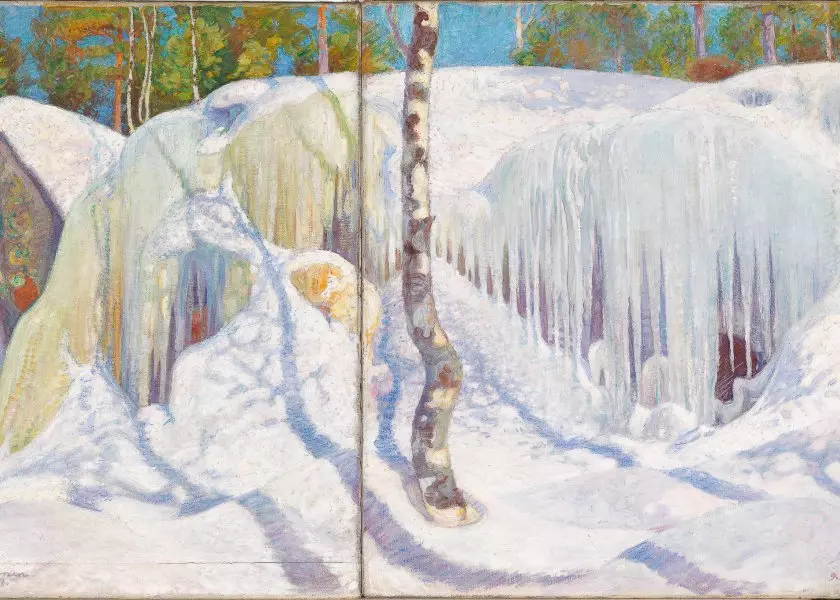
Pekka Halonen, Rocks Covered with Ice and Snow, 1911. Oil on canvas, 96 × 155.5 cm. Helsinki, Ateneum Art Museum. © Finnish National Gallery / Aleks Talve

His paintings thus became true visual manifestos, celebrating wild nature, rural life, and the cultural resistance of a people.

Pekka Halonen, Tomatoes, 1913. Oil on cardboard, 51 × 42 cm. Helsinki, Ateneum Art Museum. © Finnish National Gallery / Jenni Nurminen

Halosenniemi: living and painting in harmony with nature

Far from the bustle of Paris, Pekka Halonen chose to settle in Tuusula, on the shores of a lake. There he built Halosenniemi, his wooden house-studio, now a mythical site of Finnish culture.

In this self-sufficient environment, surrounded by his family and fellow artists, Halonen developed a philosophy of life in harmony with nature, which profoundly permeates his work.

Pekka Halonen, Winter Landscape, Myllykylä, 1896. Oil on canvas, 69 × 48 cm.
Helsinki, Ateneum Art Museum. © Finnish National Gallery / Aleks Talve

👉 Here, painting becomes an extension of everyday life, a breathing rhythm shaped by the seasons.

The painter of snow: a symphony in white

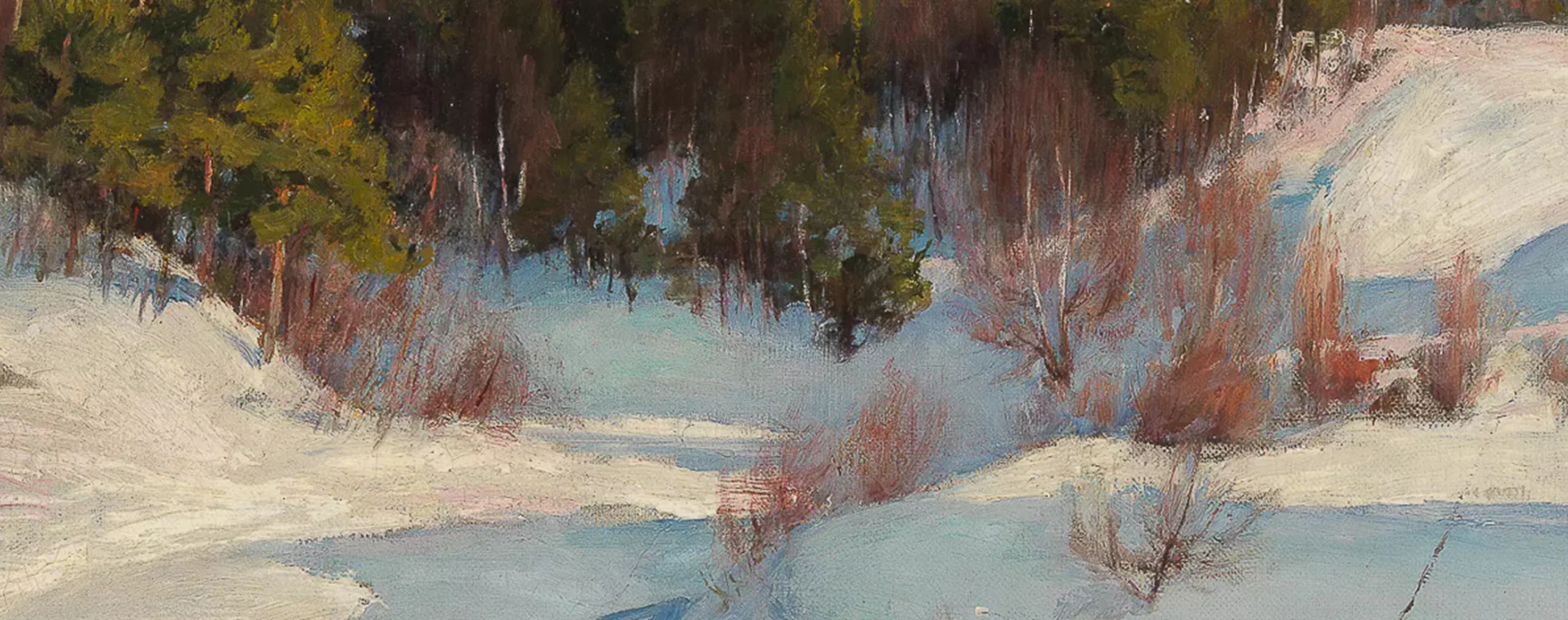
If one word were to sum up Pekka Halonen, it would be snow.

No other Finnish painter explored with such finesse:

  • the nuances of white
  • winter light
  • the silence of snow-covered landscapes

In the 1920s, some works verge on abstraction, heralding a striking modernity.

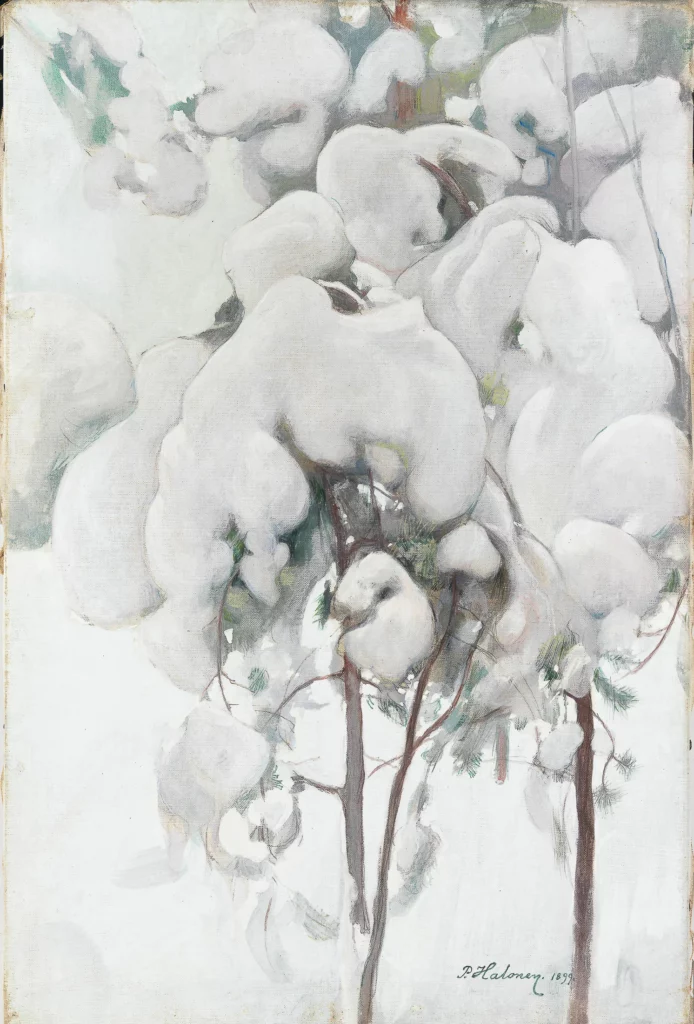
Pekka Halonen, Snow-Covered Young Pines, 1899. Tempera on canvas, 44.5 × 29.5 cm.
Helsinki, Ateneum Art Museum. © Finnish National Gallery / Yehia Eweis

🔹 The final section of the exhibition, Symphony in White Major, offers a rare contemplative experience, where the gaze slows, becoming almost meditative.

An immersive and sensory exhibition at the Petit Palais

More than a retrospective, the Petit Palais offers a truly sensory experience:

  • a refined, architecturally structured scenography
  • olfactory installations developed with dsm-firmenich
  • a meditative route inspired by Finnish nature

👉 A resolutely contemporary approach, bringing ecology, art, and perception into dialogue.

Support independent publishing! Subscribe to ART MAG and receive each issue in advance, in both print and digital format
👉 Subcribe 6 issues / 1 year

Categories
Edito - News

ART MAG #30 Editorial : Contemporary Art, the Art Market & Artwork Transmission

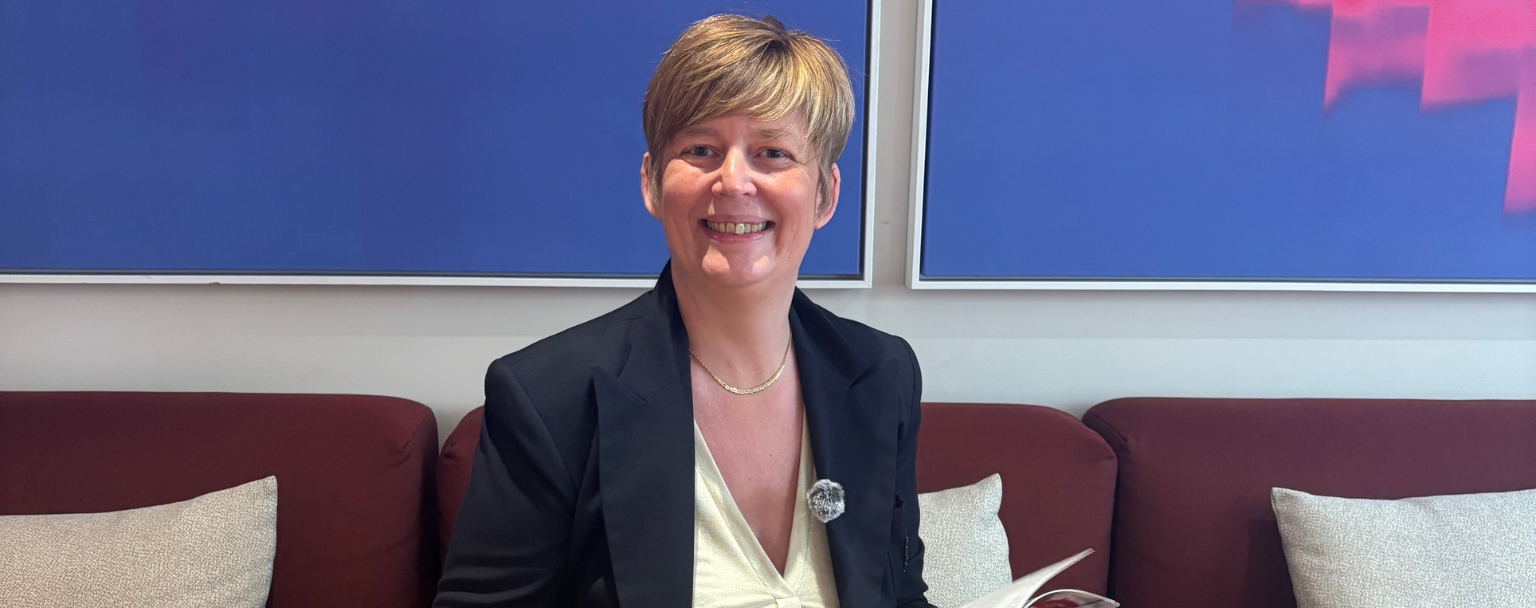
Delphine Jonckheere _ art mag EDITO

Looking at Art Today: Between Gaze, Trust, and Transmission

Looking at a contemporary artwork is never a purely aesthetic act. It means entering a story, understanding a gesture, and placing trust in an artist, a perspective, and an entire ecosystem. At a time when the contemporary art market is undergoing profound transformation—driven by new technologies, globalization, and questions of traceability—the way we look at art has become a central issue.

With this 30th issue, ART MAG, an independent contemporary art magazine, explores a fundamental question:
how do we look at, collect, and pass on art today?

👉 Order ART MAG #30

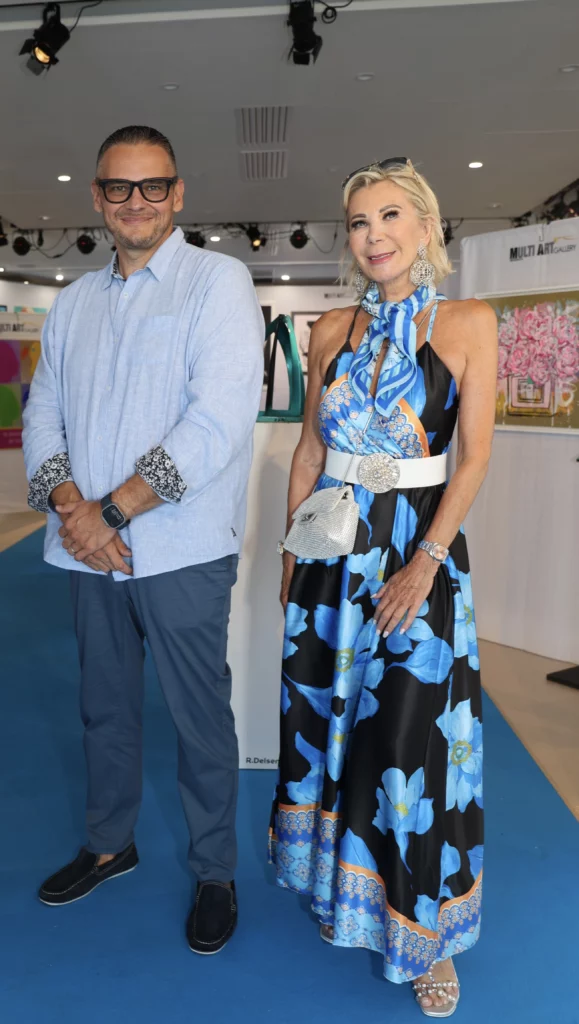
Chris The Art Agent and Wendy Lauwers – photo by Patrick Deguine

Contemporary Art and New Players in the Art Market

The cover of this issue highlights Chris The Art Agent and Wendy Lauwers, an emblematic duo embodying the new dynamics of the contemporary art market.

Chris The Art Agent acts as a trusted intermediary between artists and collectors. A specialist in artwork certification through blockchain technology, he supports artists in protecting, ensuring the traceability, and enhancing the value of their works in the digital age—without ever betraying their soul.

Alongside him, Wendy Lauwers, founder of Multi Art Gallery Monaco, develops a deeply human vision of the role of the contemporary art gallery. Through exhibition curation, artist support, and a sensitive relationship with collectors, she builds coherent, demanding, and international artistic scenes—from Monaco to Dubai, from Miami to the French Riviera.

Together, they are redefining the contours of a more transparent, secure, and human-centered art market.

👉 Order ART MAG #30

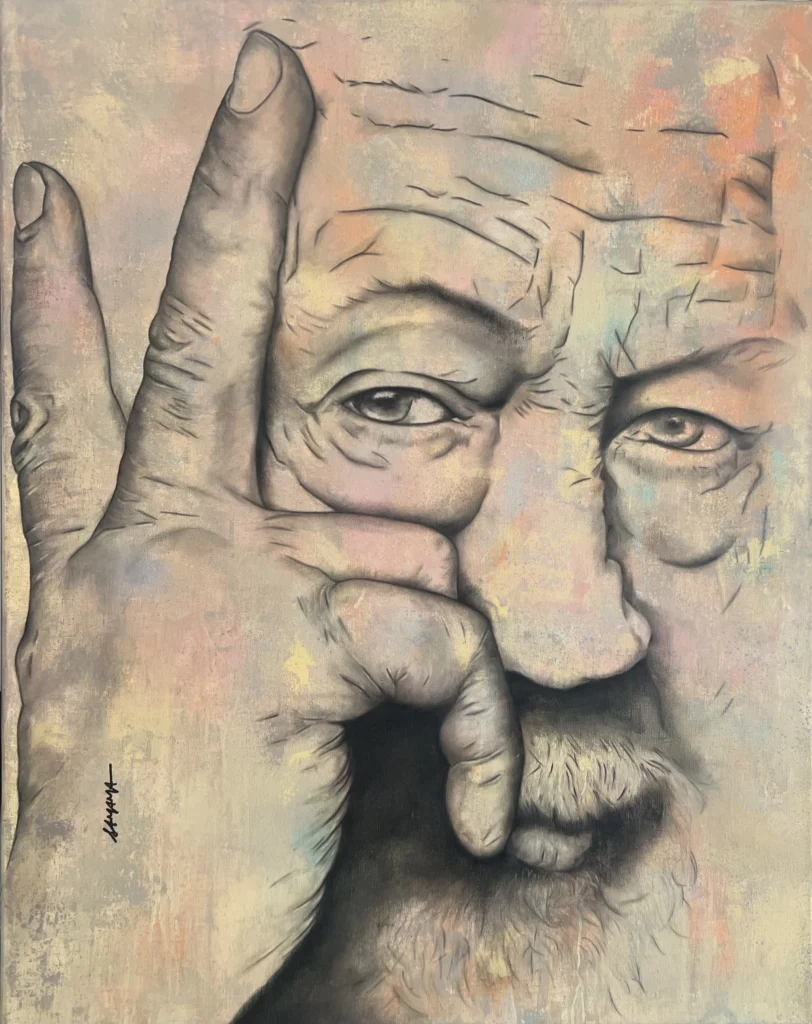
Contemporary figurative painting by Frédérique Samama, close-up male portrait with a hand partially covering the face, expressing contemplation, mixed media technique using oil, acrylic, and black stone, original artwork.
Artist: Frédérique Samama – ContemplationOil, acrylic and black stone – 92 × 73 cm

Contemporary Artists: Creating, Exhibiting, Transmitting

Around this duo revolves a generation of contemporary artists whose works question perception and memory: Willfreed, Frédérique Samama, Julien Magic, Flo Muliardo, Angélique Patte, Dominique Gautier, Sonia Souissi, and Dannie Launay.

Painting, photography, textile art, installation, visual illusion, digital art—these diverse practices all share the same ambition: to make art a living language, rooted in its time.

👉 Order ART MAG #30

© TommL / Canva

Artwork Transmission and Artistic Legacy

The central feature, “Inheriting the Gaze: Art and What Comes After?”, extends this reflection by addressing a key issue for art collectors: the transmission of artworks and private collections.

Inheritance, taxation, donations, private foundations, museum dations, as well as family conflicts or ethical choices—passing on an artwork means transmitting far more than an object. It means passing on a vision, a perspective, and a responsibility.

In this context, artwork certification, traceability, and collector support have become major challenges within the contemporary art market—issues that lie at the very heart of Chris The Art Agent’s work.

👉 Order ART MAG #30

ART MAG: A Committed Contemporary Art Magazine

Through its editorials, artist portraits, market investigations, and exhibition agenda, ART MAG asserts a clear editorial stance:

contemporary art exists only when it circulates, is protected, and is transmitted.

Whether exhibited in a gallery, presented at an international fair, certified through new technologies, or entrusted to a future generation, art remains above all a human, sensitive, and living language.

Looking at Art Is Already a Form of Transmission

This issue of ART MAG invites artists, collectors, and art lovers to rethink their relationship with artworks, the market, and the notion of transmission.

Enjoy reading.

👉 Order ART MAG #30

Read more : Julien Magic: When Magic Becomes Contemporary Art

❓ Frequently Asked Questions – Art Mag

What is Art Mag?

Art Mag is an independent magazine dedicated to contemporary art, the art market, and its key players: artists, collectors, gallerists, and cultural institutions.


Who is Art Mag for?

Art Mag is aimed at art lovers, collectors, art professionals, and anyone wishing to discover or deepen their understanding of contemporary art.


How often is Art Mag published?

Art Mag is a bimonthly magazine, featuring themed issues with in-depth features, interviews, and art news.


What topics does the magazine cover?

The magazine explores in particular:
– contemporary and modern art
– the art market and collecting
– featured artists
– exhibitions and cultural institutions
– the transmission and inheritance of art collections


Is Art Mag suitable for beginners in art?

Yes. Art Mag offers an accessible and educational approach while also providing in-depth content for more experienced readers.


Can artists submit their work to Art Mag?

Yes. Artists may submit their work via the Contact section of the website. Each submission is reviewed by the editorial team.


How can I follow Art Mag’s news?

You can follow Art Mag through the official website, the newsletter, and social media to stay informed about new issues and updates.

To read more, download ART MAG N°30
Categories
Calendar - News - Painting - Paris

Mickalene Thomas Exhibition at the Grand Palais – All About Love

Portrait d'une personne souriante vêtue d'une veste de costume sombre, d'une casquette noire et de grandes lunettes rectangulaires. Elle porte des bijoux en or, notamment une bague articulée et un bracelet, et pose avec une main près du visage sur un fond neutre.
Joshua Woods 2025

Presented at the Grand Palais, All About Love by Mickalene Thomas offers a layered and structured immersion into the work of one of the most influential figures in contemporary art today. Through a carefully curated selection of works, the exhibition explores questions of representation, intimacy, and the construction of the gaze within Western art history.

Rather than relying on spectacle, All About Love situates itself within a broader cultural reflection, addressing how bodies, identities, and narratives long marginalised are gradually being reintroduced into institutional spaces, while leaving room for individual interpretation.

An exhibition conceived as a narrative

ll About Love is not presented as a traditional retrospective. Instead, the exhibition unfolds as a progressive narrative, with each room responding to the previous one. Paintings, collages, photographs, and installations form a coherent visual sequence marked by bold compositions, layered textures, and a distinctive aesthetic language.

Explanatory texts are deliberately restrained. Rather than guiding visitors toward a single interpretation, the exhibition encourages attentive observation and personal engagement. This approach allows each work to function both independently and as part of a larger visual dialogue.

Representation and the question of the gaze

At the core of Mickalene Thomas’s practice lies a sustained interrogation of how certain bodies have historically been represented—or excluded—from dominant artistic narratives. In All About Love, this issue is addressed without overt didacticism, through the recurring presence of self-assured female figures who occupy the pictorial space with authority.

The exhibition subtly reverses traditional viewing dynamics: the spectator is no longer a passive observer but is confronted by works that seem to return the gaze. This sustained visual tension becomes a defining feature of the visitor’s experience.

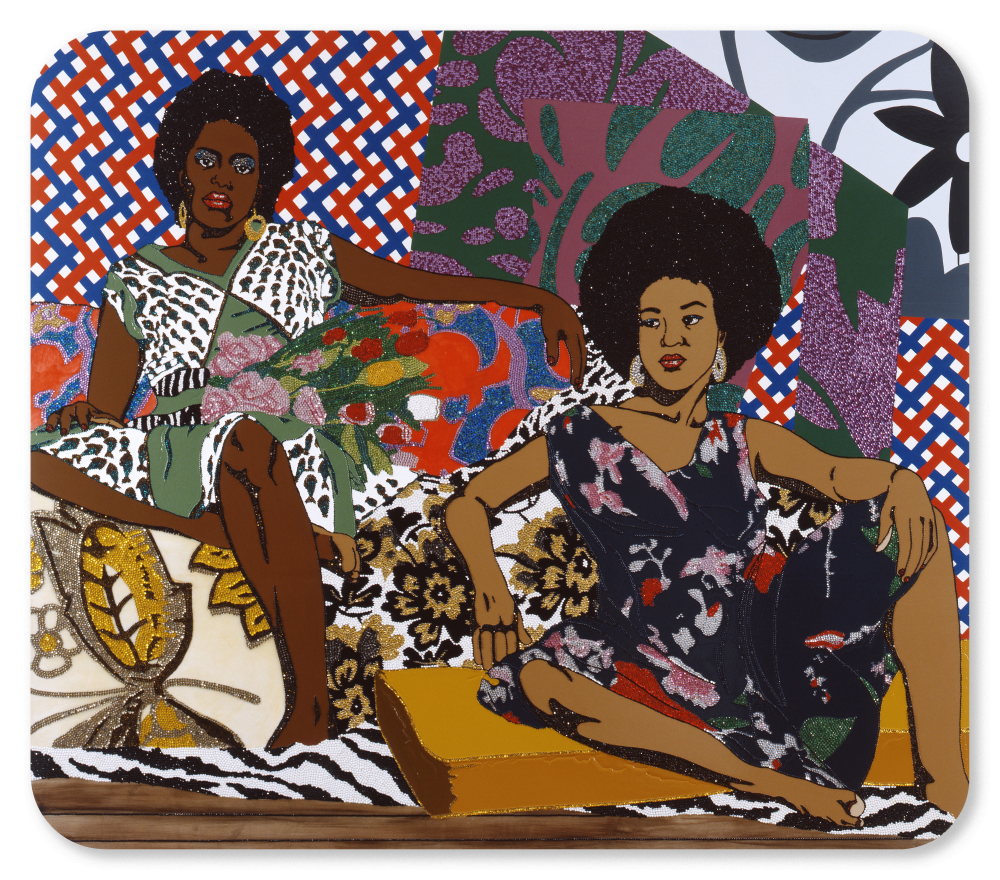
Artwork A Moment’s Pleasure #2 (2008) by Mickalene Thomas, depicting two seated women in a richly patterned interior, combining rhinestones, acrylic paint and enamel on wood panel.
A Moment’s Pleasure #2 2008 Rhinestones, acrylic paint and enamel on wood panel
182.9 × 213.4 cm © 2025 Mickalene Thomas / ADAGP, Paris

Love as a conceptual framework

The title All About Love does not refer to love as a purely sentimental or romantic notion. Instead, it functions as a conceptual framework through which relationships—to oneself, to others, and to cultural history—are examined.

In this context, love emerges as a relational space rather than an isolated emotion. The exhibition suggests that intimacy and broader social questions are not mutually exclusive, but can coexist within a single aesthetic experience.

Key works and exhibition design

Several emblematic works structure the exhibition, notably through their scale and placement within the galleries. The interplay of materials, references to art history, design, and popular culture creates multiple levels of interpretation.

In this continuity, some works assert a strong physical presence, while others invite quieter, more contemplative viewing. This alternation contributes to a balanced rhythm throughout the exhibition, preventing visual saturation and encouraging sustained attention.

An accessible exhibition without simplification

One of the notable strengths of All About Love lies in its accessibility. The exhibition does not require prior knowledge of contemporary art, yet offers multiple layers of reading for more experienced audiences.

Wall texts accompany the works without imposing fixed interpretations. This relative neutrality enhances the quality of the visitor experience by preserving interpretative freedom.

A reflection of a broader institutional evolution

Presented within a major cultural institution such as the Grand Palais, All About Love reflects a broader shift in how museums and exhibition spaces approach artistic narratives today. Without adopting an explicitly activist stance, the exhibition aligns with ongoing efforts to broaden perspectives while maintaining continuity with institutional frameworks.

In this context, it can be seen as part of a gradual evolution in cultural programming, seeking to expand representation without rupturing historical structures.

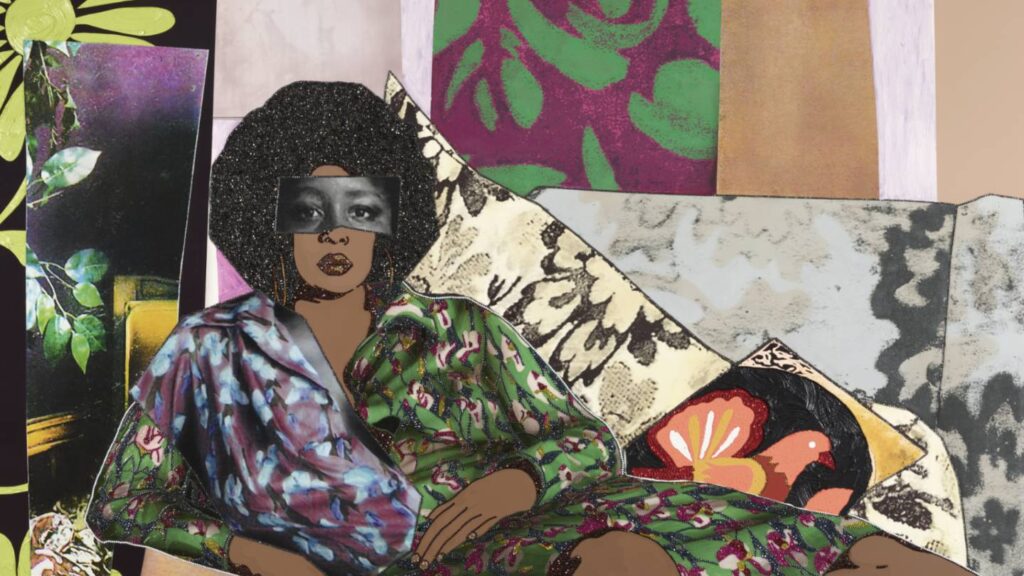
Collage-style mixed-media composition showing a seated woman with an afro, wearing a patterned green dress, reclining on a sofa surrounded by colorful pillows and layered decorative backdrops.
Afro Goddess Looking Forward 2015 Rhinestones, acrylic and oil on wood panel, 152.4 x 243.8 x 5.1 cm © 2025 Mickalene Thomas / ADAGP, Paris

Practical information

  • Venue : Grand Palais, Paris
  • Exhibition : All About LoveMickalene Thomas
  • Dates : December 17 to February 5, 2026
  • Average visit duration : Approximately 1 to 1.5 hours

Support independent publishing! Subscribe to ART MAG and receive each issue in advance, in both print and digital format
👉 Subcribe 6 issues / 1 year

FAQ

1. What is the “Mickalene Thomas – All About Love” exhibition?

It is a major exhibition dedicated to the work of American artist Mickalene Thomas, exploring love, identity, and the representation of Black women through vibrant mixed-media artworks.

2. When does the exhibition take place?

The exhibition runs from December 17, 2025 to April 5, 2026 at the Grand Palais in Paris.

3. Which artworks are featured in the exhibition?

he show includes major works such as A Moment’s Pleasure #2, Sleep: Deux femmes noires, Untitled #10, Afro Goddess Looking Forward, Guernica Detail (Resist #7), and Clarivel Face Forward Gazing.

5. Why is this exhibition significant?

Because it highlights one of the most influential voices in contemporary art, combining political, cultural, and aesthetic impact in an immersive and visually striking experience.

6. Where can visitors buy tickets?

Tickets will be available on the official Grand Palais website and through partner ticketing platforms.

Is the exhibition accessible to non-specialists?

Yes. The exhibition is designed to be approachable for general audiences while offering deeper interpretive layers for informed visitors.

Is the exhibition politically or socially engaged?

The exhibition addresses contemporary societal themes but does so through suggestion rather than prescriptive discourse.
How long should visitors plan to spend at the exhibition?

Most visitors spend between one hour and ninety minutes, depending on their level of engagement with the works.

Categories
Calendar - News - Paris

Weston & Mitchell: a century of photographic modernity reinvented at the MEP

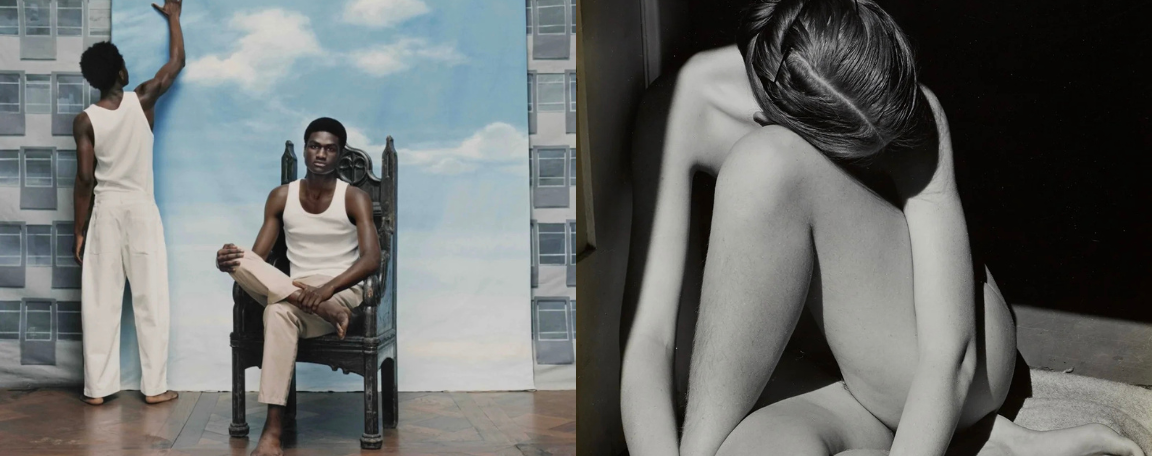
Photographic diptych: on the left, two black men in a contemporary setting by Tyler Mitchell, one seated in an armchair and the other standing in front of a painted backdrop; on the right, a black-and-white female nude photographed by Edward Weston, her body curled up in contrasting light.
© Tyler Mitchell © Center for Creative Photography

From 15 October 2025 to 25 January 2026, the Maison Européenne de la Photographie is presenting an exceptional diptych, bringing together Edward Weston and Tyler Mitchell in two parallel exhibitions.

Separated by a century but united by the same ambition to make photography a language of modernity and revelation, they embody two radically different ways of questioning reality.

The 2025 season at the MEP thus highlights, on the one hand, Weston’s seminal transition to modernism and, on the other, the emergence of a new vision championed by Mitchell, in which beauty, self-determination and black imagination unfold with force.

Edward Weston: Modernity Revealed: The Birth of a Modern Vision

The exhibition Modernity Revealed offers the most extensive presentation of Weston’s work in Paris in nearly thirty years. It brings together more than one hundred vintage prints, several of which have never been shown in France, from the Wilson Centre for Photography.

The exhibition traces his influences, his breaks with tradition and his decisive role within the f/64 group, which championed pure, unmanipulated photography.

From pictorialism to modernist rigour

The exhibition shows how Weston rapidly evolved from allegorical pictorialism to a refined style of photography based on sharpness, precision and the search for essential form.

Two iconic images, taken one year apart, bear witness to this shift:

  • M on the Black Horsehair Sofa (1921), still pictorialist,
  • Tina Modotti (Nude in Studio) (1922), strikingly modern.
Black and white photograph of a nude person sitting on a stool, facing left in a large studio. The figure, slightly bent over and holding a slender object in their hand, is positioned near a dark curtain that occupies almost the entire width of the image. The wooden floor and two other stools spaced apart complete the minimalist scene
Edward Weston, Tina Modotti (Nude in Studio), 1922 © Center for Creative Photography, Arizona Board of Regents / Edward Weston, Adagp, Paris, 2025
Courtesy Wilson Centre for Photography

Mexico: a laboratory for visual audacity

Alongside Tina Modotti, photographer and activist, Weston developed a more contrasting, immediate and daring language, fuelled by formal experimentation. His portraits, still lifes and studies of natural forms became icons of modernism.

Legendary series

The 1930s cemented his style:

  • peppers,
  • shells,
  • Charis’ nudes,
  • Point Lobos landscapes.

Weston reveals a sculptural style of photography, focused on form and light, in search of what he calls “the very essence of the thing”.

For art and photography lovers, the exhibition is one of the cultural highlights of the autumn season.

Tyler Mitchell — Wish This Was Real: Black utopia in the present

At the same time, the MEP is presenting Wish This Was Real, the first solo exhibition in France by American photographer Tyler Mitchell, born in 1995.

His multifaceted work, which includes photography, video and textiles, explores beauty, memory and freedom through luminous representations of Black people.

Mitchell, who rose to fame in 2018 after photographing Beyoncé for Vogue US, produces work in which gentleness, staging and political activism coexist harmoniously.

Lives / Freedoms: youth as a space for emancipation

His early images, influenced by skateboarding and Tumblr, depict scenes of camaraderie and freedom. They embody an everyday utopia in the face of an often hostile social context, making joy an act of self-protection.

Postcolonial / Pastoral: the earth as memory

In a reinterpretation of the pastoral landscape, Mitchell places black bodies at the centre of a romantic imagination that is nonetheless conscious of the wounds of history. His textile works amplify this symbolic gesture by introducing texture and transparency.

Family/Fraternity: Intimacy as a Living Archive

In Brooklyn, Mitchell photographs family and friends in interiors emblematic of Black American life. Following in the footsteps of Gordon Parks and Deborah Willis, he explores transmission, home, and representation as tools for anchoring identity.

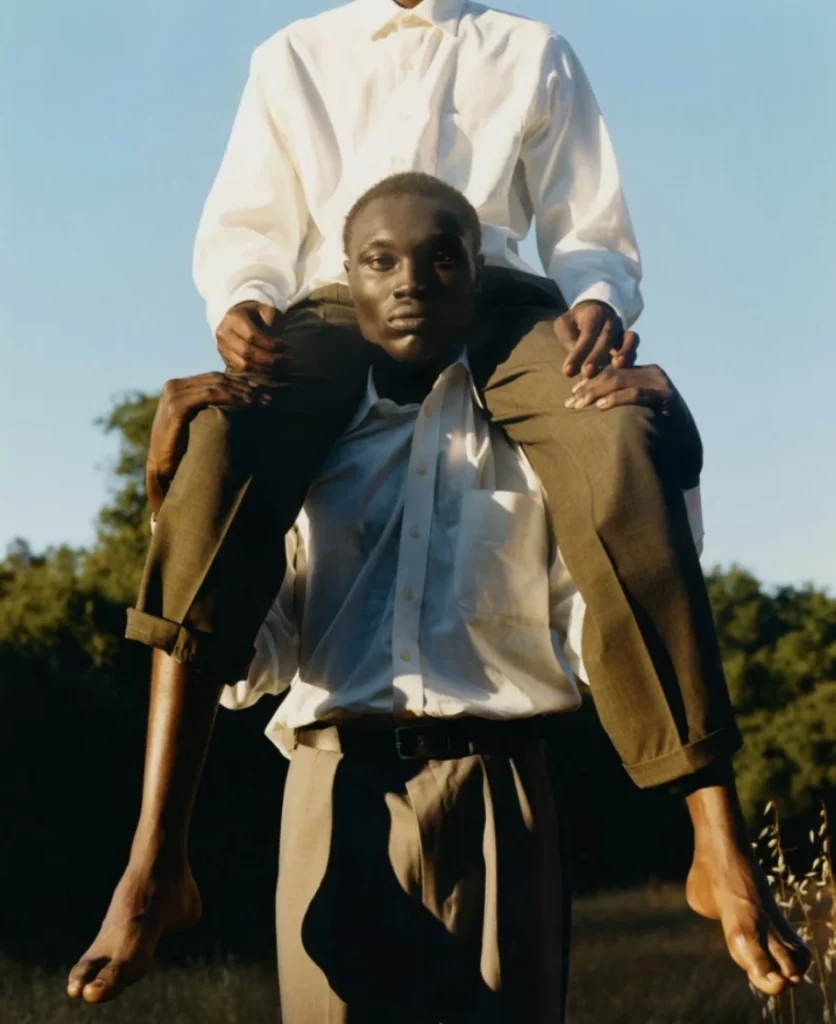
Portrait de deux hommes noirs, l’un assis sur les épaules de l’autre, dans une lumière dorée et un paysage naturel, photographie de Tyler Mitchell.
Tyler Mitchell, Untitled (Topanga II), 2017Courtesy of the artist and Gagosian ©Tyler Mitchell

An unprecedented dialogue between two visions of modernity.

By bringing Weston and Mitchell together, the MEP offers a cross-disciplinary interpretation of photography:

  • Weston reveals the world by stripping it bare,
  • Mitchell transforms reality by illuminating it.
  • One constructs modernity, the other reinvents it.
  • One works with form, the other works with the imagination.

Their works show how photography remains a field of exploration, truth and emancipation.

See also :

Support independent publishing! Subscribe to ART MAG and receive each issue in advance, in both print and digital format

👉Subcribe 6 issues / 1 year

👉Offer ART MAG

FAQ:

Why are Weston and Mitchell being exhibited together?

The MEP wants to show how photography, separated by a century, remains a language of modernity: Weston reveals form, Mitchell reinvents the imagination.

When is the exhibition on?

From 15 October 2025 to 25 January 2026 at the MEP, Paris.

What is there to see in the Weston exhibition?

Over a hundred vintage prints, including iconic images: peppers, shells, Charis, Oceano dunes, Point Lobos landscapes.

What is there to see in the Mitchell exhibition?

Luminous works exploring youth, utopia, postcolonial landscapes and family memory, as well as innovative textile pieces.

Are these exhibitions suitable for a wide audience?

Yes, the exhibitions are accessible, educational and visually striking.

Categories
Calendar - News - Painting - Paris

Georges de La Tour at the Jacquemart-André Museum: the exhibition event in Paris

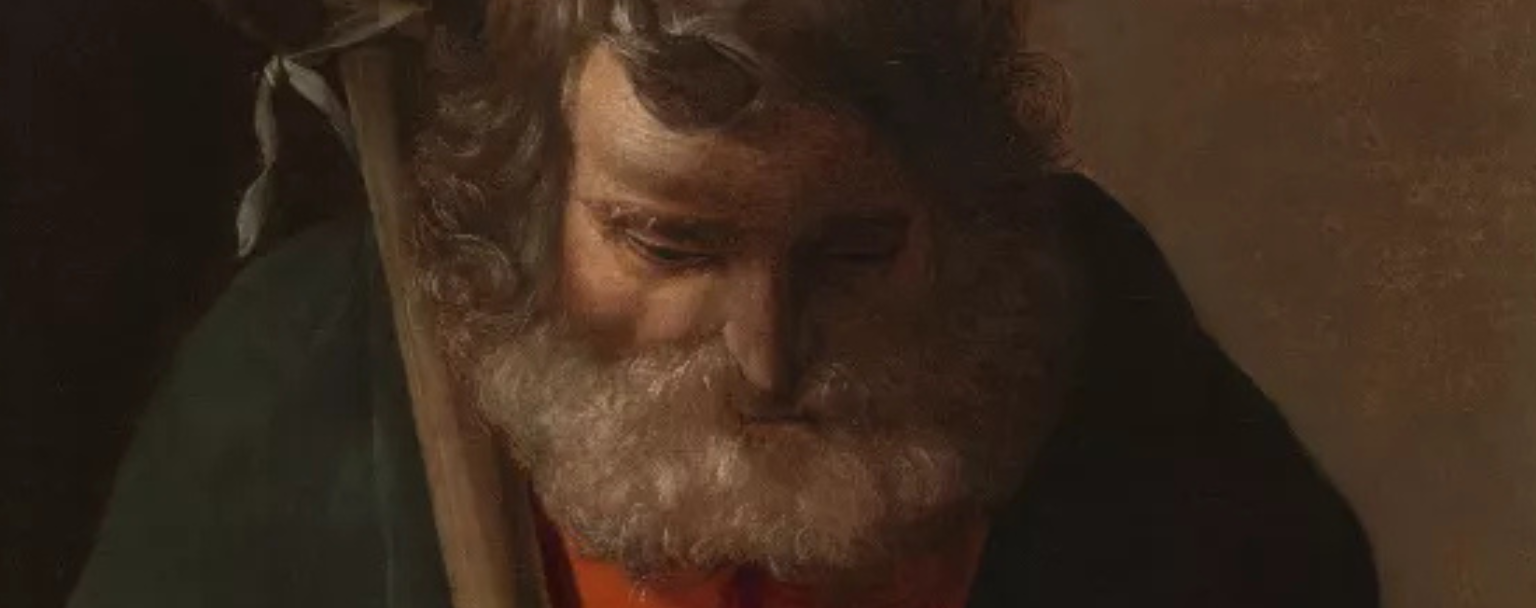
Saint Philip by Georges de La Tour, circa 1625, oil on canvas. The saint is depicted seated, his face pensive, in a soft light that illuminates his features and his clasped hands. 63.5 x 53.3 cm, on display at the Chrysler Museum of Art, Norfolk, Virginia.
Gift of Walter P. Chrysler, Jr./ Photo: Ed Pollard. Courtesy of the Chrysler Museum of Art

From 11 September 2025 to 25 January 2026, the Jacquemart-André Museum is dedicating a unique exhibition to Georges de La Tour (1593–1652).

The first major retrospective in France since the one at the Grand Palais in 1997, the event offers a fresh take on a rare and luminous painter, a master of deeply spiritual chiaroscuro.

Georges de La Tour, a major painter of the 17th century

Born in Vic-sur-Seille, Georges de La Tour worked for major patrons, including the Dukes of Lorraine and Louis XIII. In 1638, war destroyed his home and studio in Lunéville, prompting him to move closer to Paris.

Despite his fame during his lifetime, he fell into obscurity after his death in 1652. At the beginning of the 20th century, historians rediscovered his work, restoring his place among the great French painters nearly three centuries later.

A themed tour focusing on light

The exhibition brings together nearly thirty paintings and graphic works from French and foreign public and private collections.

The thematic tour highlights Georges de La Tour’s originality, particularly his candlelit night scenes.

Rather than directly imitating Caravaggio, La Tour developed his own personal interpretation of chiaroscuro. His radical realism and the simplicity of his compositions give his paintings a striking emotional power and modernity.

Two key works to see in the exhibition

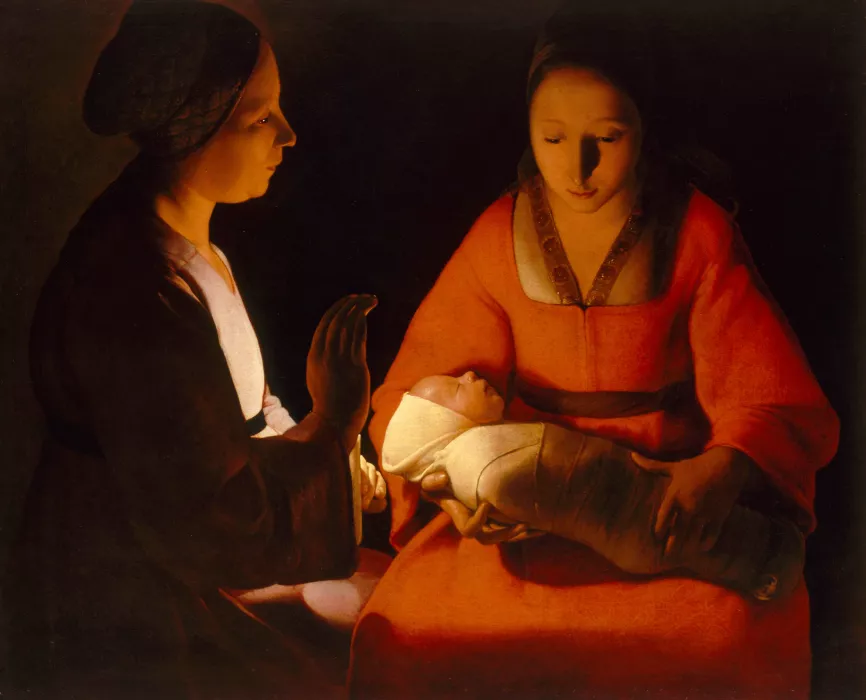
The Newborn (circa 1645)

 Georges de La Tour, ‘The Newborn’ (circa 1645), a night scene lit by candlelight, on display at the Jacquemart-André Museum in Paris from 11 September 2025 to 25 January 2026.
Georges de La Tour, The Newborn, circa 1645, oil on canvas, 76.7 x 95.5 cm, Rennes, Museum of Fine Arts © Rennes, Museum of Fine Arts

In The Newborn, subdued lighting shapes the faces and creates a meditative atmosphere; the work is one of the artist’s most famous nocturnes.

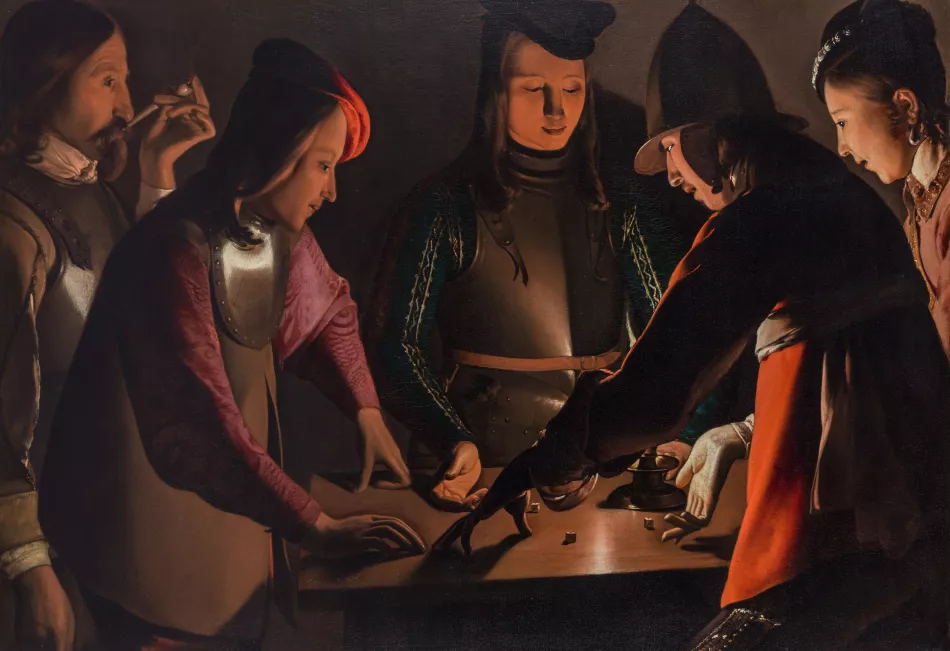
The Dice Players (circa 1650–1651)

Georges de La Tour, ‘The Dice Players’ (circa 1650–1651), a Caravaggio-esque genre scene in chiaroscuro, on display at the Jacquemart-André Museum (exhibition 2025–2026).
Georges de La Tour, The Dice Players, circa 1650–1651, oil on canvas, 92.5 × 130.5 cm, Stockton-on-Tees, Preston

With Les Joueurs de dés (The Dice Players), Georges de La Tour creates a silent drama, where gestures and glances maintain a controlled tension. The work illustrates his attraction to Caravaggio-esque subjects and his ability to humanise his figures.

See also : Artemisia Gentileschi at the Musée Jacquemart-André: A Must-See Exhibition

Support independent publishing! Subscribe to ART MAG and receive each issue in advance, in both print and digital format

👉Subcribe 6 issues / 1 year

👉Offer ART MAG

FAQ :

When is the Georges de La Tour exhibition in Paris?

It will be held from 11 September 2025 to 25 January 2026 at the Jacquemart-André Museum.

Why is this exhibition such a big deal?

The first major retrospective in France since 1997, offering a fresh perspective on a rare example of European Caravaggism.

What major works can be seen there?

The exhibition brings together nearly thirty iconic works, including The Newborn and The Dice Players.

Where is the Jacquemart-André Museum located?

The museum is located at 158 Boulevard Haussmann, in the 8th arrondissement of Paris.

What are the opening hours during the exhibition?

The museum is open daily from 10 a.m. to 6 p.m., with late opening on Fridays until 10 p.m. and at weekends until 8 p.m.

Categories
Heritage - News - Regional areas

Cathedrals Under the Scanner’s Eye

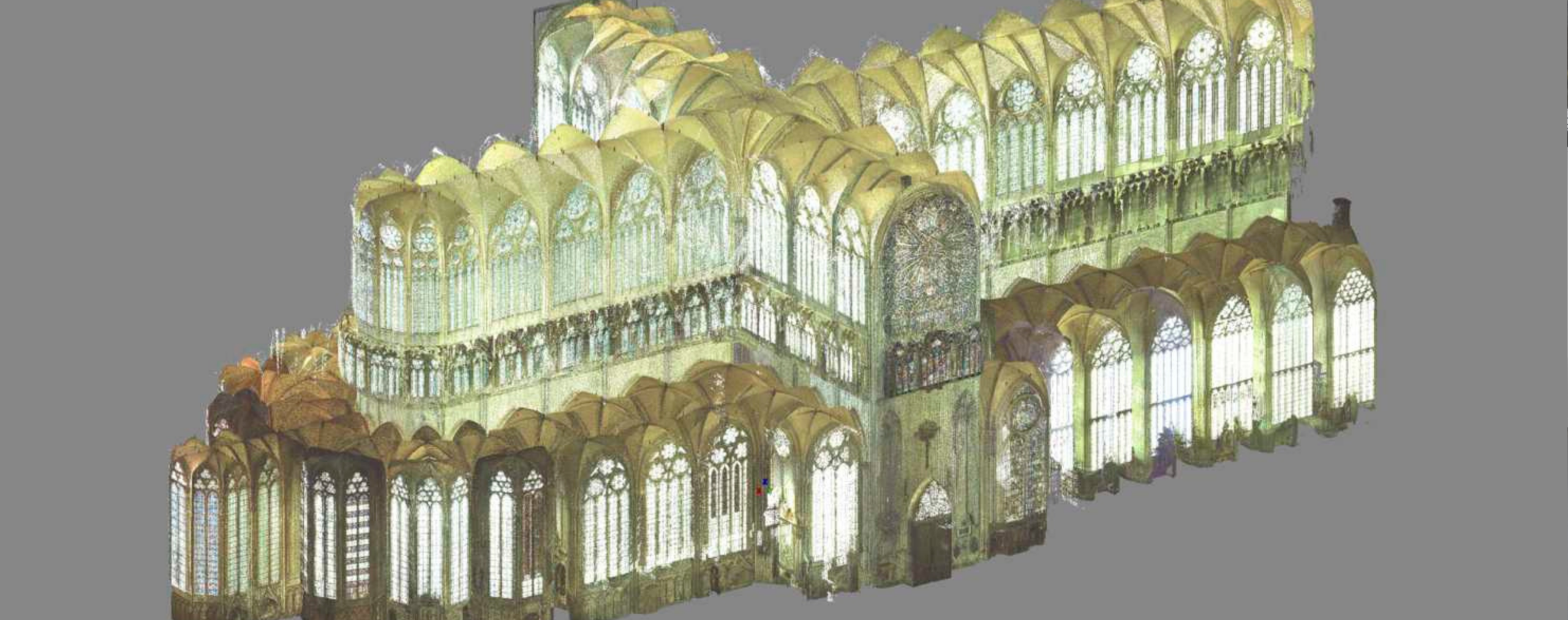
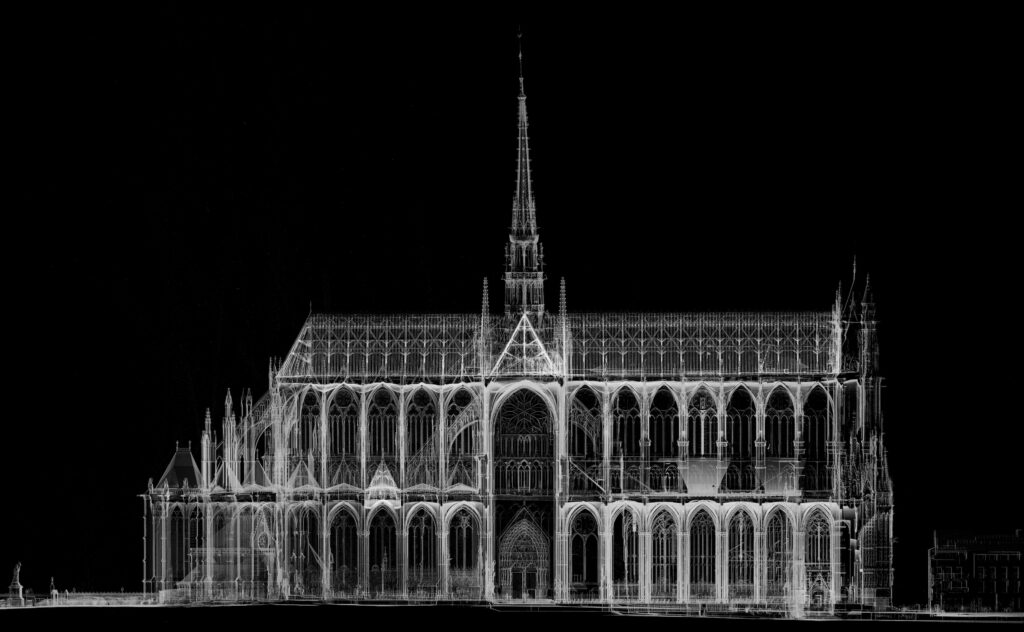
Vue numérique en transparence de la cathédrale d’Amiens révélant la structure gothique et la lumière des verrières, issue du projet e-cathédrale (Université de Picardie Jules Verne).

Cathedrals Under the Scanner’s EyeHow 3D Digitization Is Transforming the Way We See Gothic Architecture

Thanks to 3D digitization, French cathedrals are now revealing information invisible to the naked eye. From Amiens to Notre-Dame de Paris, these technologies are reshaping our understanding of heritage and uncovering an architecture that is more fragile, more dynamic—and more human—than previously imagined.

Monuments Less Immutable Than They Appear

They embody permanence, verticality, and the long span of time. Yet Gothic cathedrals are far from static. For some fifteen years, 3D digitization of heritage sites has profoundly renewed the way they are observed. Laser scanning and photogrammetry now make it possible to measure these buildings with millimetric precision, revealing their structural reality: thrusts, deformations, and gradual imbalances.

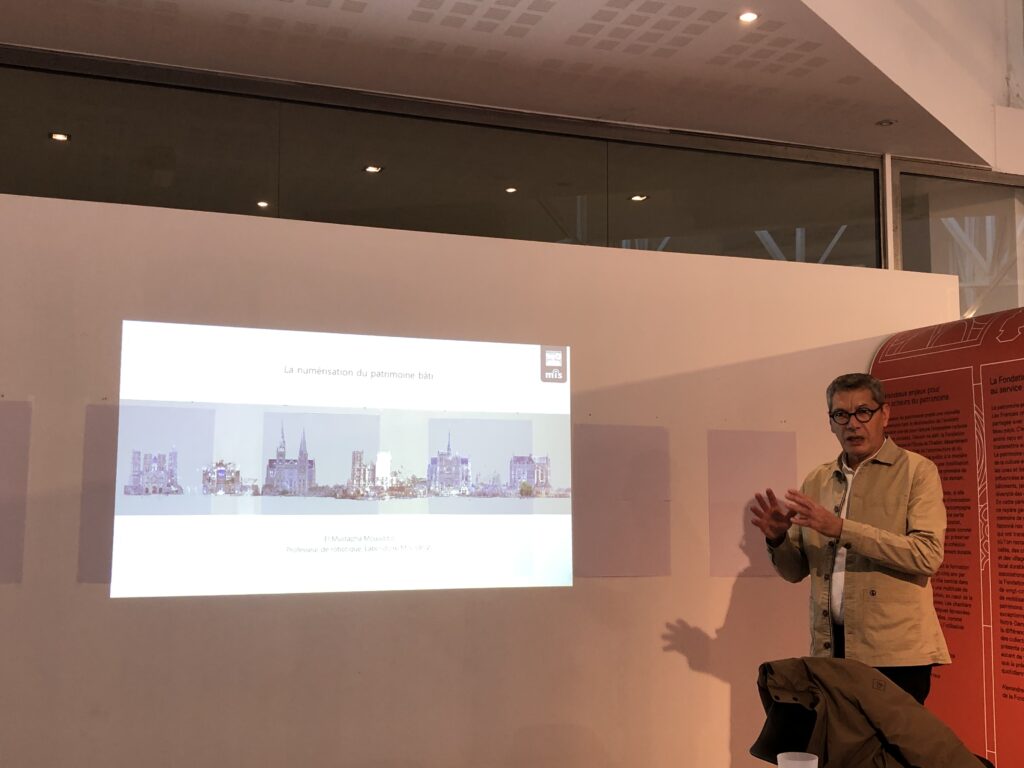
El Mustapha Mouaddib, lecture at the Maison de l’Architecture des Hauts-de-France – Pauline Creusat

It was from this observation that the e-Cathedral program was born, led by Professor El Mustapha Mouaddib, lecturer and researcher at the University of Picardie Jules Verne, within the MIS laboratory (Modelling, Information and Systems). Launched in 2010, this long-term research project has resulted in the complete digitization of several major French cathedrals and other monuments abroad.

Support independent publishing! Subscribe to ART MAG and receive each issue in advance, in both print and digital format
👉 Subcribe 6 issues / 1 year
👉 Offer ART MAG

Seeing What the Visitor Cannot See

Unlike virtual reconstructions, 3D digitization is based on exact measurement of reality. The monument is captured in the form of billions of points, creating a faithful digital twin of the building at a given moment in time. Facades, interiors, attics, stairways hidden within the masonry, inaccessible roof structures—everything is recorded.

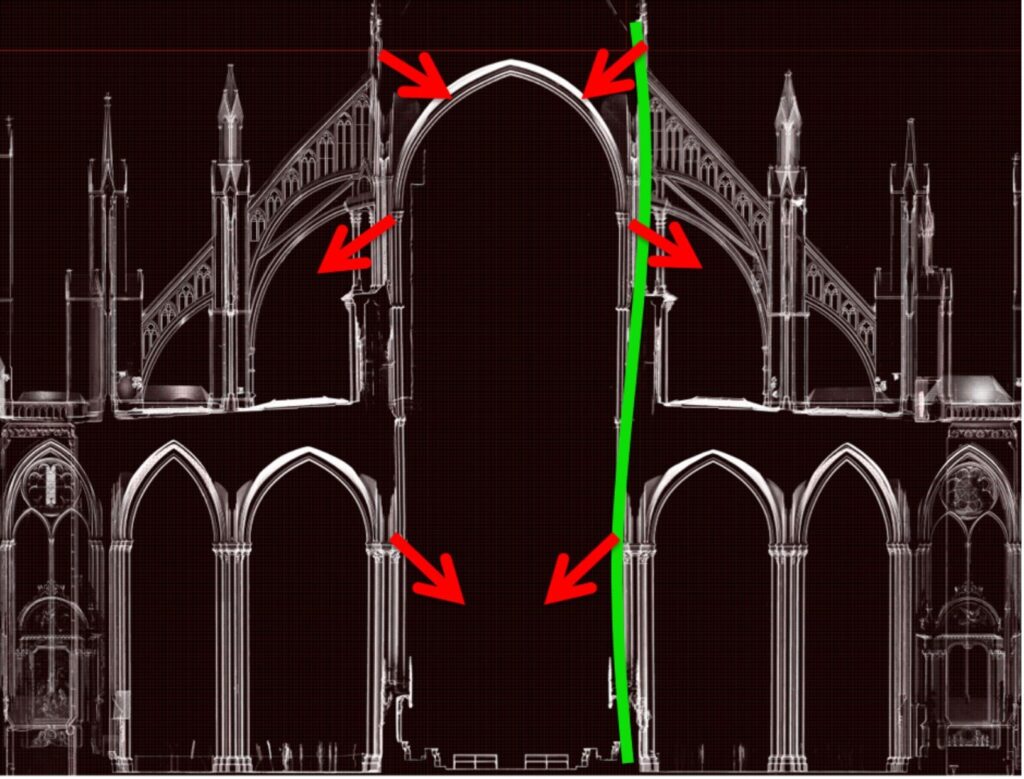
3D laser scanning analysis of Amiens Cathedral showing deformation of Gothic choir pillars, structural imbalance, and measured deviation revealed by digital heritage documentation.
Amiens Cathedral – deformation of the choir pillars – El Mustapha Mouaddib, MIS, UPJV

These data reveal phenomena invisible during a visit. In Amiens, certain pillars deviate by more than 20 centimetres from the vertical. Nothing exceptional for a Gothic cathedral, but an essential piece of information for understanding its structural behaviour and construction history.

When Geometry Becomes a Historical Narrative

The contribution of 3D goes far beyond conservation. The digital models produced within the e-Cathedral project make it possible to scientifically verify hypotheses long debated by architectural historians: regulating lines, proportions, medieval units of measurement.

Amiens Cathedral stands out for its remarkable geometric regularity, a sign of a rigorously applied master plan. At Notre-Dame de Paris, by contrast, variations in dimensions and misalignments tell the story of a longer, more fragmented construction process, shaped by urban and political constraints. Digital data do not freeze history; they reveal its successive adjustments.

Notre-Dame de Paris: Memory Before and After the Fire

The 2019 fire gave these surveys decisive importance. The 3D models created before the disaster became an irreplaceable scientific archive. Those produced afterward made it possible to precisely measure the deformations caused by the fire and the collapse of the roof structure.

Overlaying the “before” and “after” surveys guided restoration choices, particularly in assessing the condition of the vaults and weakened structures. The 3D digitization of Notre-Dame de Paris thus emerged as a major conservation tool—and as a safeguard memory in the face of the possible loss of the built fabric.

From Raw Data to Cultural Mediation

One essential challenge remains: making these data intelligible to the public. A point cloud, however precise, can seem abstract. The e-Cathedral project therefore included extensive mediation work: virtual tours, urban exhibitions, and interactive interfaces.

These tools offer unprecedented viewpoints—passing through a facade, observing the interior of a pillar, understanding the logic of flying buttresses—without ever replacing the physical experience of the monument. 3D does not substitute for stone; it offers a complementary, analytical, and deeply contemporary perspective.

Black-and-white 3D scan showing a cross-section of Amiens Cathedral with visible nave, side aisles, vaults, and roof structure.
Transverse section of Amiens Cathedral – El Mustapha Mouaddib, MIS, UPJV

Heritage Projected into the Future

In the face of aging materials, climate risks, and disasters, the digital preservation of heritage now appears as a necessity. It does not replace architecture, but extends its existence in other forms: scientific, educational, and cultural.

Having entered the era of the scanner, cathedrals lose none of their symbolic power. They gain a new depth: that of a heritage made legible in all its complexity, at the intersection of art, science, and collective memory.

Support independent publishing! Subscribe to ART MAG and receive each issue in advance, in both print and digital format
👉 
Subcribe 6 issues / 1 year
👉 Offer ART MAG

Categories
Calendar - News - Paris - Photography

Tyler Mitchell at the MEP: an exhibition that redefines contemporary visual narratives

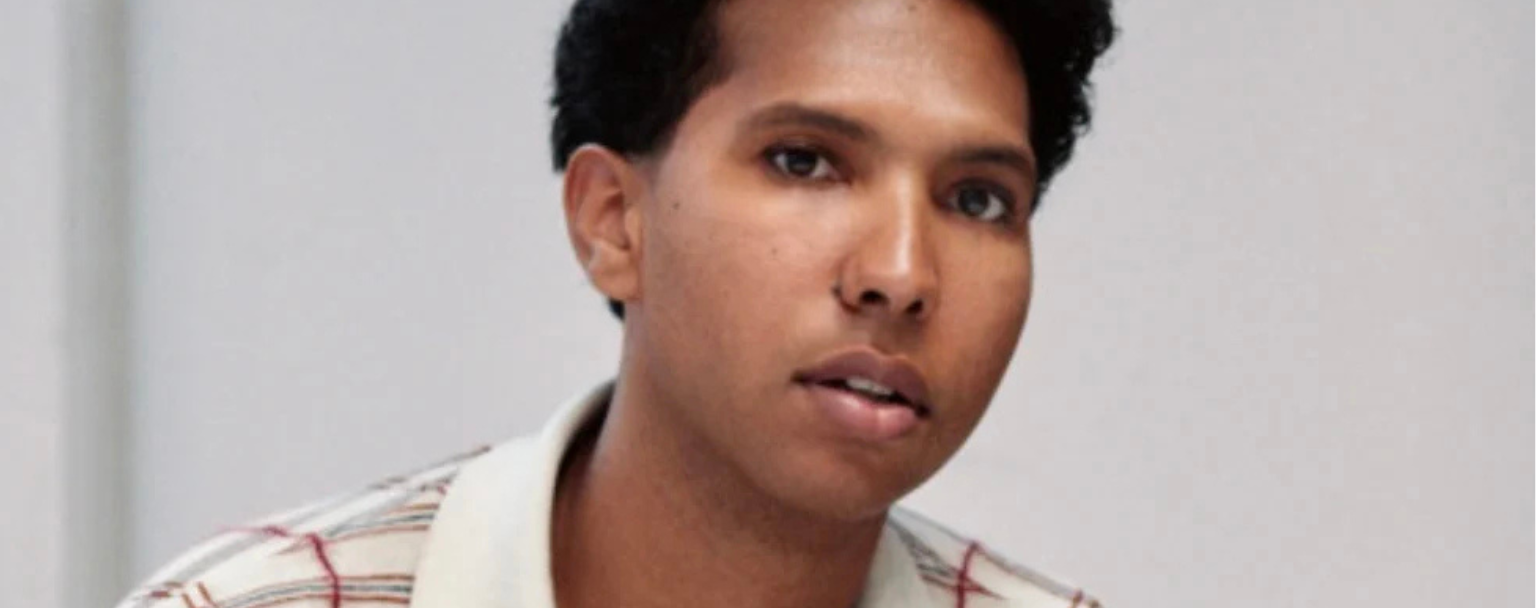
Colour portrait of a person sitting cross-legged on a white surface. They are wearing a cream and red checked top and blue jeans. Their hands are resting in front of them, with a bracelet and ring visible. The person is looking slightly to the right, with a calm expression.
Tyler Mitchell

From 15 October 2025 to 25 January 2026, the Maison Européenne de la Photographie (MEP) is dedicating a major exhibition to Tyler Mitchell, the young prodigy of American photography.

Entitled Wish This Was Real, this installation brings together nearly ten years of creative work and offers a fresh perspective on the beauty, freedom and self-determination of Black communities.

Mitchell, born in Atlanta in 1995, quickly established himself as one of the most influential figures of his generation.

Après la Tisch School of the Arts, il devient célèbre en 2018 en photographiant Beyoncé pour la couverture du Vogue US, première Une signée par un photographe noir. 

A decade of brilliant, political and poetic creativity

The exhibition presents a body of work combining photography, video, sculpture and textiles, reflecting Mitchell’s desire to explore new, sensitive and engaging visual worlds. The artist explains:

“I try to portray black people in a true and pure way. I hope there is an honest perspective in my photos.”

Wish This Was Real se structure en trois grands chapitres qui révèlent la cohérence et la puissance de son œuvre.

VLives / Freedoms: celebrating youth and joy

The first part of the exhibition draws inspiration from skateboard culture and the visual aesthetics of Tumblr, where Mitchell forged his first images.

Against a backdrop of racial tensions and Black Lives Matter, these photos offer bubbles of utopia, camaraderie and emancipation.

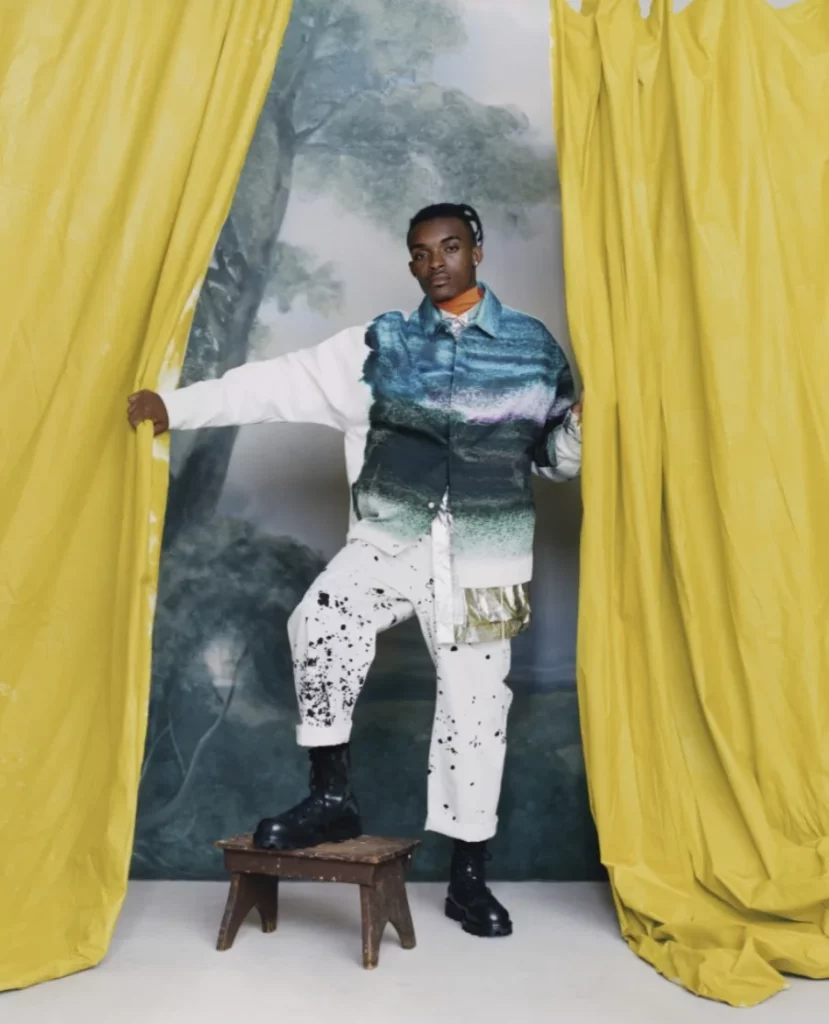
Colour photograph showing a person standing between two large yellow curtains pulled apart. She is posing with one foot on a small wooden stool, wearing a blue and green gradient jacket, white trousers with black spots, and black boots. In the background, a painted backdrop depicts a wooded landscape.
Tyler Mitchell, Curtain Call, 2018 Courtesy of the artist and Gagosian © Tyler Mitchell

These performances are acts of resistance as much as they are celebrations. They show black youth in all their dignity, creativity and humanity, far removed from media clichés.

Postcolonial / Pastoral: a reinvention of the landscape

In this section, Mitchell revisits the codes of pastoral landscape, a tradition often idealised and disconnected from history. The artist inscribes a vivid memory of the land, made up of romanticism, injustice and reinvention.

Inspired by Toni Morrison, Seurat, Kerry James Marshall and Julie Dash, he creates scenes where black subjects finally regain a central place in nature.

Textile works complete this section, introducing a new material and memorial dimension to his practice. The fabric, suspended or stretched, becomes a poetic medium where intimate stories and collective narratives overlap.

Family/Fraternity: intimacy as gentle resistance

The final section explores the domestic sphere as a place of memory, heritage and reaffirmation of identity. Supported in 2020 by the Gordon Parks Foundation, Mitchell pays tribute to one of the great chroniclers of Black American life.

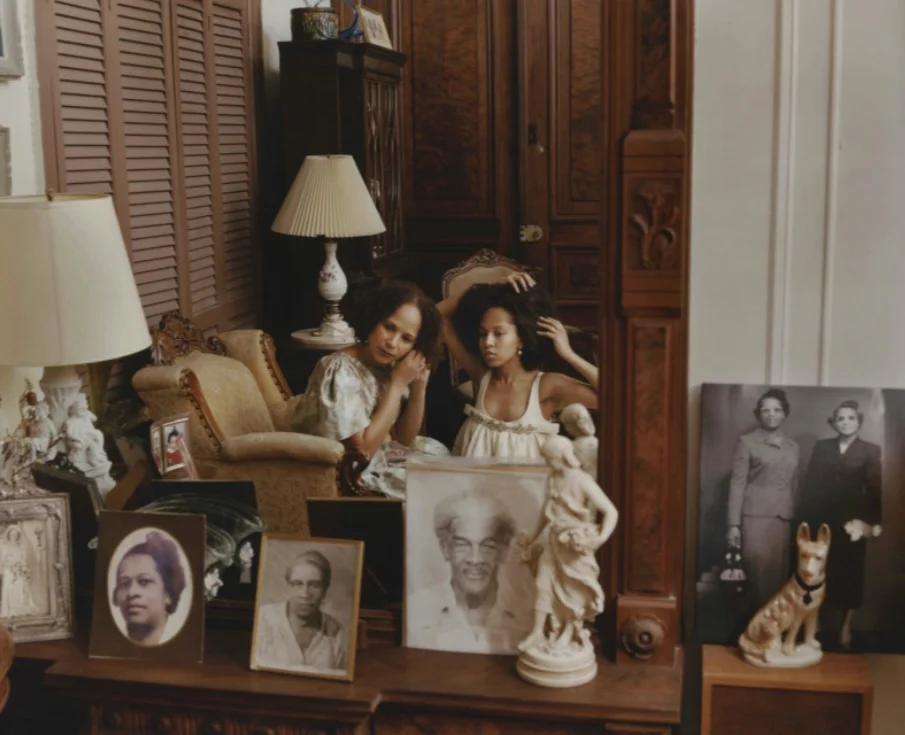
In Bedford-Stuyvesant, Brooklyn, he photographs his loved ones, celebrating family rituals, simple gestures and everyday elegance.

Indoor photograph showing two women seated in front of a large mirror decorated with carved wood. One, wearing a light-coloured dress, sits upright and adjusts her hair, while the other, seated beside her, observes her reflection. Around the mirror, numerous framed antique portraits are arranged on a piece of furniture, along with decorative statuettes and a lamp. The atmosphere evokes an intimate space steeped in family history.
Tyler Mitchell, Ancestors, 2021 © Tyler Mitchell

These images embody his ambition: to reinvent the visual representations of a community that has been confined to unambiguous narratives for too long.

A seductive, precise and deeply political contemporary aesthetic

With bold colours, carefully studied gestures and meticulous staging, Mitchell composes each of his images like a modern painting. His work engages in dialogue with fashion, art history and the avant-garde, while conveying a deeply contemporary sensibility.

Gentleness becomes a weapon for him, a gesture of resistance, a means of imagining alternative, possible, desirable ways of being.

see also:

Support independent publishing! Subscribe to ART MAG and receive each issue in advance, in both print and digital format
👉 Subcribe 6 issues / 1 year
👉 Offer ART MAG

FAQ

Who is Tyler Mitchell?

Tyler Mitchell is an American artist, photographer and filmmaker born in 1995. He explores the representation of black people through poetic, political and luminous images.

What does the title ‘Wish This Was Real’ mean?

It reflects Mitchell’s desire to create visual worlds where freedom, beauty and black self-determination are fully expressed.

What are the main themes of his exhibition?

Major themes include: youth and freedom, postcolonial landscape, family memory, intimacy, black utopia, and positive representation.

Why is Tyler Mitchell famous?

He became world famous in 2018 when he photographed Beyoncé for the cover of US Vogue, the first cover shot by a black photographer.

Where can you see the exhibition “Wish This Was Real”?

At the MEP, 5/7 rue de Fourcy, Paris 4th arrondissement, from 15 October 2025 to 25 January 2026.

Categories
Featured Artist - News - Painting - Women artists

Mezz Zapharelli: Revealing the Icon, Redefining the Portrait, Rethinking the Image

photo portrait mezz zapharelli artiste peintre

From the Image Factory to the Studio: An Art That Slows the World Down

In a landscape saturated with accelerated visual production, Mezz Zapharelli stands apart. Her work resists immediacy, opting instead for a painting practice built on precision, duration, and presence. Coming from applied image industries—fashion, television, film sets—she learned early how quickly figures are manufactured. Since the 1980s, Zapharelli has developed an ethic of slowness, where portraiture becomes a site of recalibration, alignment, and renewed attention.

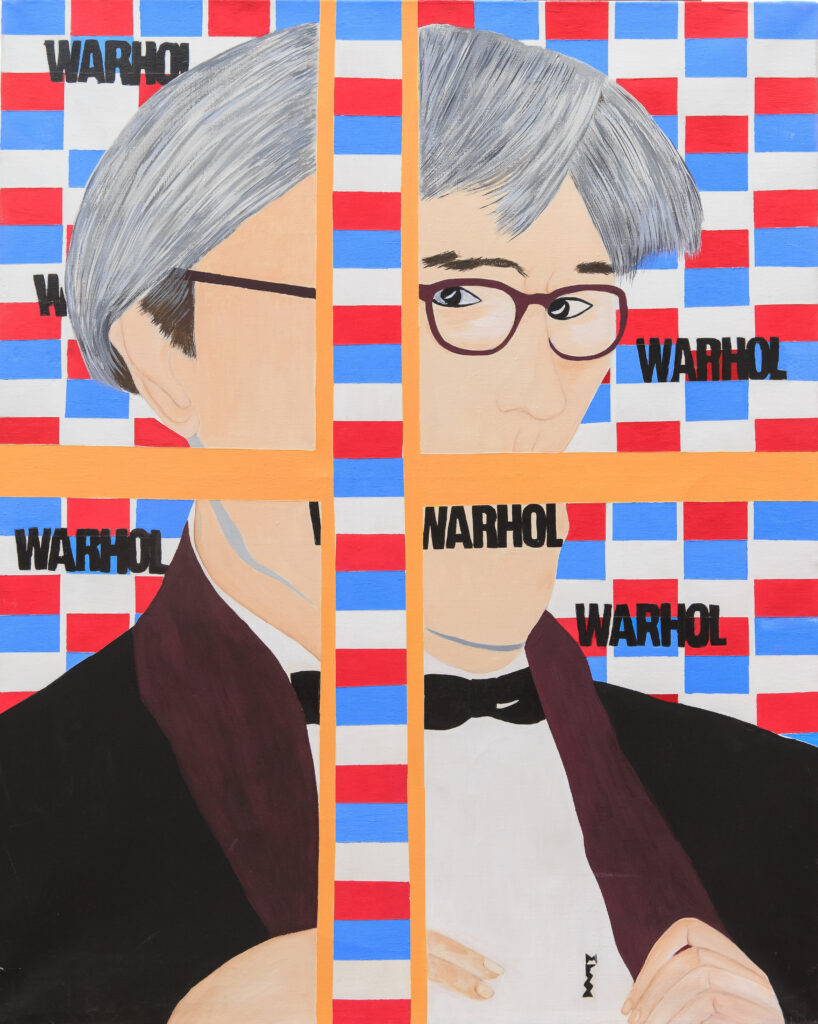
Contemporary painting by Mezz Zapharelli featuring a stylized portrait fragmented into four panels, set against a red, blue, and white geometric background with the repeated word ‘WARHOL
Stylized four-panel portrait by Mezz Zapharelli, set against a geometric background featuring the repeated ‘WARHOL’ motif

From Image-Making Industries to the Studio

Zapharelli’s path to painting begins far from traditional fine arts. A research trip to Australia opens five years of hands-on experience: television costumes, music-industry garments, film sets. Each environment teaches speed, efficiency, and the necessity of immediate visual impact.

New York intensifies this training. Invited by Andy Warhol’s office to celebrate the artist’s birthday at Studio 54, she encounters a full-scale icon-making machine—an ecosystem built on repetition, visibility, and velocity.

London and Central Saint Martins bring a turning point: the gesture must carry responsibility, the form must hold. After a decade inside the high-pressure world of image production, Zapharelli chooses a new direction: painting.

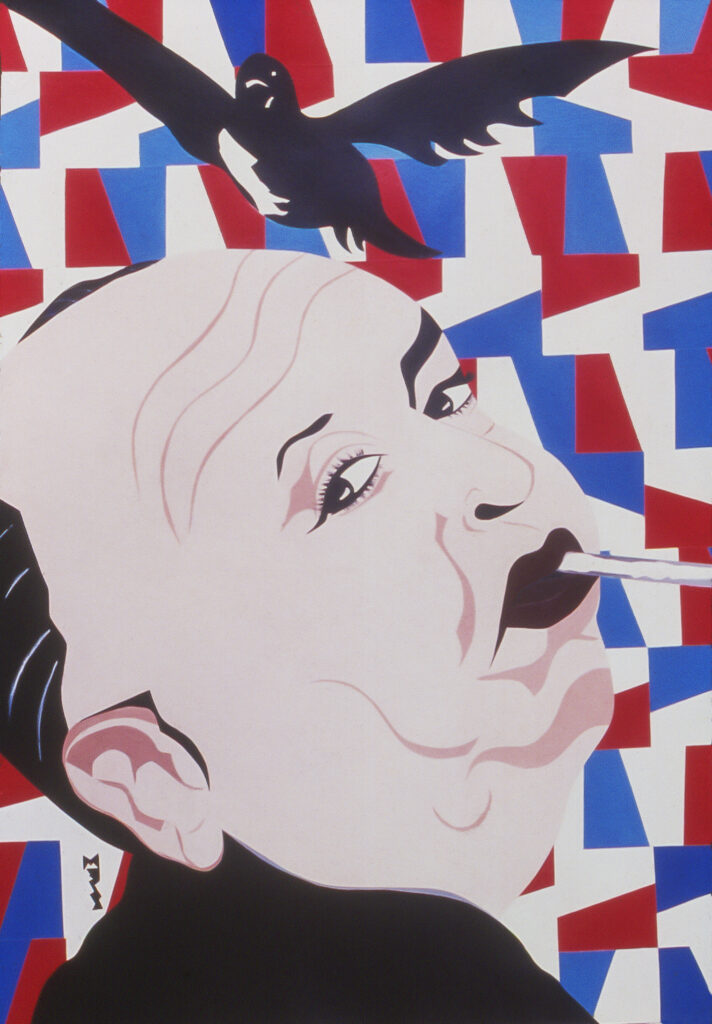
Stylized portrait of Alfred Hitchcock in vivid colors, depicting a man with a round face and a black bird flying above him, set against a red, blue, and white geometric background, contemporary painting by Mezz Zapharelli
Stylized Alfred Hitchcock portrait by Mezz Zapharelli, with bold colors and geometric form

The 1980s: Portraiture as a Passage

Her first portrait series marks a deliberate exit from the visual flux. Leaving clothing—understood as a social surface—she turns toward the face, a surface of being. The formats are frontal, restrained. Execution time expands. The hand slows. The eye abandons easy effects in favor of subtle presence.

This transition is not just aesthetic; it is ethical. Painting becomes a way to unlearn speed and allow figures to emerge with depth and steadiness.

Testing the Icon: Marilyn, Hitchcock, Chanel

When Zapharelli engages hyper-mediated figures, she avoids both homage and parody. The icon is treated as resistant material. Painting exposes its seams, its silences, the pressure of light against form. Her work does not embellish; it desaturates.

These images carry the memory of her proximity to the image factory. After years of acceleration, the painting becomes a braking device—a resonant chamber where the icon can breathe again.

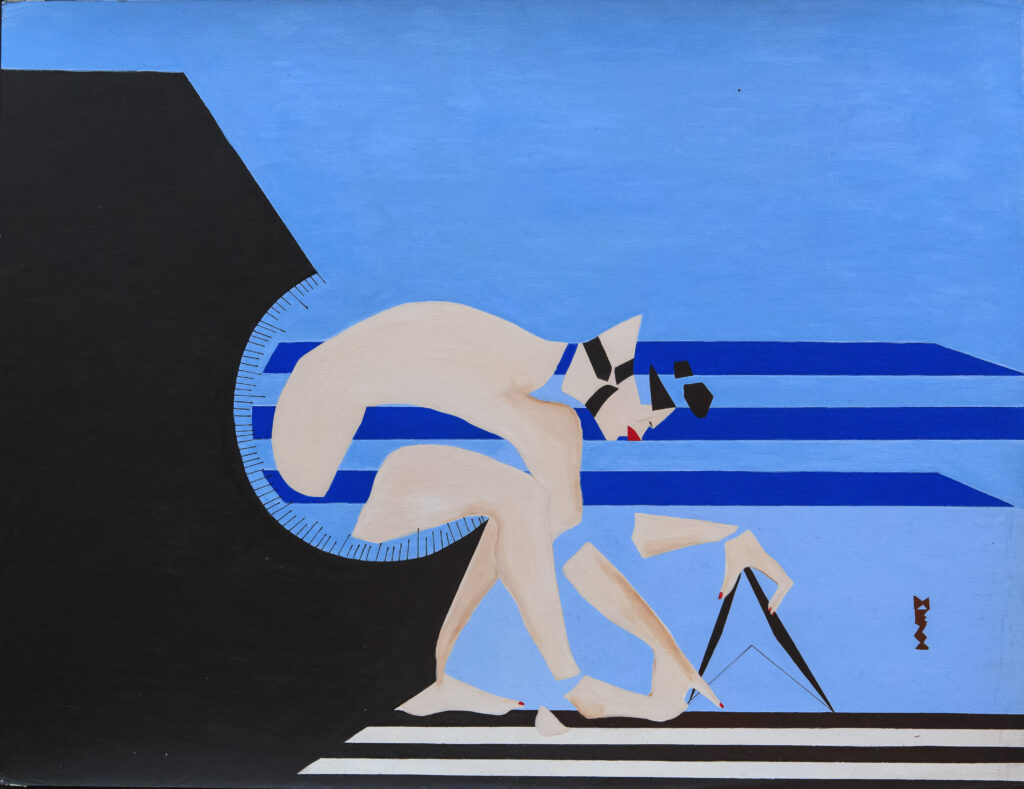
Contemporary painting by Mezz Zapharelli depicting a stylized figure using a compass, set against a blue background with geometric lines and black-blue contrasts
Contemporary Art by Mezz Zapharelli: The Compass and the Human Figur

The Compass: A Politics of the Axis

A recurring, tool-like motif appears: the compass. For Zapharelli, it symbolizes the act of realigning the human figure. Far from decorative metaphor, it articulates the studio’s core ambition: to measure, orient, and restore balance to a figure worn down by media circulation.

The painting is no longer a showcase; it becomes an instrument. What matters is not stylistic signature (which shifts), but the axis—the sustained line of force that holds the work.

Lines of Force: A Coherent Artistic Trajectory

Zapharelli’s path is not a biographical romance but a coherent artistic logic born from the tension between two regimes of images:

  • The image factory: costume workshops, sets, runways, repetition, speed, industrial reproduction
  • Painting: slow, risky, irreversible, where each decision carries weight

One regime shapes her speed and cut; the other grants her the right to duration. It is this shift of regime—from production to contemplation—that defines the strength and integrity of her work.

Support independent publishing! Subscribe to ART MAG and receive each issue in advance, in both print and digital format
👉 Subcribe 6 issues / 1 year
👉 Offer ART MAG

To read more, download ART MAG N°29