


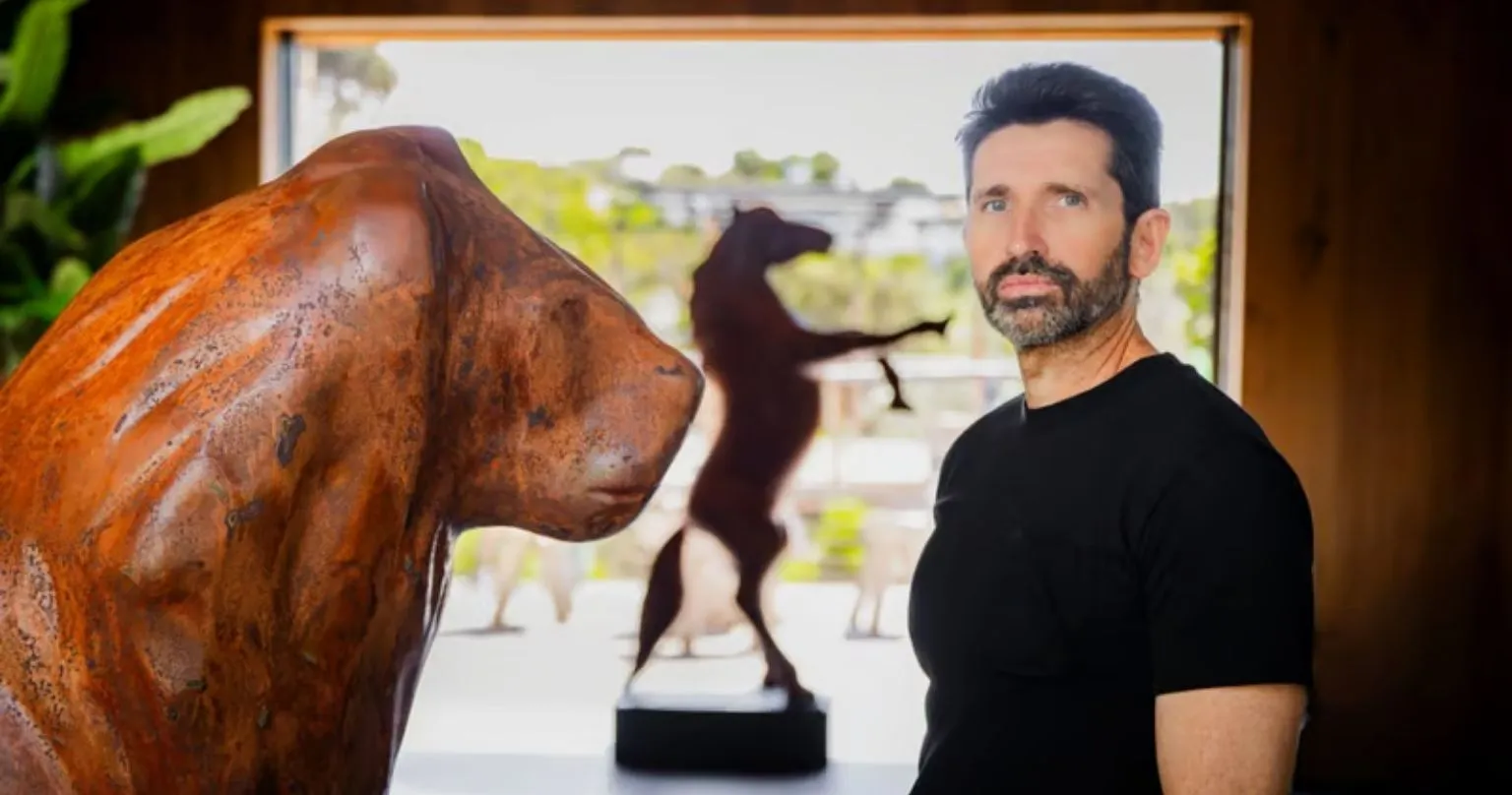
When Contemporary Sculpture Becomes an Act of Memory
What can animal sculpture still tell us in the twenty-first century?
For Cyril Maccioni, the answer goes far beyond representing wildlife. His sculptures are not simply tributes to the beauty of animals; they invite us to reflect on our responsibility to preserve what is quietly disappearing before our eyes. With The Forgotten, presented at Terra di Gaya in Corsica, the French contemporary sculptor creates an exhibition in which every sculpture becomes a silent witness to a changing world.
Lions, gorillas, bears and sheep appear suspended in time.
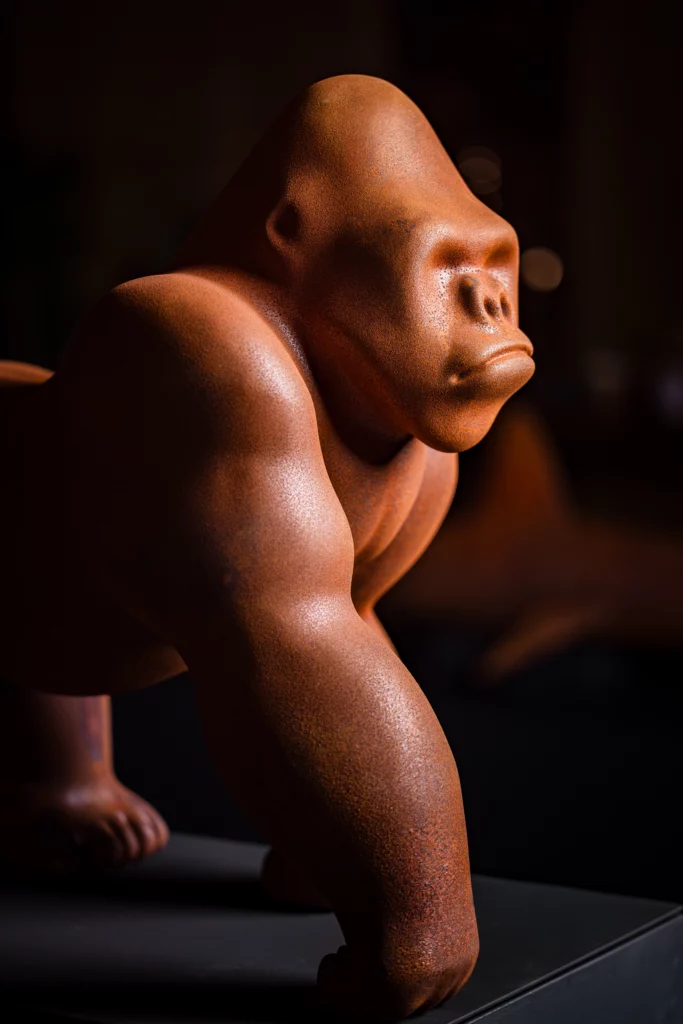
Their eyes are missing.
This absence—now the artist’s unmistakable signature—encourages visitors to ask a simple yet profound question: what do we still choose to see?
More than an exhibition, The Forgotten offers a deeply emotional encounter where sculpture becomes an act of remembrance.
Cyril Maccioni: A Contemporary Sculptor Dedicated to the Living World
Over the years, Cyril Maccioni has developed an artistic language that is instantly recognisable. Working with resin, fiberglass and oxidised metal, he creates monumental sculptures in which strength and vulnerability coexist.
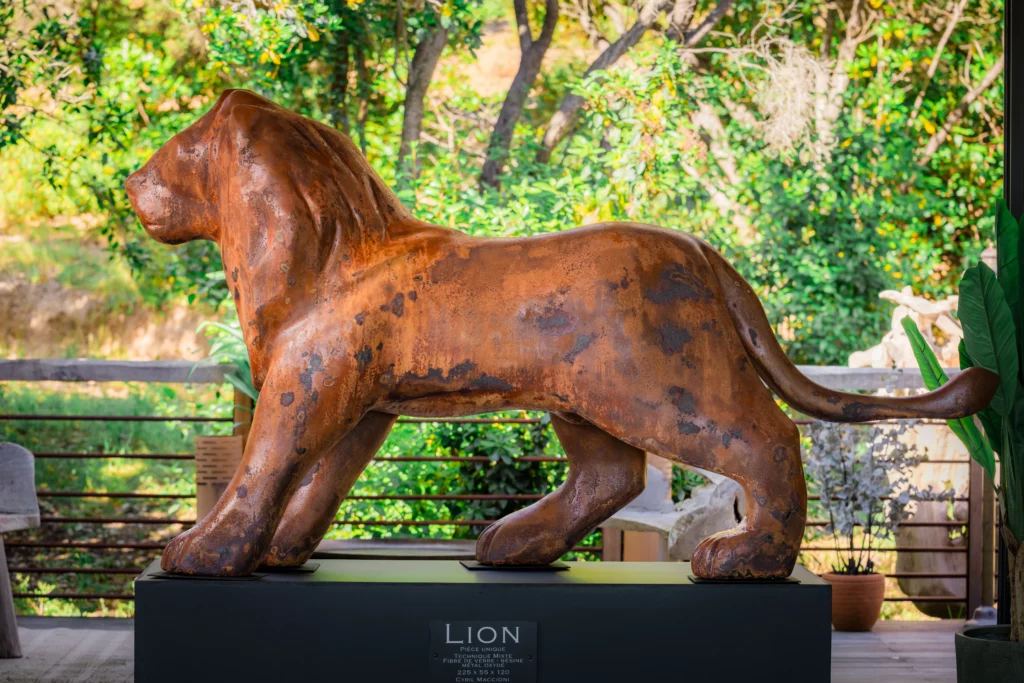
Rather than depicting animals as naturalistic subjects, Maccioni transforms them into universal symbols of a living world in transition. The lion embodies strength made vulnerable, while the gorilla seems to carry the weight of collective memory. The bear, meanwhile, stands as the silent guardian of a fragile world.
By deliberately moving away from realism, the sculptor invites viewers to look beyond the animal itself and reflect on humanity’s relationship with nature. Each sculpture becomes a quiet meditation on memory, loss and the responsibility we share towards the living world.
The Forgotten: An Exhibition That Challenges the Way We Look
Presented at Terra di Gaya, a site deeply committed to biodiversity in Corsica, The Forgotten finds its natural setting within the landscape itself.
Visitors gradually encounter monumental animals that seem both rooted in and detached from their surroundings.
Then comes the revelation.
The eyes are gone.
This deliberate artistic choice fundamentally transforms the relationship between the artwork and its audience.
“Animals sacrificed their gaze so that we might finally open our own.” Cyril Maccioni
By removing the eyes, the sculptor reverses the traditional relationship between viewer and artwork.
The animals no longer observe us.
Instead, we become responsible for the way we choose to see them.
Few artistic absences have ever carried such emotional power.
Between Strength and Vulnerability
One of the defining qualities of Cyril Maccioni’s work is its refusal of spectacle.
Although monumental in scale, his sculptures never rely on technical virtuosity alone.
Their forms remain deliberately simplified.
The lines are clean.
The oxidised surfaces evoke both stone and the passage of time.
This visual restraint gives each sculpture a timeless presence.
Emotion arises not from realism but from the quiet intensity of the work itself.
Every sculpture seems to hold an untold story, leaving space for the viewer’s own interpretation.
Reimagining the Tradition of Animal Sculpture
Animal sculpture has a long artistic history, from François Pompon to Rembrandt Bugatti.
Like these masters, Cyril Maccioni seeks to capture the essential nature of the animal rather than its outward appearance.
Yet he introduces a contemporary dimension.
His sculptures are shaped not only by beauty and strength but also by memory.
These animals feel both present and already part of history.
It is precisely this ambiguity that gives his work its remarkable emotional depth.
A Contemporary Vision of Environmental Art
At a time when environmental concerns increasingly shape artistic practice, Cyril Maccioni follows a singular path.
His sculptures never become manifestos.
They avoid moralising.
They reject sensationalism.
Instead, they embrace silence.
Within that silence lies reflection.
Without imposing answers, his work gently reminds us of the extraordinary fragility of the living world.
Terra di Gaya: Where Art Meets Biodiversity
The Forgotten finds its most meaningful setting at Terra di Gaya, a place dedicated to preserving biodiversity.
Here, the surrounding landscape becomes an extension of the sculptures themselves.
Nature is no longer merely the backdrop.
It becomes an essential part of the artistic experience.
The exhibition also carries a tangible environmental commitment, with part of the proceeds supporting the WWF and its conservation initiatives.
ART MAG’s Perspective
What truly distinguishes Cyril Maccioni’s work is its ability to move the viewer without ever resorting to spectacle.
At a time when socially engaged art often relies on explicit statements, the sculptor chooses a far subtler language—that of silence.
His sculptures neither accuse nor seek to persuade.
Instead, they bear quiet witness to the fragility of the living world, inviting each visitor to reconsider the way they look at nature.
This restraint gives his work remarkable strength. It reminds us that contemporary sculpture still possesses a rare power: the ability to slow our gaze, suspend time and leave a lasting emotional imprint long after the exhibition has ended.
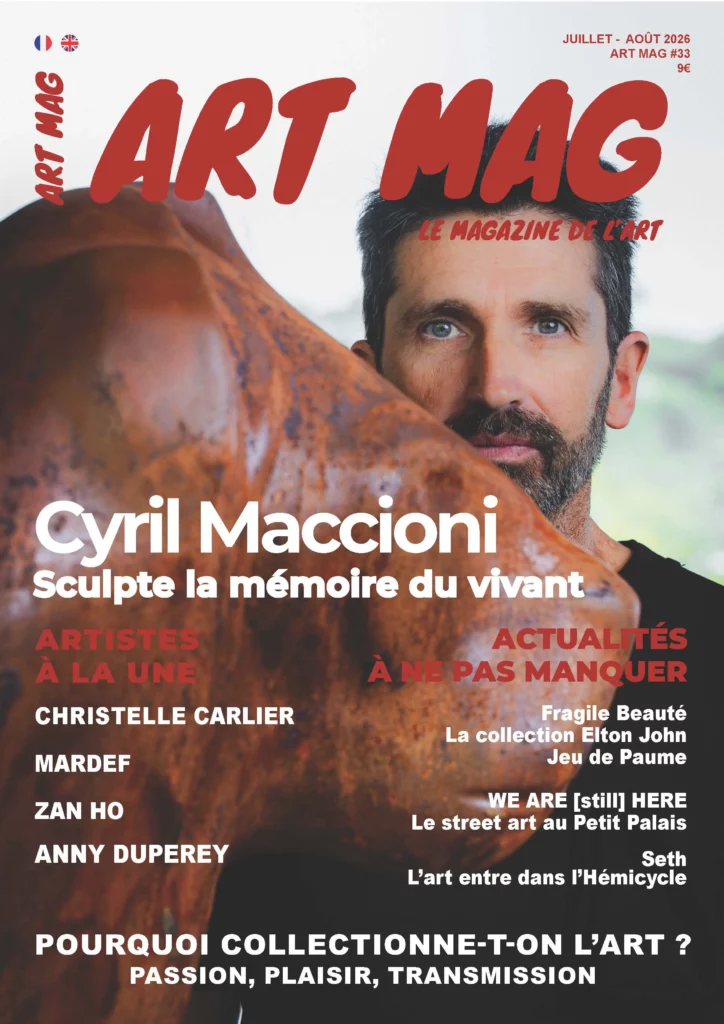
This article is adapted from Issue #33 of ART MAG International.
Each edition brings together in-depth analyses, critical perspectives, exclusive interviews and inspiring discoveries, offering readers a deeper understanding of contemporary artists, their works and the evolving landscape of contemporary art.
FAQ
Cyril Maccioni is a French contemporary sculptor whose work focuses on the animal world. His sculptures explore themes of memory, biodiversity and humanity’s relationship with nature.
Why do Cyril Maccioni’s sculptures have no eyes?
The absence of eyes is the artist’s signature. It symbolises a reversal of perspective: rather than being watched by the animals, viewers are invited to examine their own relationship with the living world.
Where is The Forgotten exhibition presented?
The Forgotten is exhibited at Terra di Gaya, in Corsica, a site dedicated to biodiversity and environmental preservation.
What materials does Cyril Maccioni use?
He primarily works with resin, fiberglass and oxidised metal to create monumental sculptures whose textured surfaces evoke the passage of time.
Why is Cyril Maccioni’s work significant?
His sculptures move beyond traditional animal representation to offer a thoughtful reflection on memory, biodiversity and the fragile balance between humanity and nature.