


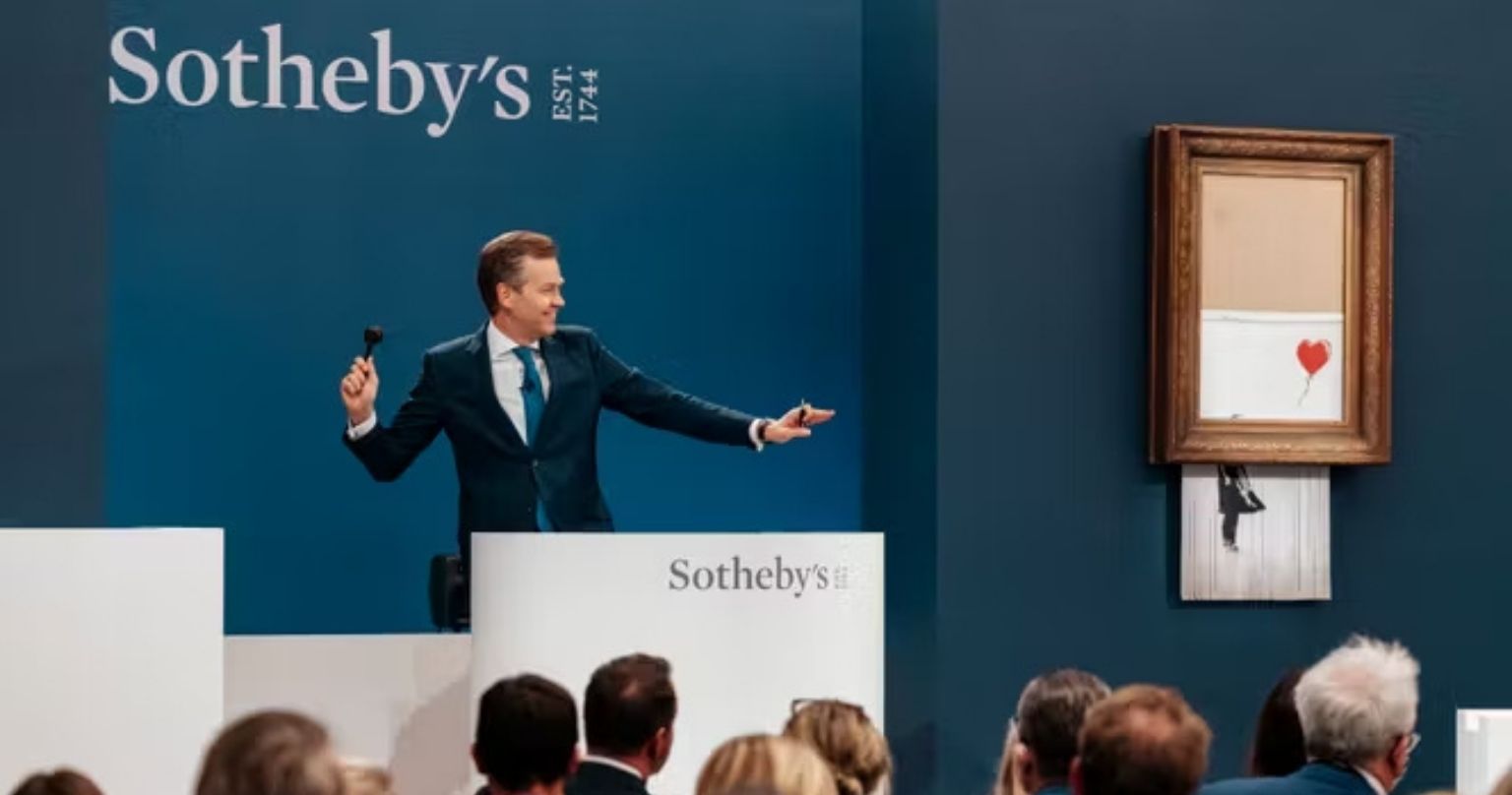
By Delphine Jonckheere – Publisher and Editor-in-Chief of ART MAG International
6-minute read
Imagine this. A gallery offers you a Banksy screen print.
The artwork is stunning, the asking price appears consistent with the market, and the seller explains that it comes from a private collection. Everything suggests you are about to make an excellent acquisition.
Then someone asks a simple question:
“Does the artwork have a Pest Control certificate?”
Within seconds, uncertainty sets in.
On the Banksy market, this document is far more than a certificate. Today, it represents the leading proof of authenticity recognised by collectors, galleries and international auction houses.
What is Pest Control?
In 2008, Banksy established Pest Control Office, an independent organisation responsible for verifying the authenticity of his works and ensuring their traceability. This decision marked a turning point in the history of the contemporary art market.
Today, Pest Control certification has become the market standard. Major international auction houses, including Sotheby’s, Christie’s and Phillips, generally require recognised authentication when a Banksy artwork is offered for sale.
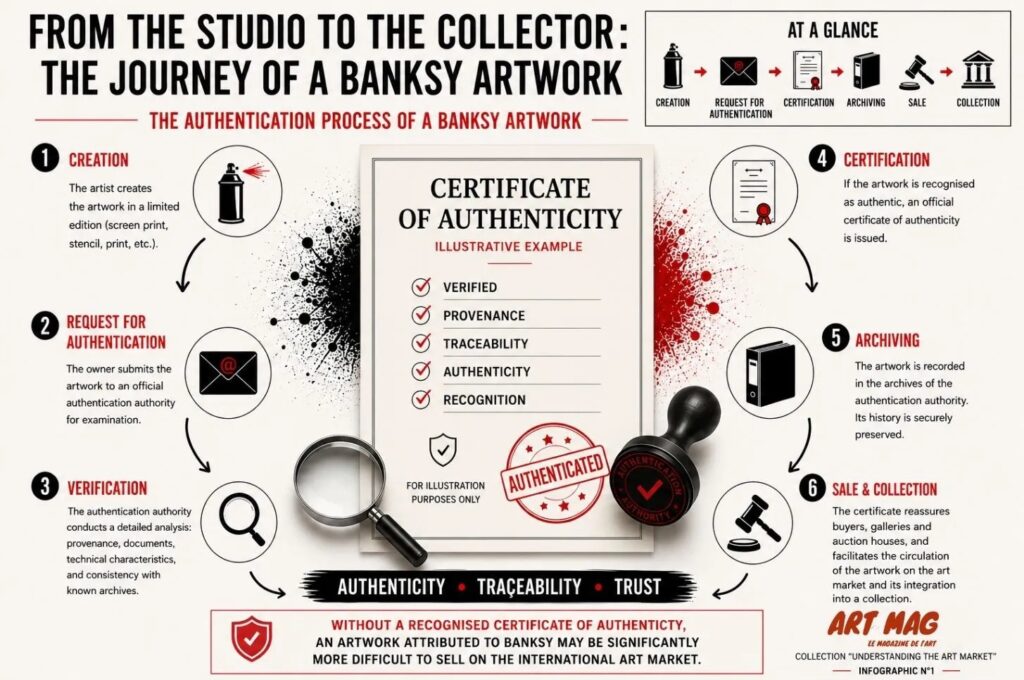
This infographic summarises how the authentication process for a Banksy artwork works. It highlights the importance of the certificate of authenticity, the artwork’s provenance and traceability, and the guarantees expected by collectors, galleries and international auction houses.
Why did Banksy create Pest Control?
Banksy occupies a unique place in the history of contemporary art. Unlike most artists, he has never wanted his identity to become part of his public profile.
Quite the opposite.
His anonymity is an essential part of his artistic practice.
However, this decision quickly created a challenge.
How can an artwork be authenticated when it is impossible to ask its creator whether it is genuine?
As Banksy’s market value increased, copies, forged certificates and wrongly attributed works became increasingly common.
In response, Banksy created Pest Control Office in 2008, an independent organisation officially responsible for authenticating his works.
Its mission is twofold:
- to protect collectors;
- to preserve Banksy’s anonymity.
This decision permanently changed the way the Banksy market operates.
The journey of a Banksy artwork
Banksy creates the artwork
↓
First acquisition
↓
Authentication by Pest Control Office
↓
Official certificate
↓
Private collection
↓
Gallery / Auction house
↓
New collector
Pest Control protects more than collectors
Pest Control is often described simply as an authentication body. In reality, its role is far broader.
It also protects:
- Banksy’s reputation;
- specialist galleries;
- international auction houses;
- future buyers.
By limiting the circulation of counterfeit works, Pest Control helps maintain confidence throughout the market.
Without that confidence, the record-breaking results achieved at Sotheby’s and Christie’s would be far more difficult to achieve.
In other words, Pest Control indirectly contributes to the value of Banksy’s works.
Support independent publishing! Subscribe to ART MAG and receive each issue in advance, in both print and digital format
👉 Subcribe 6 issues / 1 year
Why do auction houses require this certificate?
Whenever a work is offered in a major international auction, its authenticity must be beyond question.
For Banksy, this assurance relies primarily on the Pest Control certificate.
An artwork without this document may immediately raise questions about its provenance.
Conversely, a work accompanied by its certificate benefits from authentication that is widely recognised across the market.
The certificate does not improve the artistic quality of the work.
It secures the transaction.
In a market where hundreds of thousands—or even millions—of pounds or dollars may be involved, that security is essential.
What does Pest Control actually verify?
The organisation examines, among other things:
- the artwork’s provenance;
- its ownership history;
- its technical characteristics;
- supporting documentation;
- its consistency with known archives.
Each request is assessed individually.
If the artwork is recognised as authentic, an official certificate is issued.
For collectors, the Pest Control certificate is more than proof of authenticity.
It also acts as a genuine passport, allowing the artwork to circulate confidently on the international art market.
What does Pest Control guarantee?
- International recognition
- Authenticity
- Traceability
- Trust
- Secure transactions
Buying a Banksy: five essential checks
🟩 Pest Control certificate
Confirms recognised authenticity.
🟦 Provenance
Documents the artwork’s ownership history.
🟨 Original invoice
Strengthens traceability.
🟧 Condition report
Directly influences value.
🟥 Reputable seller
Reduces the risk of fraud.
ART MAG’s perspective: Pest Control has transformed the art market
The story of Pest Control reflects a major evolution in the contemporary art market.
For many years, an artist’s signature alone was enough to reassure buyers.
Today, that is no longer always the case.
Globalisation, the international circulation of artworks and the rise in counterfeiting have fundamentally changed collectors’ expectations.
Trust now depends as much on documentation as it does on the artwork itself.
By creating Pest Control, Banksy did more than establish an authentication system.
He developed an entirely new way of protecting the value of his work while preserving the anonymity that has become central to his artistic identity.
Ultimately, Pest Control demonstrates that a work of art is no longer defined solely by its aesthetic qualities. In today’s art market, authenticity, provenance and traceability have become inseparable from value itself. By protecting both his anonymity and the integrity of his works, Banksy has profoundly influenced the way collectors, galleries and auction houses understand trust in the contemporary art market.
Support independent publishing! Subscribe to ART MAG and receive each issue in advance, in both print and digital format
👉 Subcribe 6 issues / 1 year
Eplore More on ART MAG International
Would you like to explore Banksy’s work in greater depth? Discover our other analyses dedicated to the artist and his influence on contemporary art.
Banksy Censored in London: When a Work About Freedom of Expression Disappears
How the removal of a Banksy artwork reignited debate about censorship, public art and freedom of expression.
Banksy Unmasked? The Robin Gunningham Investigation
Who is the man believed to be behind the world’s most famous anonymous artist?
New Banksy in London: Why This Artwork Says as Much About Us as It Does About Street Art
An in-depth analysis of one of Banksy’s latest public interventions and its broader meaning.
Banksy in London: Where to See the New Statue and What It Really Means
Discover Banksy’s latest installation in London and explore its symbolism and artistic significance.
FAQ – Pest Control Banksy
Pest Control Office is the only organisation officially recognised by Banksy to authenticate his artworks. Created in 2008 at the artist’s request, it issues certificates of authenticity that help secure transactions on the art market.
Why is a Pest Control certificate essential?
A Pest Control certificate is the leading proof of authenticity recognised by collectors, galleries and auction houses. It facilitates transactions, strengthens buyer confidence and reinforces the artwork’s provenance and traceability.
Can you sell a Banksy without a Pest Control certificate?
Yes, but selling a Banksy without a Pest Control certificate can be significantly more difficult. The absence of certification often raises questions about the artwork’s authenticity and provenance, which may reduce buyer confidence and affect its market value.
Do all Banksy artworks have a Pest Control certificate?
No. Works created for the art market, such as screen prints, editions and certain original artworks, may be authenticated by Pest Control. However, Banksy’s street artworks and public interventions are not all certified.
What does Pest Control verify before issuing a certificate?
Pest Control reviews several elements, including the artwork’s provenance, ownership history, technical characteristics, supporting documentation and consistency with its known archives. Every application is assessed individually.
Does a Pest Control certificate increase the value of a Banksy?
A certificate does not create an artwork’s artistic value. However, it confirms authenticity and provides reassurance to buyers. In today’s art market, that confidence is a key factor in both buying and selling.
Do auction houses require a Pest Control certificate?
Major international auction houses, including Sotheby’s, Christie’s and Phillips, generally require recognised authentication when a Banksy artwork is offered for sale. A Pest Control certificate has become the accepted market standard.
Why is Pest Control unique in the art world?
Pest Control is almost unique in the contemporary art market. By creating an independent organisation responsible for authenticating his works, Banksy has managed to preserve his anonymity while providing collectors with an internationally recognised guarantee. This model has had a lasting influence on the way the contemporary art market operates.