


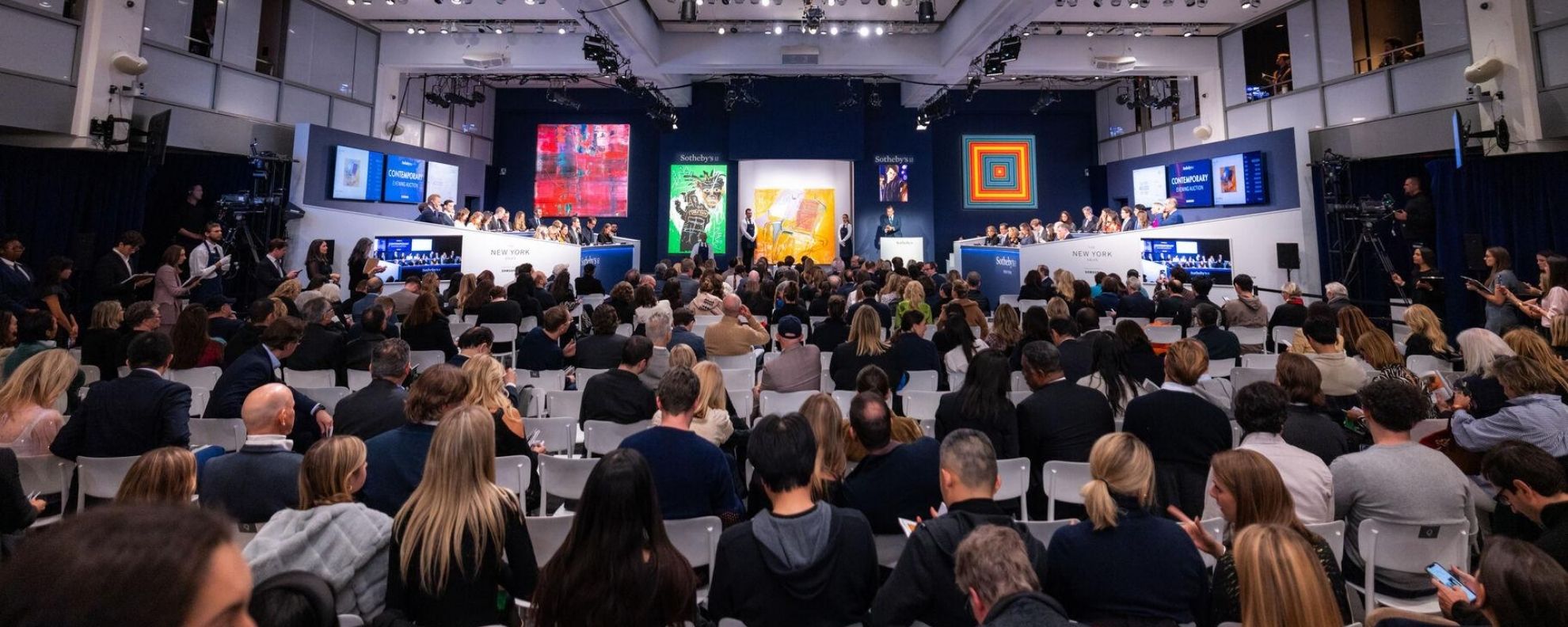
After two years of slowdown, the global art market is showing signs of renewed growth. Sales are rising, major auction houses are reporting stronger results, and headline auction records are making a comeback. At first glance, confidence appears to have returned. Yet behind these encouraging figures lies a more complex reality. The recovery is real, but it remains highly selective. Rather than marking a simple rebound, 2026 reveals a profound shift in the criteria that now determine the value of artworks, artists and galleries.
Key Figures for the Global Art Market
- US$59.6 billion in global art sales in 2025 (+4%)
- US$20.7 billion in public auction sales (+9%)
- US$34.8 billion in gallery sales (+2%)
- 44% of the global market remains concentrated in the United States
- 18% in the United Kingdom
- 8% in France, the European Union’s leading art market
- +30% increase in works sold above US$10 million
Sources: Art Basel & UBS Art Market Report 2026, Artprice, Sotheby’s and Phillips.
A Recovery That Remains Uneven
The latest market data confirms that the global art market has entered a new phase of growth. According to the Art Basel & UBS Art Market Report 2026, worldwide art sales reached US$59.6 billion in 2025, representing a 4% increase compared with the previous year.
Gallery sales rose by 2%, while public auction sales increased by 9%, suggesting that confidence is gradually returning after two years of market contraction.
Collectors are buying again, consignors are returning to the market and professionals are showing renewed optimism.
However, these figures should not be mistaken for a return to the exceptional post-pandemic boom experienced in 2021 and 2022.
Overall activity remains below the historic highs recorded during that period and, more importantly, the recovery is far from evenly distributed.
Some sectors are expanding rapidly.
Others continue to face significant challenges.
The market is recovering.
It is simply not recovering everywhere.
Auction Houses Regain Momentum
The first signs of recovery have come from the international auction houses.
Public auctions generated approximately US$20.7 billion in 2025. Including private sales organised by the major auction houses, total turnover exceeded US$24 billion.
The trend has continued into 2026.
Phillips reported more than US$500 million in auction sales during the first half of the year, representing growth of almost 60% compared with the previous year.
Sotheby’s also announced one of its strongest first-half performances in recent years.
These results undoubtedly demonstrate renewed activity.
Yet they also require careful interpretation.
Auction houses communicate their overall turnover, which includes not only fine art but also jewellery, watches, luxury collectibles, design, classic cars and other high-value categories.
Consequently, an increase in their global revenue does not necessarily reflect an equivalent rise in the contemporary art market alone.
Headline auction records are returning.
They do not, however, tell the whole story.
The Return of Trophy Works
Auction results reveal another striking trend.
In 2025, the value of artworks sold for more than US$1 million increased by 21%.
Sales above US$10 million grew by approximately 30%.
This performance has largely been driven by prestigious collections and exceptionally rare masterpieces entering the market.
When museum-quality works become available, international collectors continue to compete aggressively.
In a more uncertain economic environment, buyers naturally gravitate towards established names and proven quality.
Provenance, historical significance, condition, rarity and institutional recognition have become even more decisive factors than before.
By contrast, artworks sold below US$50,000 have experienced a slight decline in both value and volume.
The contrast is revealing.
A handful of spectacular sales dominate international headlines.
Meanwhile, the middle segment of the market remains considerably more cautious.
A Familiar Pattern in Art Market History
This situation is far from unprecedented.
Throughout history, periods of economic uncertainty have often encouraged collectors to return to artists whose markets are already well established.
When confidence weakens, buyers generally favour works supported by documented provenance, museum exhibitions, critical recognition and stable secondary-market performance.
The evolution observed in 2026 follows this historical pattern.
Rather than representing an entirely new phenomenon, it signals a renewed focus on the market’s fundamental principles.
Contemporary Art Does Not Benefit Equally
It would nevertheless be misleading to conclude that the entire contemporary art sector is benefiting from the recovery.
The highest auction prices continue to be achieved primarily by artists who already occupy an established place in art history.
Post-war art, Modern art and blue-chip contemporary artists still dominate the international auction calendar.
Collectors themselves appear to be changing the way they buy.
The period during which some acquisitions were driven largely by fear of missing the next rising star seems to be fading.
Today’s purchasing decisions increasingly rely on long-term indicators such as institutional exhibitions, museum acquisitions, scholarly publications, critical recognition, established gallery representation and a stable secondary market.
Visibility remains important.
But visibility alone is no longer sufficient to build lasting value for an artist.
Galleries Continue to Face Significant Challenges
The situation for galleries is considerably more nuanced than the encouraging figures reported by the major auction houses.
While overall gallery sales have recorded modest growth, this average conceals significant disparities. Some galleries have enjoyed an excellent year, whereas others continue to experience declining turnover and increasingly fragile business models.
At the same time, operating costs continue to rise.
Higher rents, international shipping, insurance premiums, participation in art fairs, specialist packaging, logistics and staffing expenses are placing growing pressure on profit margins.
The challenge is therefore no longer simply to sell more artworks.
It is to maintain a sustainable economic model.
Mid-sized galleries appear particularly vulnerable. Unlike the largest international galleries, they rarely benefit from extensive global networks or significant financial resources. Yet they must continue to support ambitious exhibition programmes, represent artists over the long term and remain visible at increasingly expensive international art fairs.
In today’s market, resilience has become just as important as commercial performance.
Paris Continues to Strengthen Its Position
Against this backdrop, France continues to consolidate its place within the global art market.
Representing approximately 8% of worldwide art sales, France remains the leading art market in the European Union and the fourth-largest market globally.
The arrival of international galleries, the growing influence of Art Basel Paris, and the sustained dynamism of French auction houses have all contributed to reinforcing Paris’s international profile.
However, this renewed momentum does not alter the overall balance of the global market.
The United States still accounts for around 44% of worldwide sales, while the United Kingdom maintains its position as the world’s second-largest art market.
The most significant auction results continue to be achieved primarily in New York.
Paris is undoubtedly gaining influence.
Yet the centre of gravity of the global art market remains firmly international.
A New Definition of Value
Beyond the figures, the most significant transformation concerns the way value is now created.
For several years, rapid online visibility, social media exposure and speculative enthusiasm were often capable of accelerating an artist’s market recognition.
Today, the market appears to be returning to more durable foundations.
The quality of the artwork itself, the consistency of an artist’s career, museum exhibitions, institutional acquisitions, scholarly publications, catalogue raisonnés and respected gallery representation are once again becoming decisive indicators.
In other words, today’s market rewards credibility more than novelty.
This evolution also restores the importance of specialist art magazines, exhibition catalogues and critical writing.
As collectors seek greater reassurance before making acquisitions, these publications play an increasingly important role in documenting artistic careers, contextualising artworks and contributing to an artist’s long-term reputation.
In an era dominated by rapidly changing digital content, carefully researched editorial publications remain essential tools for building lasting recognition.
What This Means for Artists
For contemporary artists, this shift sends a clear message.
Building a sustainable career is no longer simply a question of increasing visibility or maintaining a strong social media presence.
In a more selective market, consistency matters.
Exhibitions, institutional partnerships, publications, museum collections, artist residencies, critical essays and long-term gallery relationships are becoming increasingly important components of professional recognition.
Success is once again being measured over years rather than months.
For many artists, this may ultimately prove to be a healthier and more sustainable model of career development.
What Collectors Should Consider
For collectors, the current market environment encourages a more considered approach to acquisition.
Several factors have regained particular importance.
Documented provenance.
Exhibition history.
Scholarly publications.
Institutional recognition.
The relationship between the primary and secondary markets.
And the long-term stability of an artist’s career.
An exceptional auction result alone is no longer sufficient to demonstrate the strength of an artist’s market.
Today’s collectors increasingly favour informed decisions supported by research rather than short-term speculation.
More Than a Recovery: A New Market Cycle
The global art market is undeniably recovering in 2026.
The data clearly supports that conclusion.
Yet the most significant development lies elsewhere.
Rather than signalling a return to the exuberance that followed the pandemic, the current recovery appears to mark the beginning of a new market cycle.
Collectors are purchasing more selectively.
Quality is taking precedence over speculation.
Confidence is once again becoming one of the market’s most valuable currencies.
The art market is not merely redefining prices.
It is gradually redefining what constitutes lasting value.
For artists, galleries and collectors alike, this may ultimately be the most encouraging development of all.
It reminds us that the value of an artwork has never been determined solely by auction records or market trends.
It is built over time through artistic quality, critical recognition, institutional support, documented provenance and the confidence of those who preserve and transmit cultural heritage.
Read More :
Yes. After two years of slower activity, the global art market has returned to growth. However, the recovery remains uneven across different market segments.
Collectors are prioritising exceptional works with strong provenance, museum-quality significance, established market histories and institutional recognition.
Not equally. The market has become more selective, placing greater emphasis on consistent artistic practice, exhibitions, publications and long-term career development.
Yes. France remains the European Union’s leading art market and continues to reinforce Paris’s position as a major international art hub.
Many experts believe that the current environment favours thoughtful acquisitions based on quality, provenance and long-term artistic relevance rather than short-term market speculation.