


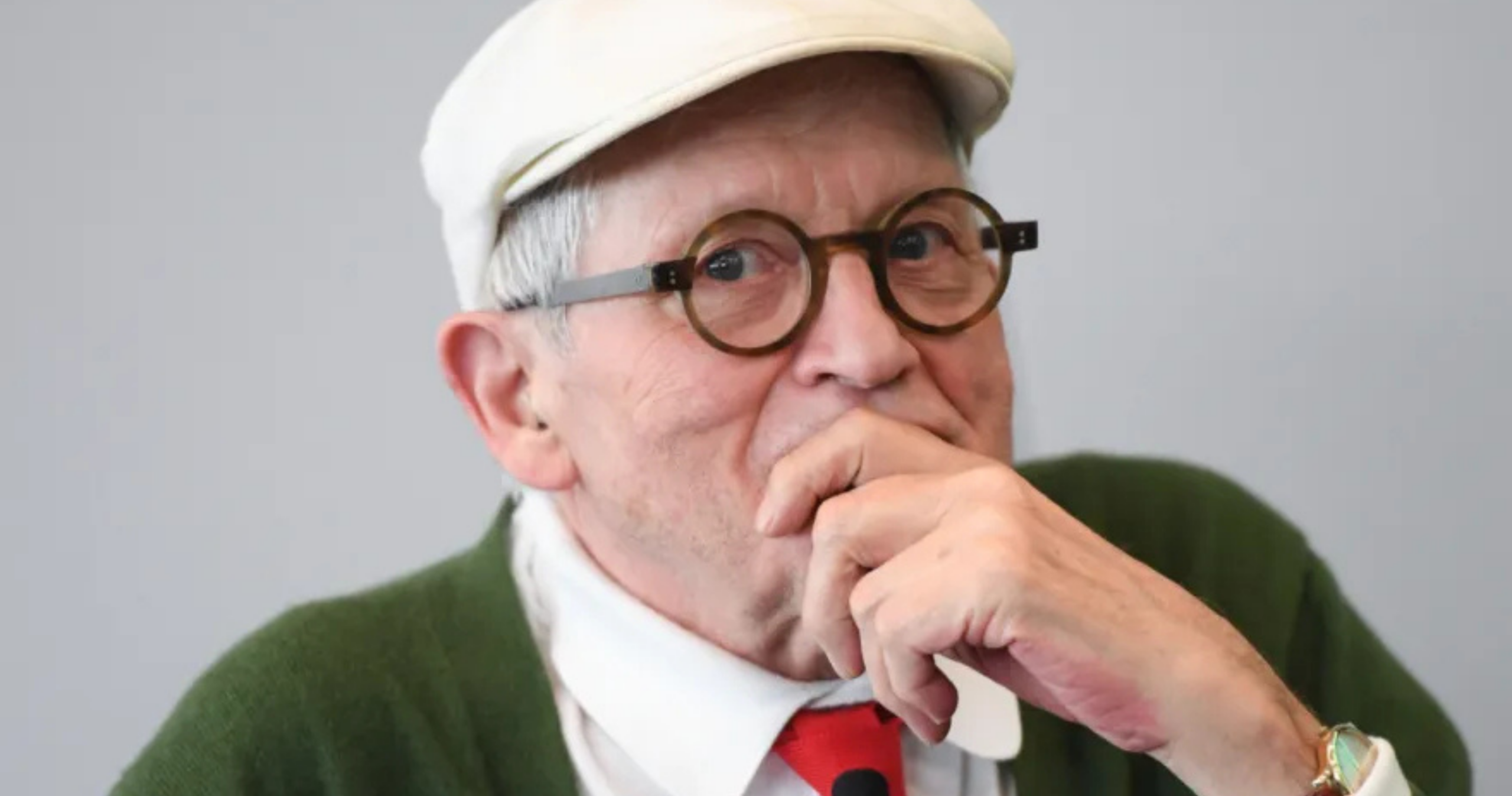
David Hockney passed away on June 11, 2026, at the age of 88. A major figure in British contemporary art, the artist leaves behind more than six decades of creation and some of the most iconic images in modern art history. Known for his Californian swimming pools, luminous landscapes, and striking portraits, he profoundly influenced contemporary painting while also exploring photography and digital media.
Yet reducing David Hockney to his most famous works would mean missing what truly mattered.
For if his work feels remarkably relevant today, it is neither because of his colours nor because of his early adoption of the iPad.
It is because he devoted his life to defending an idea that has become increasingly rare: looking at the world remains an adventure.
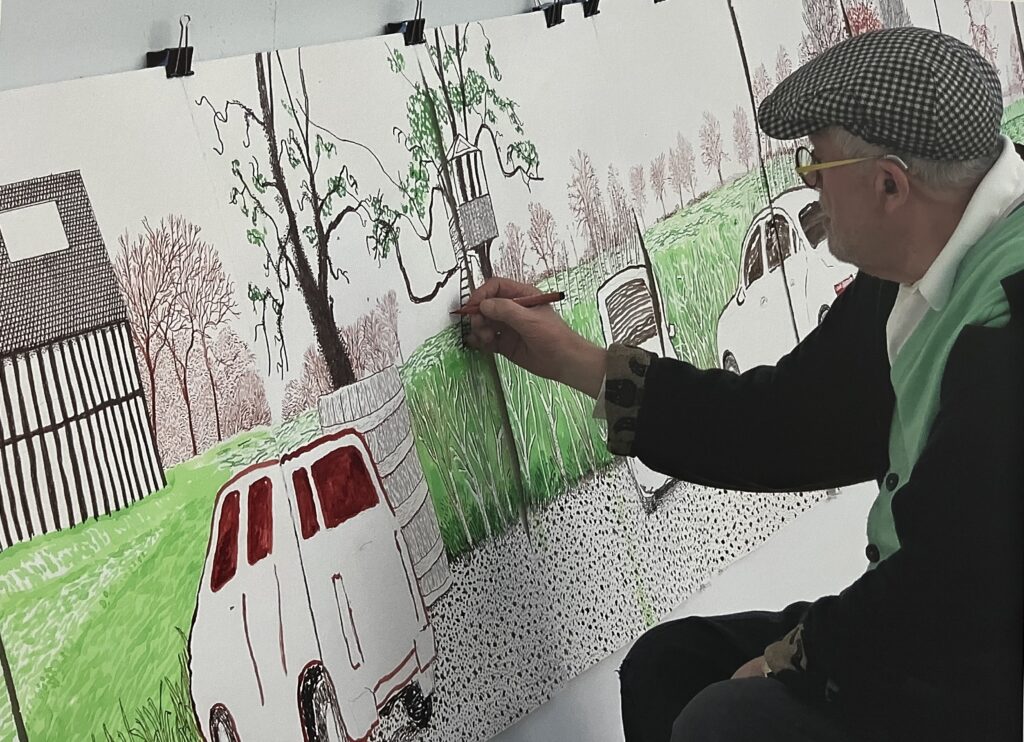
David Hockney and the Defence of the Visible
Hockney is often remembered as the painter of California. The swimming pools of Los Angeles, the dazzling light of the American West Coast, and the vast landscapes of Yorkshire all contributed to his international reputation.
Yet these subjects were never the true heart of his work.
For more than sixty years, David Hockney pursued a single question: how do we see the world?
This inquiry runs throughout his entire career. His paintings, photocollages, studies of the Old Masters, and digital experiments all form part of an ongoing reflection on perception.
From an early stage, Hockney understood that human vision does not function like a camera. We never observe a scene from a single fixed viewpoint. Our eyes move, compare, select, and constantly reconstruct what they perceive.
His celebrated photographic collages of the 1980s embody this intuition. They do not simply depict a place or a face; they attempt to recreate the very experience of looking.
Support independent publishing! Subscribe to ART MAG and receive each issue in advance, in both print and digital format
👉 Subcribe 6 issues / 1 year
👉 Offer ART MAG
An Artist Against the Current
The importance of David Hockney may lie in this unwavering commitment to direct visual experience.
While contemporary art explored new conceptual, performative, and technological directions, Hockney continued to investigate the visible. Not out of nostalgia. Not out of resistance to modernity.
Quite the opposite.
Few artists of his generation embraced new tools with such curiosity. Photography, fax machines, video, digital drawing, and the iPad all became part of his creative vocabulary.
Yet he used these technologies to address an enduring question.
How can the human experience of seeing be translated into an image?
This consistency explains why his work escapes easy categorisation. Too experimental to be considered merely figurative. Too deeply rooted in observation to be reduced to conceptual art.
Hockney occupied a singular position.
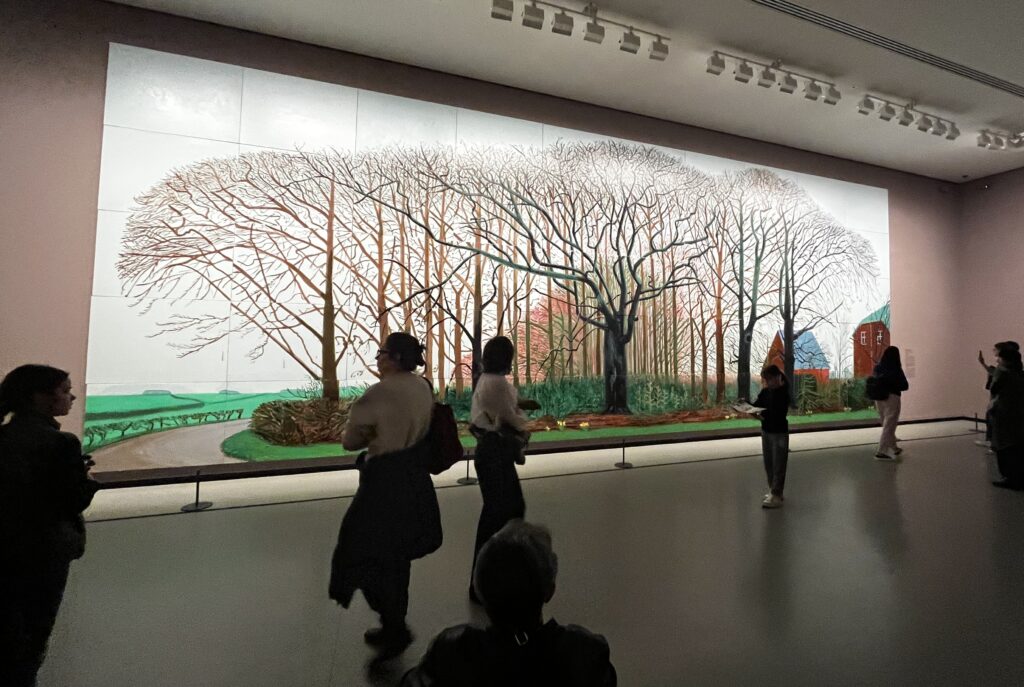
Why His Work Still Speaks to Us Today
David Hockney’s passing comes at a time when images have never been more abundant.
Yet his legacy is not primarily about technology.
It is about attention.
Faced with a flowering tree, a landscape, or a portrait, Hockney reminds us that seeing is never automatic.
Looking requires time.
Availability.
Curiosity.
This proposition may seem modest.
It is, in fact, profoundly radical.
In a world driven by speed, constant commentary, and immediacy, devoting one’s life to observing light on a wall, the colours of a landscape, or the features of a face can almost be seen as a form of resistance.
That is perhaps why his work feels so relevant today.
Support independent publishing! Subscribe to ART MAG and receive each issue in advance, in both print and digital format
👉 Subcribe 6 issues / 1 year
👉 Offer ART MAG
What Legacy Does David Hockney Leave Behind?
David Hockney leaves behind an immense body of work that has influenced generations of artists.
Yet his legacy extends far beyond museums, auction records, or major retrospectives.
For more than sixty years, he demonstrated that there is always something left to see.
Through his paintings, photographs, and digital drawings, he reminds us that art is not only about producing images.
It is also about learning how to look.
With David Hockney’s passing, we may have lost one of the last artists for whom observing the world remained an adventure.
Read More : David Hockney: An Unprecedented Retrospective at the Fondation Louis Vuitton
Support independent publishing! Subscribe to ART MAG and receive each issue in advance, in both print and digital format
👉 Subcribe 6 issues / 1 year
👉 Offer ART MAG
FAQ : David Hockney
David Hockney passed away on June 11, 2026, at the age of 88.
David Hockney is regarded as one of the most influential British artists of the twentieth and twenty-first centuries. He is known for his paintings, portraits, landscapes, and groundbreaking explorations of perception.
Among his best-known works are A Bigger Splash (1967), Portrait of an Artist (Pool with Two Figures) (1972), Mr and Mrs Clark and Percy (1971), and his monumental Yorkshire landscapes.
Yes. David Hockney is often associated with British Pop Art of the 1960s. However, his work extends far beyond the movement and developed into a broader exploration of vision and representation.
Hockney viewed the iPad as a creative tool rather than a technological statement. He used it extensively to create digital drawings while continuing his lifelong exploration of colour, light, and perception.
David Hockney leaves behind a body of work that transformed the way we think about perception, representation, and visual experience. His influence can be seen in both contemporary painting and digital artistic practices.
David Hockney’s works are held in major museums and collections worldwide, including institutions in London, Paris, Los Angeles, and New York.