



A sphere supporting a tilted form, two shapes seemingly searching for balance: in Stéphane Clamens’ work, wood tells stories that words sometimes struggle to express. Through sculptures defined by clean, understated lines, the contemporary artist explores the vulnerabilities, impulses and relationships that shape human existence.
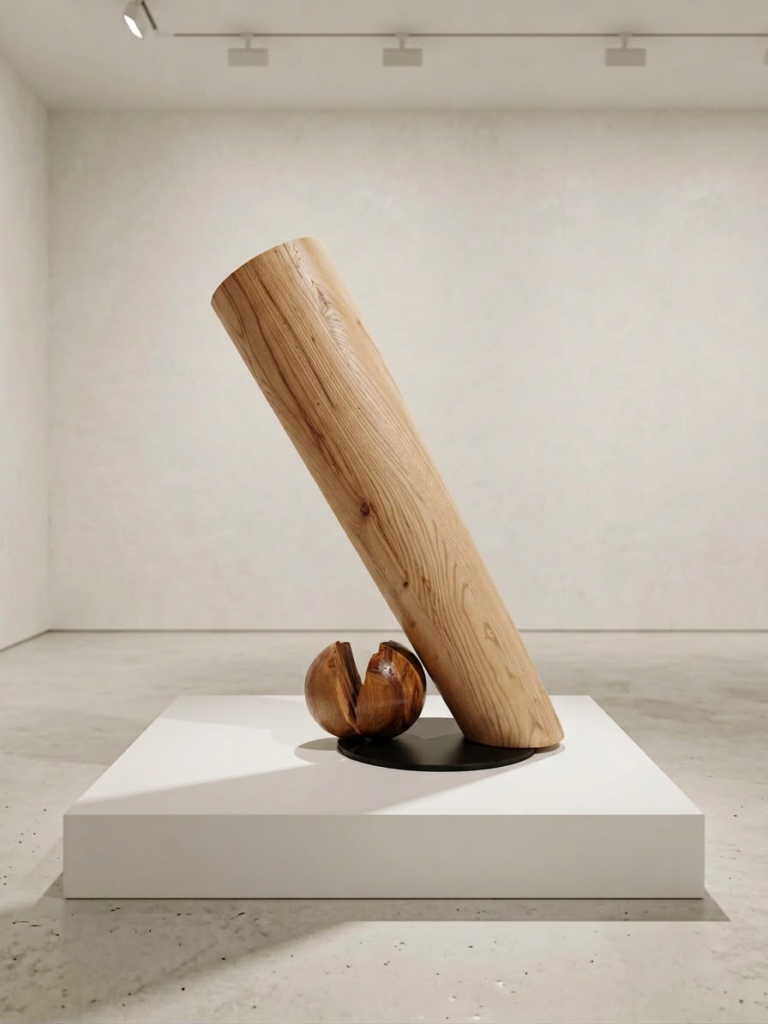
Stéphane Clamens: A Sculptural Language Between Abstraction and Emotion
How can human relationships be evoked without depicting a single figure? This is one of the questions raised by Stéphane Clamens’ work. His contemporary wooden sculptures bring together simple geometric forms whose interactions suggest surprisingly familiar situations.
A sphere appears to support a larger volume, a structure seems on the verge of tipping over, two elements find a shared point of support. Nothing is explicitly figurative, yet something unfolds between the forms.
This ambiguity is one of the defining characteristics of his work. While abstraction can sometimes create distance between an artwork and its audience, Clamens seeks instead to encourage intuitive recognition. His compositions evoke gestures, attitudes and relationships that viewers can interpret through their own experiences.
The artist thus develops a sculptural language in which the arrangement of volumes matters as much as their appearance. A slight tilt, a point of contact or the space between two elements can be enough to transform the perception of the whole.
Wood: A Material That Already Carries a Story
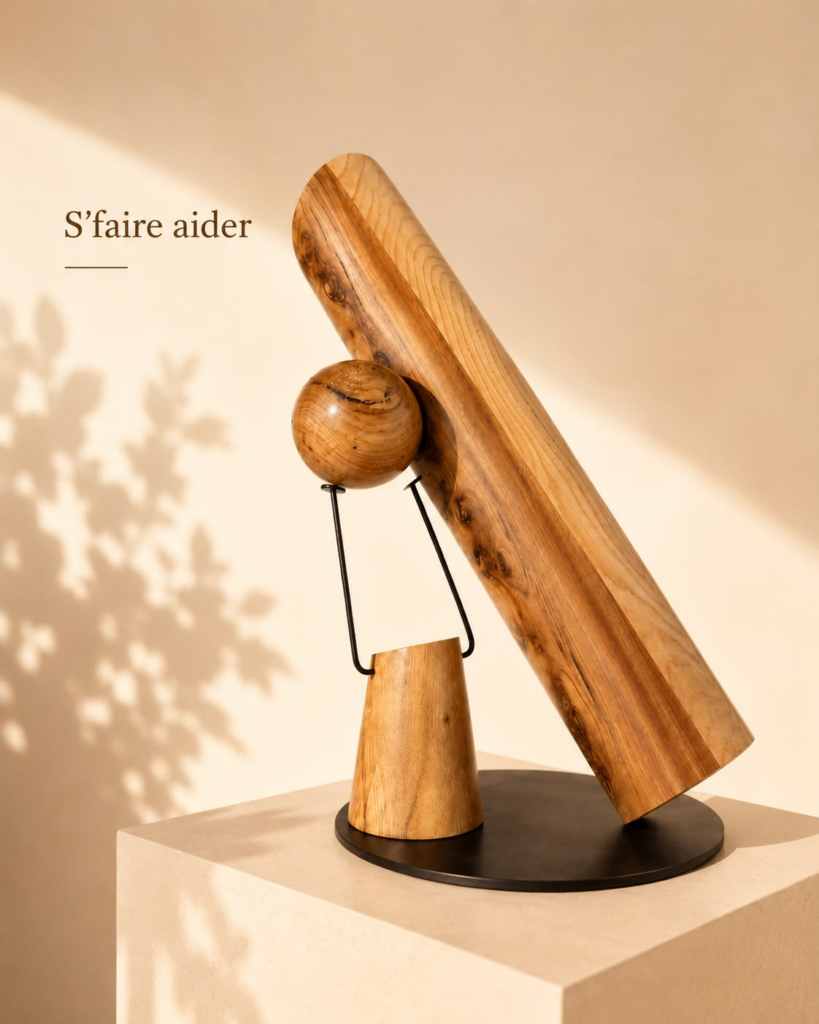
The choice of wood is far from incidental in Stéphane Clamens’ work. Its grain, subtle variations in colour and natural irregularities introduce an organic dimension into compositions otherwise built around geometric forms.
This encounter between natural material and geometric precision creates a particularly striking contrast in his sculptures.
Wood retains the traces of its growth, while the lines shaped by the artist give it a new direction. The material is therefore more than a simple medium: it actively contributes to the artwork’s expression.
Clamens’ background sheds light on this particular relationship with the material. After more than thirty years in a professional field far removed from artistic creation, he gradually turned to woodworking, initially producing unique pieces of furniture before developing lighting objects with increasingly sculptural forms.
Sculpture eventually became his primary means of expression as formal exploration took precedence over function.
This evolution remains visible in his work today, where each element appears to serve a sculptural purpose rather than a decorative one.
“Les sphères le temps”: Sculptures Exploring Human Relationships
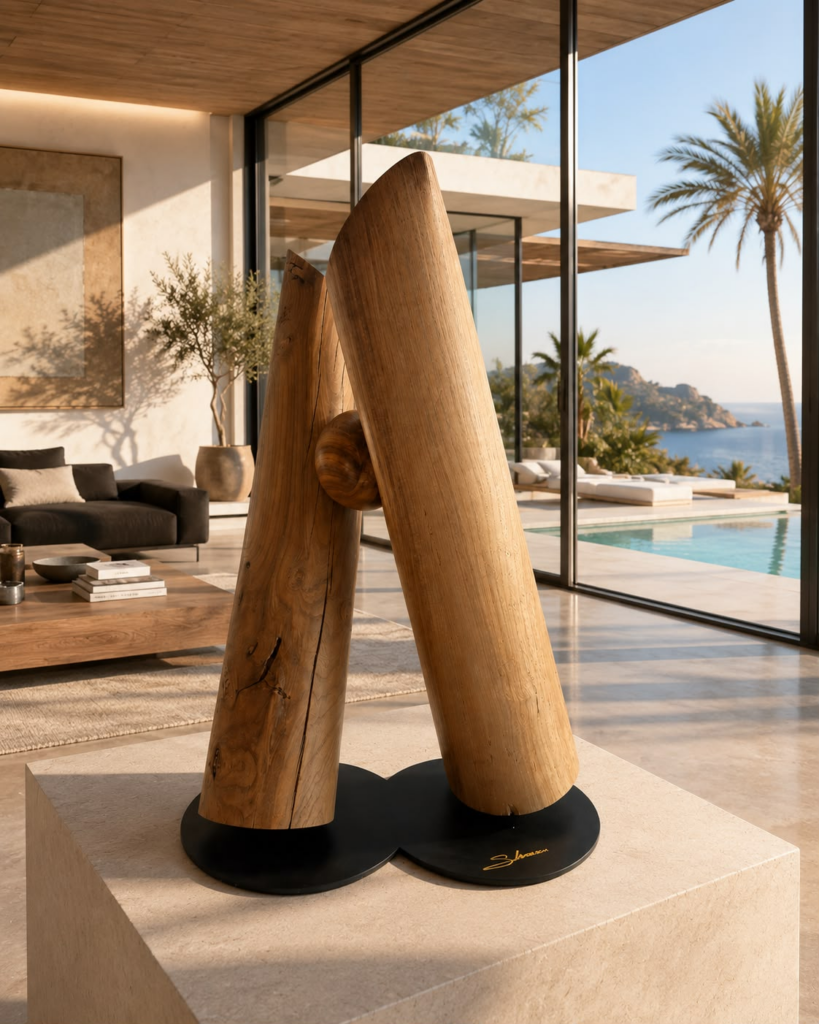
With his series Les sphères le temps, Stéphane Clamens introduces a narrative dimension into compositions that deliberately remain open to interpretation.
The titles play a distinctive role. S’faire aider (Getting Help), S’faire plaisir (Treating Oneself) and S’faire éclater (Bursting Apart) draw on everyday French expressions that immediately evoke human experiences.
In S’faire aider, a sphere and a supporting structure accompany a tilted wooden volume. The composition suggests a relationship of dependence or solidarity without imposing a single interpretation.
S’faire éclater introduces a different dynamic. The arrangement of its elements creates a sense of tension, as though the sculpture were capturing a moment of transformation.
In S’faire plaisir, the proximity of the volumes suggests a calmer relationship, shaped by their closeness.
These works share a common characteristic: they seem to capture a fleeting moment rather than depict a fixed state.
Sculpture becomes a space for personal projection. The forms do not tell a specific story, but offer enough visual clues for viewers to imagine their own.
When the Viewer’s Gaze Extends the Artwork
Another compelling aspect of Stéphane Clamens’ sculptures is the way they change depending on how they are observed.
Seen from the front, a composition may appear stable. Viewed from the side, it reveals a more pronounced inclination or an unexpected relationship between its volumes. The empty spaces become just as significant as the wooden elements themselves.
This interplay between solid forms and negative space contributes to the construction of meaning.
Rather than multiplying details, the artist favours an economy of means that leaves considerable room for imagination. This restraint is both the strength of his visual language and its central challenge: to evoke emotion without relying on conventional forms of representation.
The viewer is therefore invited to do more than simply contemplate an object. In a sense, they must complete what they see.
It is within this space between physical form and personal interpretation that the sculptures acquire another dimension.
Stéphane Clamens’ sculptures do not seek to tell a single story. They present situations in which each viewer may recognise something of their own existence. Between what the artist suggests and what the viewer imagines, the artwork finds its true freedom.
Discover Stéphane Clamens in ART MAG International
Would you like to explore his artistic journey and sculptural universe in greater depth?
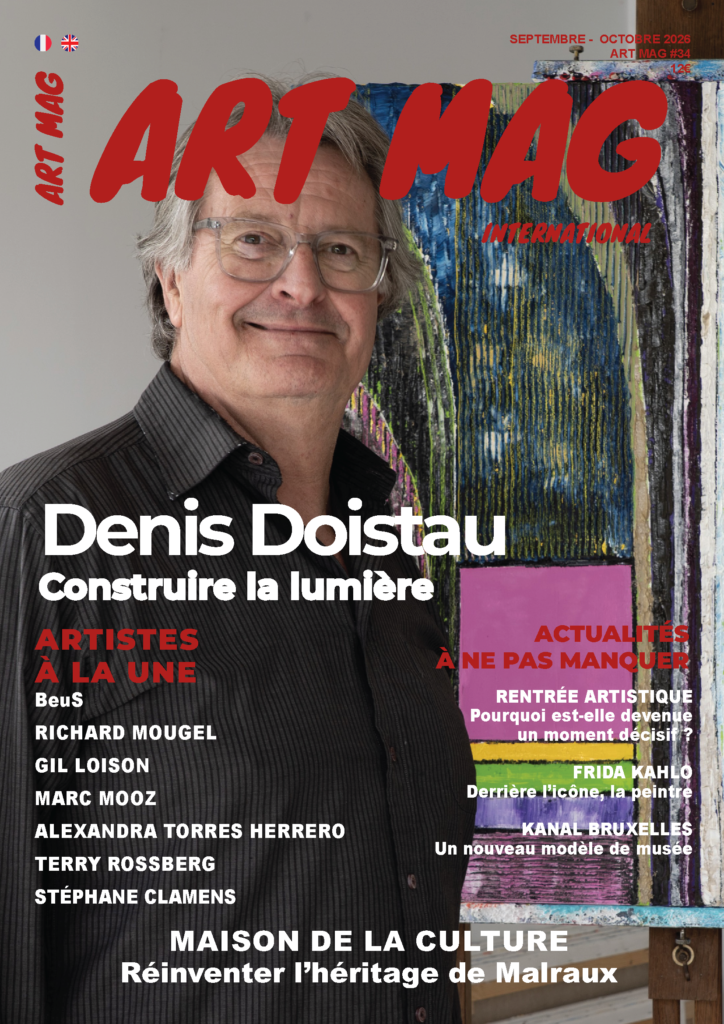
Discover Stéphane Clamens in issue 34 of ART MAG International (September–October 2026).
Two illustrated pages, in French and English, offer a deeper insight into his artistic approach, the evolution of his work and the way his sculptures give rise to visual narratives.
Continue your exploration with ART MAG International, the independent magazine dedicated to contemporary art.
📖Le numéro 34 est disponible en version papier et numérique.