


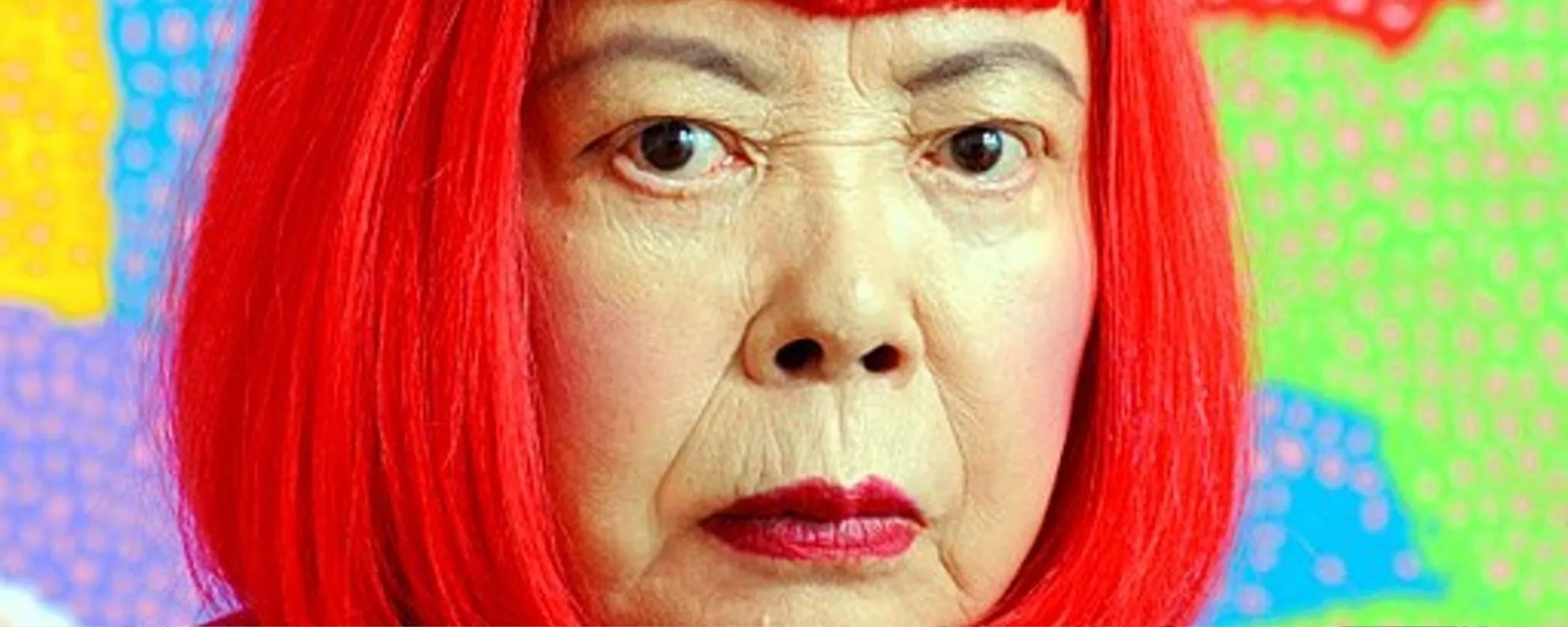
Japanese artist Yayoi Kusama died in Tokyo on 14 August 2026 at the age of 97. From her early Infinity Nets to the immersive installations that captivated audiences around the world, she spent more than eight decades exploring repetition, self-obliteration and infinity. Beyond the polka dots and pumpkins that became iconic, her death raises a broader question: how does an artistic language become so distinctive that an artwork can be recognised before we even see the artist’s name?
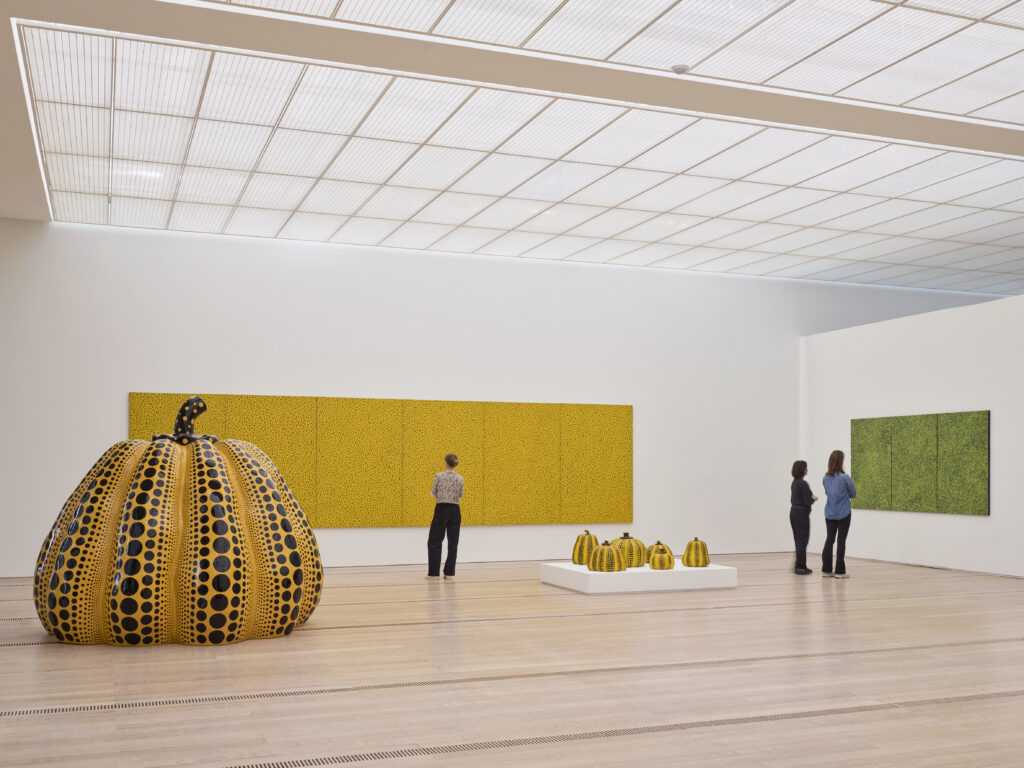
Yayoi Kusama: a loss that goes beyond the icon
The death of Yayoi Kusama, announced on 27 August by her studio and the museum bearing her name in Tokyo, marks the end of one of the most distinctive careers in contemporary art.
Born on 22 March 1929 in Matsumoto, Japan, Kusama leaves behind a body of work spanning more than eight decades, from painting and sculpture to performance and immersive installation.
Yet today, only a few visual signs are needed to evoke her name.
Polka dots proliferating across a surface. A monumental pumpkin. Mirrors in which light appears to repeat endlessly.
Kusama had become recognisable before we even read her signature.
That immediate visual recognition can almost make us forget the depth of her work: behind the images that became iconic lies a persistent investigation into repetition, the dissolution of the self and our relationship with infinity.
When repetition becomes a language
Yayoi Kusama’s polka dots were not conceived simply as a decorative motif.
From childhood, the artist described experiencing perceptions in which forms and patterns seemed to proliferate around her. These experiences gradually fed into a vocabulary of dots, nets and accumulations.
Repetition became more than a visual process: it was a way of thinking about space and the individual’s place within it.
Kusama would develop the concept of “self-obliteration” around this idea. The motif repeats until it invades the surface; the individual, in turn, seems capable of dissolving within it.
This principle would run throughout her work.
The medium changes. The language remains.
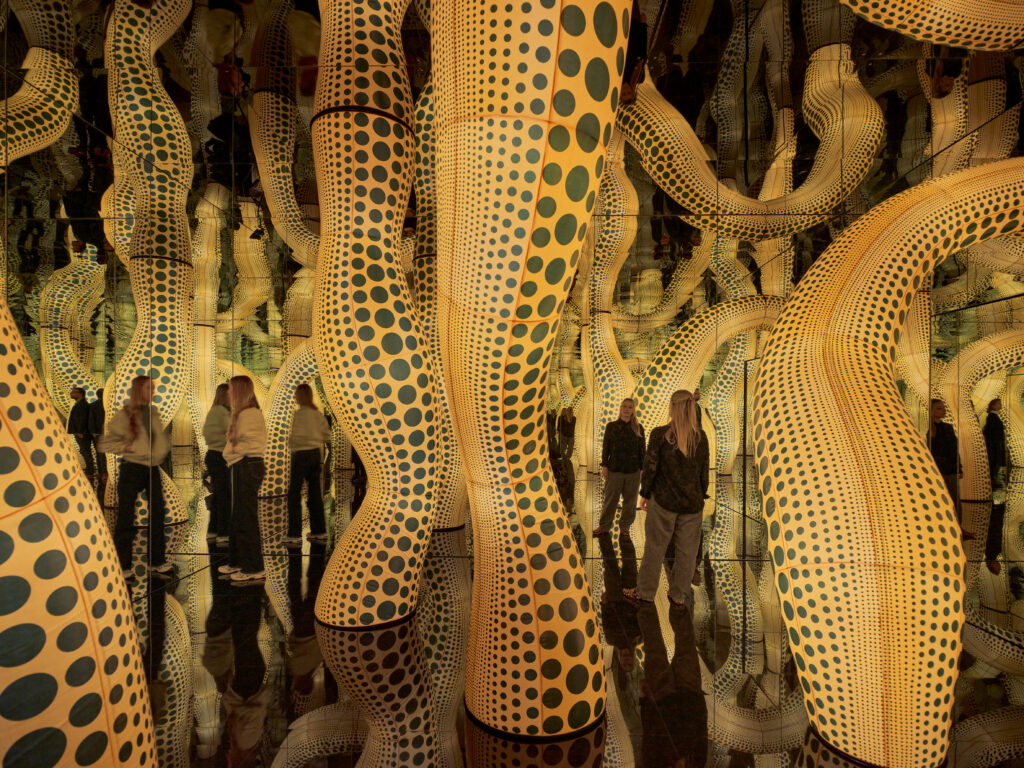
From Infinity Nets to Infinity Mirror Rooms
When Yayoi Kusama moved to New York in the late 1950s, the American art scene was undergoing profound transformation.
There she developed her Infinity Nets, vast paintings covered with countless small, repeated gestures. No true centre structures the composition. The network appears capable of continuing beyond the edges of the canvas.
Infinity is already present.
A few years later, this investigation gradually moved beyond the painted surface and into physical space.
With the Infinity Mirror Rooms, mirrors, lights and repetition visually dissolve architectural boundaries. The viewer is no longer simply standing in front of an artwork: they enter it.
Their own reflection multiplies until it becomes part of the installation itself.
From the Infinity Nets to the mirrored rooms, Kusama ultimately pursued the same question: how can we give form to something that seems as though it will never end?
The pumpkin: from familiar object to icon
Another motif runs throughout her work: the pumpkin.
Painted, sculpted or installed in public spaces, it gradually became inseparable from the artist.
Covered in polka dots and produced on dramatically different scales, the pumpkin encapsulates part of the Kusama paradox: she takes a familiar form and turns it into something instantly identifiable yet strangely unfamiliar.
Her monumental pumpkins would contribute significantly to the international recognition of her work.
Above all, however, they reveal an essential ability: to transform an extremely limited visual vocabulary into a universe capable of renewing itself over several decades.
Recognition was far from immediate
Yayoi Kusama’s ubiquity today might suggest a career marked by uninterrupted recognition. Her trajectory was far more complex.
In 1960s New York, she participated in the avant-garde, developing paintings, sculptures, installations and performances while remaining difficult to confine within any single artistic movement.
After returning to Japan in 1973, her international visibility diminished for several years.
It was not until the 1990s that her work regained a major position on the international art scene. Her appearance at the 1993 Venice Biennale, where she represented Japan, marked a decisive stage in this rediscovery.
Major international exhibitions followed.
An artist who had long occupied the margins of several dominant narratives of twentieth-century art gradually became one of its most celebrated figures.
Did success eventually overshadow the art?
This may be one of the most interesting paradoxes surrounding Yayoi Kusama.
Her Infinity Mirror Rooms became experiences sought out by millions of visitors. Her monumental pumpkins entered public spaces. Her polka dots moved beyond museums into fashion and popular culture.
In the age of social media, her installations also possess all the qualities of images designed to circulate: immersion, light, repetition and spectacle.
But this extraordinary popularity can also alter the way we look at her work.
When Kusama is so instantly recognisable, do we still truly look at the art?
The media phenomenon can sometimes obscure the fact that her visual vocabulary was established long before Instagram, queues for the Infinity Rooms and international collaborations.
For Kusama, repetition did not originate as an image-making strategy. It was one of the foundational obsessions of her practice.
And it is precisely this continuity that distinguishes an artistic signature from a mere visual identity.
How does an artwork become a signature?
Yayoi Kusama’s death therefore raises a question that extends far beyond her own career: what makes an artist’s work truly recognisable?
In her case, the answer does not lie solely in polka dots, mirrors or pumpkins.
It lies in the consistency with which she explored a small number of fundamental concerns over more than eight decades: repetition, accumulation, infinity, the dissolution of the self and the relationship between the individual and space.
An artistic signature emerges when these elements cease to be merely a style and become the expression of a way of thinking.
Kusama offers a particularly striking example.
Her motifs can be reproduced. Her installations can be photographed endlessly. Her pumpkins can be recognised instantly.
Yet behind these familiar signs remains the same question, pursued from one artwork to the next.
What will remain of Yayoi Kusama?
The death of an artist inevitably changes the way their work is viewed.
In Kusama’s case, this question carries particular resonance. Her entire body of work seems to have sought to transcend boundaries: those of the canvas, the body, space and, ultimately, the individual.
Her studio stated that she continued painting until her final days.
That gesture probably says more about her career than her immense celebrity ever could.
For more than eight decades, Yayoi Kusama returned to a small number of forms, repeating, shifting, enlarging and transforming them.
Until repetition itself became a form of difference.
And infinity became her signature.
FAQ – Yayoi Kusama
Yayoi Kusama died in Tokyo on 14 August 2026, at the age of 97. Her death was officially announced on 27 August 2026 by her studio and the Yayoi Kusama Museum.
The Japanese artist is best known for her polka dots, Infinity Nets, pumpkin sculptures and immersive Infinity Mirror Rooms. Her work explores repetition, infinity, accumulation and the dissolution of the self.
The Infinity Mirror Rooms are installations in which Yayoi Kusama uses mirrors, lights and repeated elements to create the impression of space extending infinitely. The viewer becomes an integral part of the artwork.
Polka dots belong to the artistic vocabulary Kusama developed early in her career around repetition and proliferation. Over time, they became one of the most immediately recognisable elements of her work.
Yayoi Kusama participated in the New York avant-garde, and her work has connections with several twentieth-century movements, including Minimalism and Pop Art. However, her highly individual artistic language makes her difficult to confine within any single movement.
Yayoi Kusama leaves behind more than eight decades of artistic creation and an instantly recognisable visual language. Beyond the popularity of her installations, her work profoundly explored repetition, infinity and the place of the individual within space.