


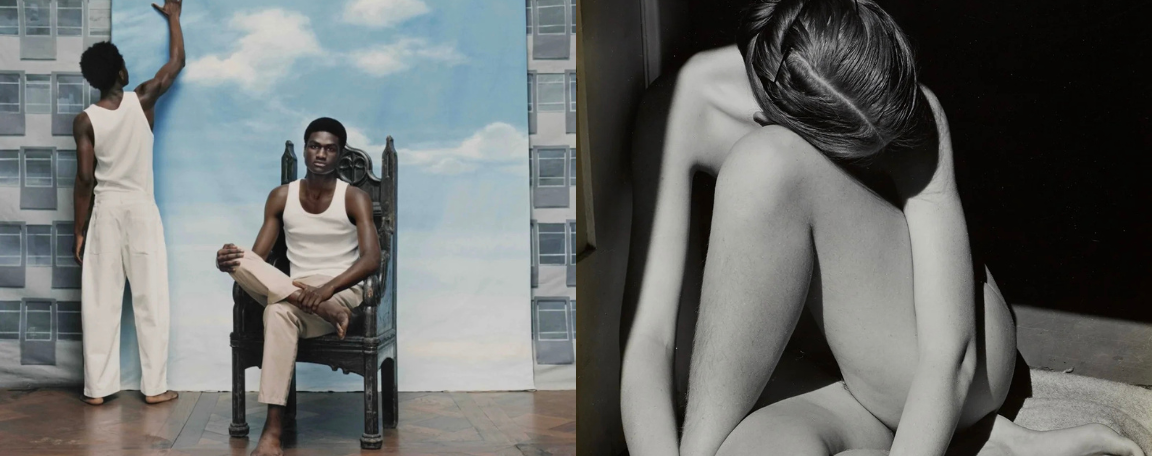
From 15 October 2025 to 25 January 2026, the Maison Européenne de la Photographie is presenting an exceptional diptych, bringing together Edward Weston and Tyler Mitchell in two parallel exhibitions.
Separated by a century but united by the same ambition to make photography a language of modernity and revelation, they embody two radically different ways of questioning reality.
The 2025 season at the MEP thus highlights, on the one hand, Weston’s seminal transition to modernism and, on the other, the emergence of a new vision championed by Mitchell, in which beauty, self-determination and black imagination unfold with force.
Edward Weston: Modernity Revealed: The Birth of a Modern Vision
The exhibition Modernity Revealed offers the most extensive presentation of Weston’s work in Paris in nearly thirty years. It brings together more than one hundred vintage prints, several of which have never been shown in France, from the Wilson Centre for Photography.
The exhibition traces his influences, his breaks with tradition and his decisive role within the f/64 group, which championed pure, unmanipulated photography.
From pictorialism to modernist rigour
The exhibition shows how Weston rapidly evolved from allegorical pictorialism to a refined style of photography based on sharpness, precision and the search for essential form.
Two iconic images, taken one year apart, bear witness to this shift:
- M on the Black Horsehair Sofa (1921), still pictorialist,
- Tina Modotti (Nude in Studio) (1922), strikingly modern.

Courtesy Wilson Centre for Photography
Mexico: a laboratory for visual audacity
Alongside Tina Modotti, photographer and activist, Weston developed a more contrasting, immediate and daring language, fuelled by formal experimentation. His portraits, still lifes and studies of natural forms became icons of modernism.
Legendary series
The 1930s cemented his style:
- peppers,
- shells,
- Charis’ nudes,
- Point Lobos landscapes.
Weston reveals a sculptural style of photography, focused on form and light, in search of what he calls “the very essence of the thing”.
For art and photography lovers, the exhibition is one of the cultural highlights of the autumn season.
Tyler Mitchell — Wish This Was Real: Black utopia in the present
At the same time, the MEP is presenting Wish This Was Real, the first solo exhibition in France by American photographer Tyler Mitchell, born in 1995.
His multifaceted work, which includes photography, video and textiles, explores beauty, memory and freedom through luminous representations of Black people.
Mitchell, who rose to fame in 2018 after photographing Beyoncé for Vogue US, produces work in which gentleness, staging and political activism coexist harmoniously.
Lives / Freedoms: youth as a space for emancipation
His early images, influenced by skateboarding and Tumblr, depict scenes of camaraderie and freedom. They embody an everyday utopia in the face of an often hostile social context, making joy an act of self-protection.
Postcolonial / Pastoral: the earth as memory
In a reinterpretation of the pastoral landscape, Mitchell places black bodies at the centre of a romantic imagination that is nonetheless conscious of the wounds of history. His textile works amplify this symbolic gesture by introducing texture and transparency.
Family/Fraternity: Intimacy as a Living Archive
In Brooklyn, Mitchell photographs family and friends in interiors emblematic of Black American life. Following in the footsteps of Gordon Parks and Deborah Willis, he explores transmission, home, and representation as tools for anchoring identity.
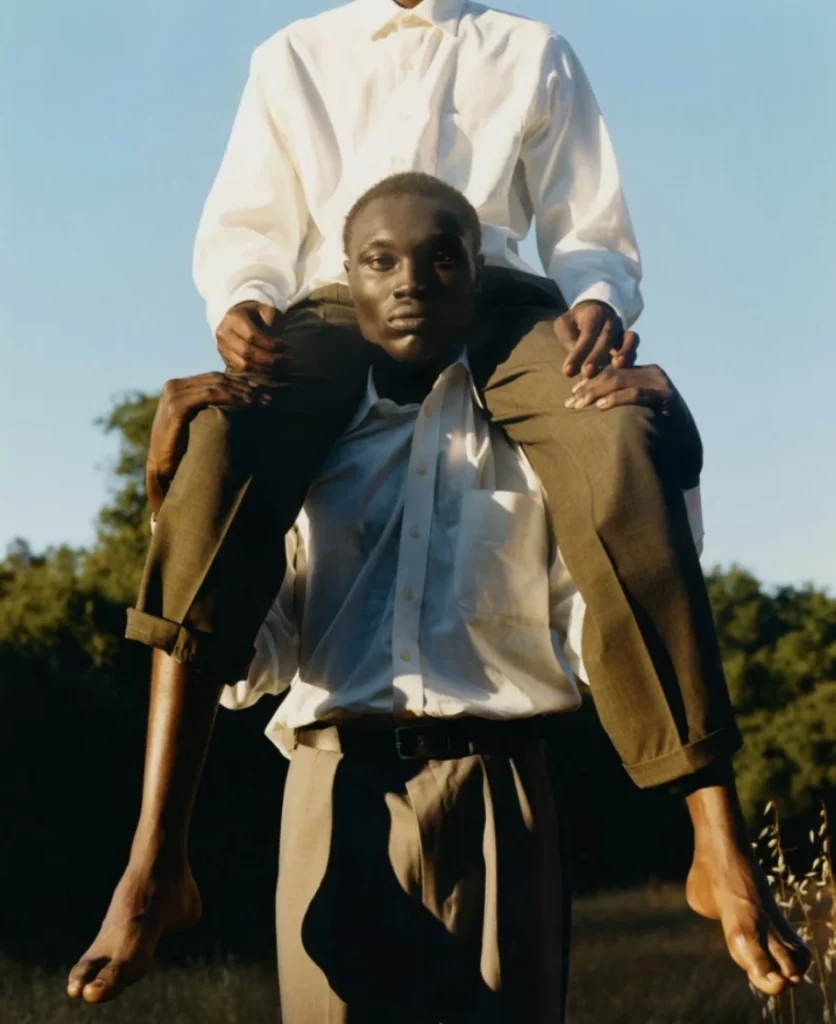
An unprecedented dialogue between two visions of modernity.
By bringing Weston and Mitchell together, the MEP offers a cross-disciplinary interpretation of photography:
- Weston reveals the world by stripping it bare,
- Mitchell transforms reality by illuminating it.
- One constructs modernity, the other reinvents it.
- One works with form, the other works with the imagination.
Their works show how photography remains a field of exploration, truth and emancipation.
See also :
- Tyler Mitchell at the MEP: an exhibition that redefines contemporary visual narratives
- A major event: Edward Weston at the MEP in 2025
FAQ:
The MEP wants to show how photography, separated by a century, remains a language of modernity: Weston reveals form, Mitchell reinvents the imagination.
From 15 October 2025 to 25 January 2026 at the MEP, Paris.
Over a hundred vintage prints, including iconic images: peppers, shells, Charis, Oceano dunes, Point Lobos landscapes.
Luminous works exploring youth, utopia, postcolonial landscapes and family memory, as well as innovative textile pieces.
Yes, the exhibitions are accessible, educational and visually striking.