


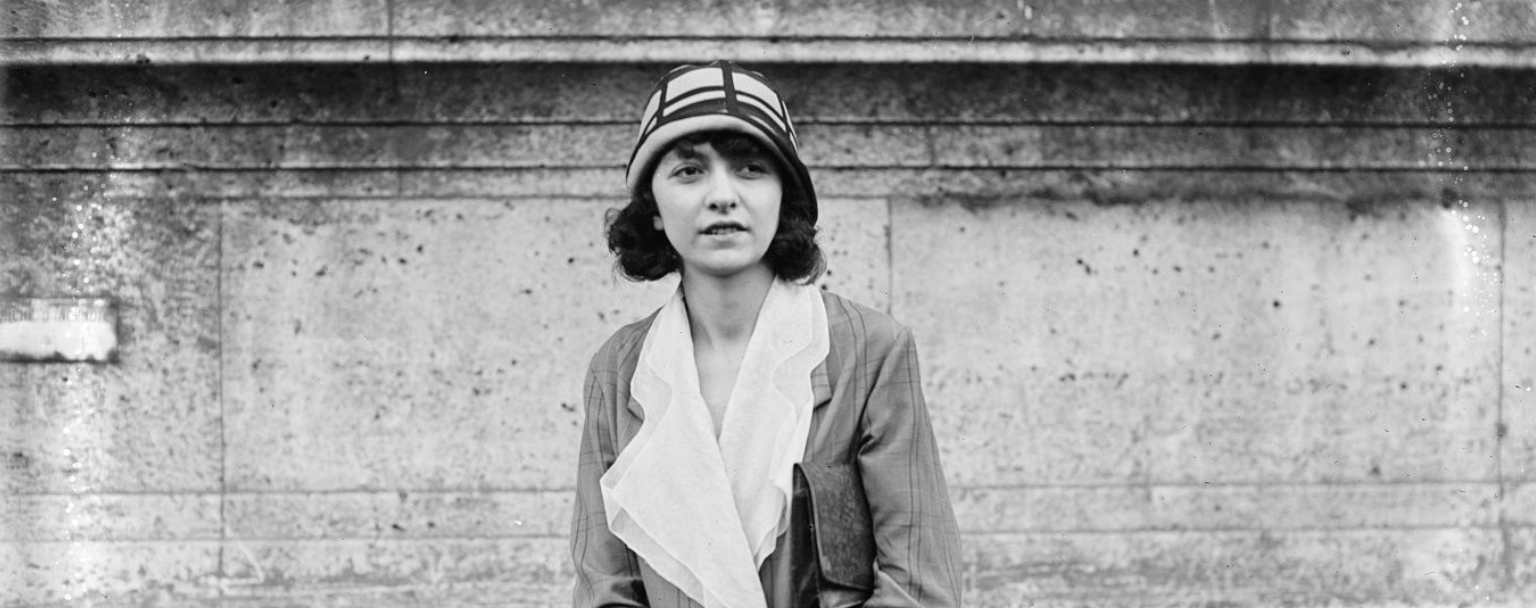
The first woman painter to win the Grand Prix de Rome (1925), Odette Pauvert forged a sober, frontal modernity, nourished by the Quattrocento and conceived for large-scale decorative schemes. From the Villa Medici to the intimate scenes of the postwar years, her path sheds light on another history of the interwar period.
Biographical Landmarks
Trained at the École des Beaux-Arts in Paris, Pauvert stayed at the Villa Medici (1926–1929), where her clean contours, matte colors, and portrait-landscape approach were refined. Back in Paris, she set her sights on mural painting (the Église du Saint-Esprit, school decorations, Sèvres, 1937 International Exposition). In 1934, the Casa de Velázquez liberated her drawing (charcoal, red chalk). After 1945, material constraints and family life led her toward smaller formats without renouncing her initial ambition.
Style & Key Works
- Promotion 1926 (1927) — a signature of the Roman period.
- Invocation à Notre-Dame-des-Flots (1925) — inhabited classicism.
- Habib Benglia (1931), Paris 1932 (Yvonne Pesme) — commanding frontality.
- Le Torero (1934) — stylization and tension of line.
- Odile, Yves et Rémy at the Rond-Point des Champs-Élysées (1946) — a domestic postwar turn.
Legacy
Long overshadowed by the avant-gardes, Pauvert embodies an alternative modernity: clarity, calibrated scale, and a disciplined gaze. Recent reassessments place her among the major women artists of the 20th century, at the crossroads of Art Deco and Renaissance tradition.
Want to see more?
👉 Subscribe — 6 issues / 1 year
👉 Gift ART MAG
FAQ — Odette Pauvert (1903–1966)
Who is Odette Pauvert?
Odette Pauvert was a French Art Deco painter and the first woman painter to win the Grand Prix de Rome (1925). Her work advances a sober, frontal modernity informed by the Quattrocento and conceived for large-scale decorative schemes.
Why is she important in Art Deco history?
She embodies a classical modernity as an alternative to the avant-gardes: clarity of form, clean contours, matte colors, a strong sense of mural scale, and disciplined looking.
Where did she train?
At the École des Beaux-Arts in Paris, then at the Villa Medici (1926–1929), where her frontal style and portrait-landscape approach matured. A stay at the Casa de Velázquez (1934) further liberated her drawing (charcoal, red chalk).
What does “classical modernity” mean in her work?
A pursuit of balance and legibility derived from the Italian Renaissance (Quattrocento), applied to contemporary subjects—portraits, scenes, and mural painting.
What are her key works to know?
- Promotion 1926 (1927) — a signature of the Roman period.
- Invocation à Notre-Dame-des-Flots (1925) — inhabited classicism.
- Habib Benglia (1931), Paris 1932 (Yvonne Pesme) — commanding frontality.
- Le Torero (1934) — stylization and line tension.
- Odile, Yves et Rémy at the Rond-Point des Champs-Élysées (1946) — domestic postwar turn.
What is meant by “portrait-landscape” in her practice?
A frontal framework where the sitter is set within an architectured space (decor, city, sea), creating a dialogue between figure and environment.
Did she produce monumental works?
Yes. She pursued large-scale decoration: the Église du Saint-Esprit, school murals, collaborations with Sèvres, and participation in the 1937 International Exposition.
How does her style evolve after 1945?
Material and family constraints led to smaller formats, without abandoning the initial ambition for clarity, frontality, and calibrated scale.
How does she differ from the avant-gardes?
She favors measure, structure, and legibility over radical formal rupture—an alternative modernity of the interwar years.
Where can I see the Odette Pauvert exhibition in Roubaix?
At La Piscine – Museum of Art and Industry, Roubaix, October 11, 2025 to January 11, 2026 (useful dates for visit planning and local SEO).
What techniques does she favor?
Drawing (charcoal, red chalk), painting with matte color fields, a clear line, and controlled modeling in support of frontality.
Why rediscover her today?
Recent reassessments place Pauvert among the major women artists of the 20th century, at the crossroads of Art Deco and Renaissance tradition.