


A New Architectural Icon in the Heart of Paris
Behind the classical stone façade of 2 Place du Palais-Royal, Jean Nouvel has designed one of the most ambitious museum transformations in Europe.
What appears from the outside as a refined Haussmannian building conceals a living, moving structure — an architectural organism made of steel, light and void.
The latest images reveal what visitors may never witness directly: the monumental, exposed skeleton of the future Fondation Cartier, engineered to adapt, transform and breathe.
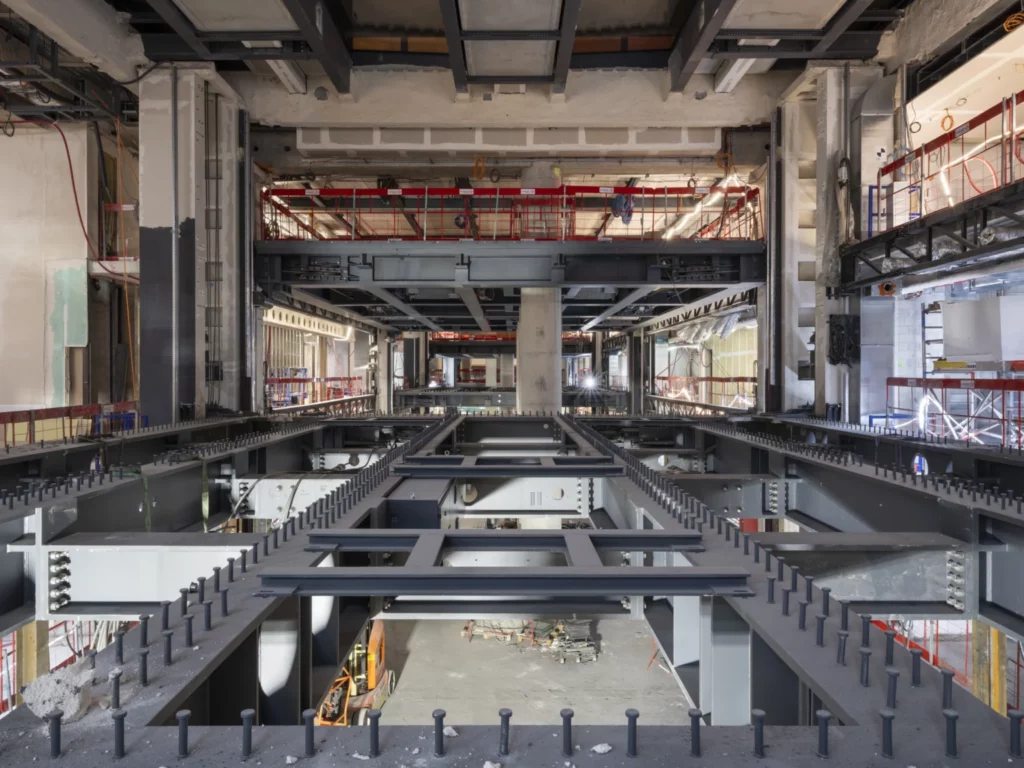
Inside the Monumental Steel Framework
Beneath the restored 19th-century arches, the interior unfolds like an industrial cathedral.
Suspended steel platforms float between pillars.
Every cable, beam and joint contributes to the silent choreography shaping the future museum.
Stone meets metal.
Weight meets flexibility.
Heritage meets mechanics.
Nouvel turns the former Louvre des Antiquaires into a raw, poetic machine — a building that exposes its anatomy as an artistic gesture.
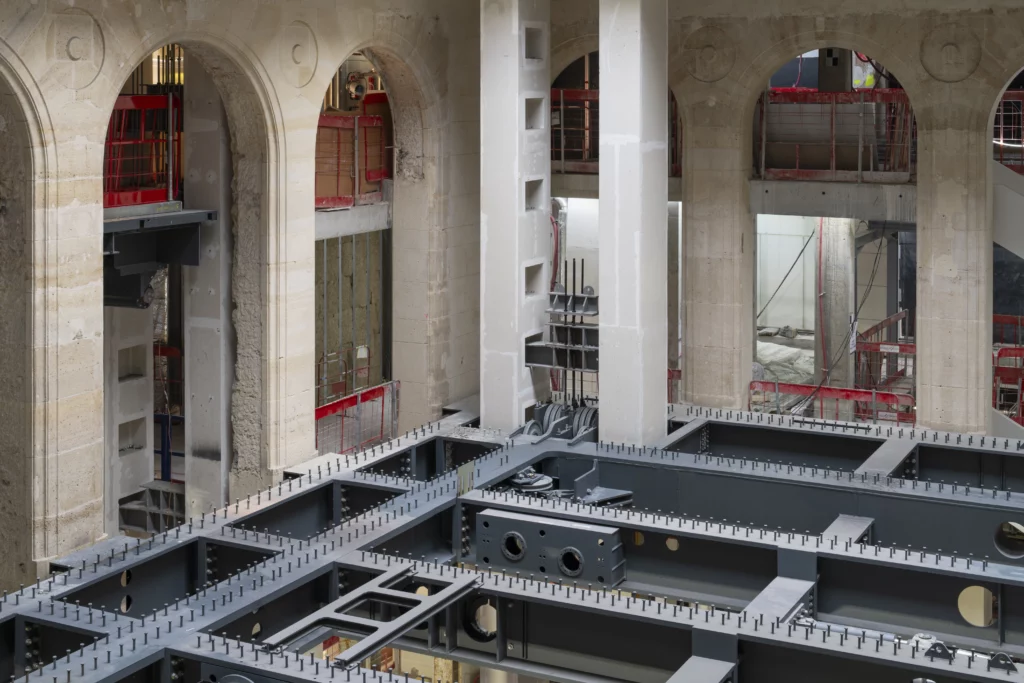
Light, Movement and the Architecture of the Future
Nouvel did not rebuild a museum — he carved out an active void.
Light travels across steel surfaces, brushing raw pillars and slipping under glass ceilings.
At the heart of the design lies a radical idea:
the building is an instrument of perception.
A sculptural device revealing the sky, the material and the movement within.
Support independent publishing! Subscribe to ART MAG and receive each issue in advance, in both print and digital format
👉 Subcribe 6 issues / 1 year
👉 Offer ART MAG

Five Mobile Platforms: A World First
The Fondation Cartier becomes a transformable space composed of five massive steel platforms — machines capable of rising and descending to eleven different heights.
This allows the museum to reinvent its architecture for every exhibition, performance or installation:
- monumental sculptures
- theatre-based works
- immersive environments
- sensitive, intimate pieces
The building is no longer fixed; it responds to the art it hosts.

© Jean Nouvel / ADAGP, Paris, 2025. Photo © Martin Argyroglo
An Industrial Cathedral Hidden Behind Haussmann Stone
Behind its discreet Parisian façade, the Fondation Cartier reveals a vast interior nave, illuminated by natural light visible from Rue de Rivoli.
The newly built volumes are crossed by bridges, vertical shafts of light, and suspended platforms that recall the rigging of a theatre.
Nouvel merges past and present into a single architectural gesture:
a cathedral of industry, tailored for contemporary art.
A Museum Designed to Evolve With Art
As the construction phase transitions toward completion, the industrial rigor softens: the glass roofs clear, the golden arches shine, and verticality returns.
Nouvel signs a manifesto for the museums of the 21st century:
a structure that adapts to artists, responds to exhibitions, and reshapes itself with the city.

A New Space for Encounters
The building also includes the Studio Marie-Claude Beaud, a 110-seat auditorium designed for talks, screenings and performances — extending the Fondation’s mission of dialogue between artists, curators and audiences.
👉 Read more in ART MAG: our focus on the Studio Marie-Claude Beaud
Practical Information
📍 Fondation Cartier pour l’art contemporain
2, Place du Palais-Royal, Paris 1st
🗓️ Opening: October 2025
🎨 Inaugural exhibition: Exposition Générale
👉 Read in ART MAG: Exposition Générale, the grand opening of the Fondation Cartier.
Support independent publishing! Subscribe to ART MAG and receive each issue in advance, in both print and digital format
👉 Subcribe 6 issues / 1 year
👉 Offer ART MAG
FAQ – Fondation Cartier Palais-Royal & Jean Nouvel’s Architecture
When does the new Fondation Cartier open?
In October 2025, at 2 Place du Palais-Royal, Paris 1st, facing the Louvre.
The inaugural exhibition Exposition Générale will present major works from forty years of contemporary creation.
Who designed the new building?
The architecture is by Jean Nouvel, renowned for the Louvre Abu Dhabi and the original Fondation Cartier building on Boulevard Raspail (1994).
He transformed the former Louvre des Antiquaires into a living, light-driven, transformable space.
What makes the project unique?
Its five movable steel platforms — a groundbreaking engineering system allowing infinitely variable exhibition layouts.
Why did the Fondation Cartier leave Boulevard Raspail?
To expand its capacity, scale, and architectural flexibility.
The Palais-Royal location offers a larger, more adaptable space at the heart of Paris.
How large is the building?
8,500 m² open to the public, including 6,500 m² of exhibition space, plus a bookstore, restaurant, auditorium and a 300 m² educational workshop (La Manufacture).
How does this architecture stand out in Paris?
By merging a 19th-century façade with a contemporary industrial core — a monumental, luminous interior visible from Rue de Rivoli.
Why is this project a turning point for Jean Nouvel?
Because it condenses his philosophy:
“We do not build a space; we build within space.”
It continues his vision of museums as emotional instruments, already seen in the Institut du Monde Arabe, the Quai Branly Museum and the Louvre Abu Dhabi.
What exhibitions will follow the opening?
The Fondation will host thematic exhibitions, performances, screenings, debates and cross-disciplinary projects linking art, science, architecture and live arts.
Where to follow Fondation Cartier updates?
On fondationcartier.com and the Fondation’s official social media.
Support independent publishing! Subscribe to ART MAG and receive each issue in advance, in both print and digital format
👉 Subcribe 6 issues / 1 year
👉 Offer ART MAG