


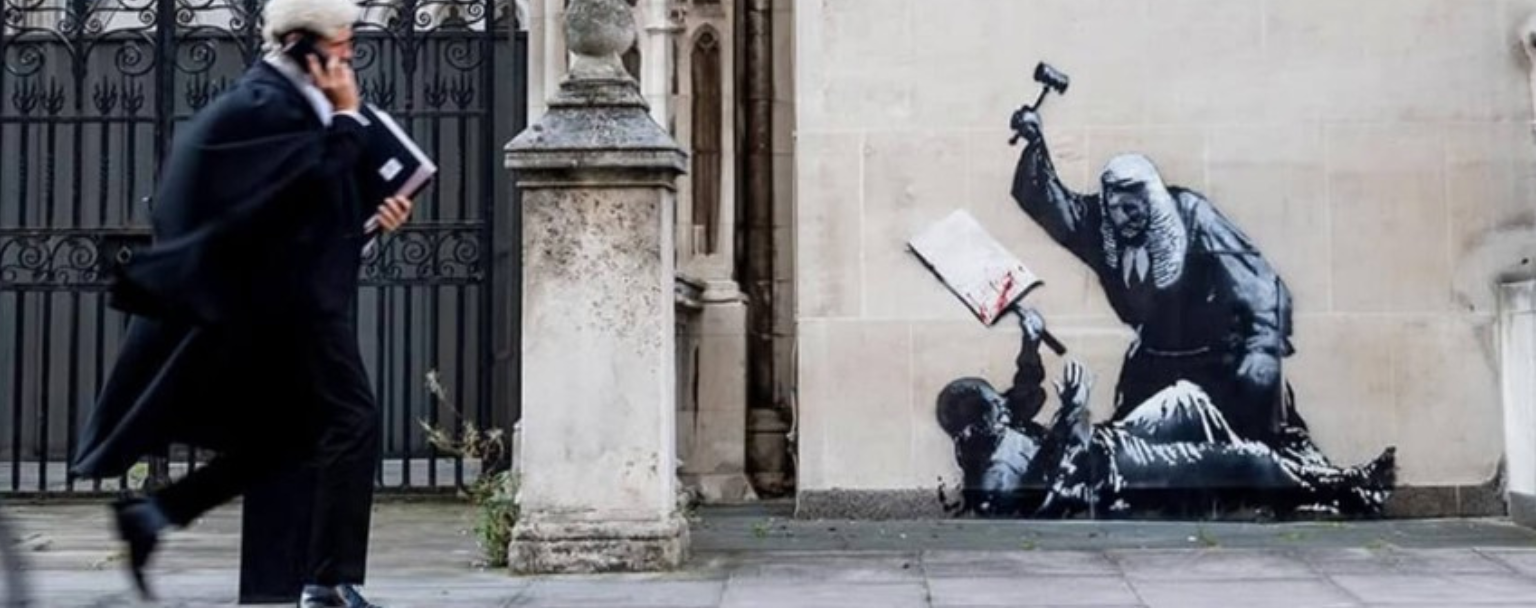
A new Banksy mural hidden within hours
On September 8, 2025, a new Banksy artwork appeared on the façade of the Royal Courts of Justice in London. The stencil depicted a British judge striking a protester on the ground, who held up a bloodstained placard as his only shield.
A shocking image, immediately covered by tarpaulins and fences, before the public could truly see it.
When justice itself is on trial
Usually, authorities protect the British street artist’s works with transparent panels and anti-graffiti coatings. This time, however, the intervention was erased almost instantly, as if it struck too directly at a fragile institution.
Banksy highlights a contradiction: a justice system meant to guarantee freedom of expression, yet capable of becoming the tool of its suppression.
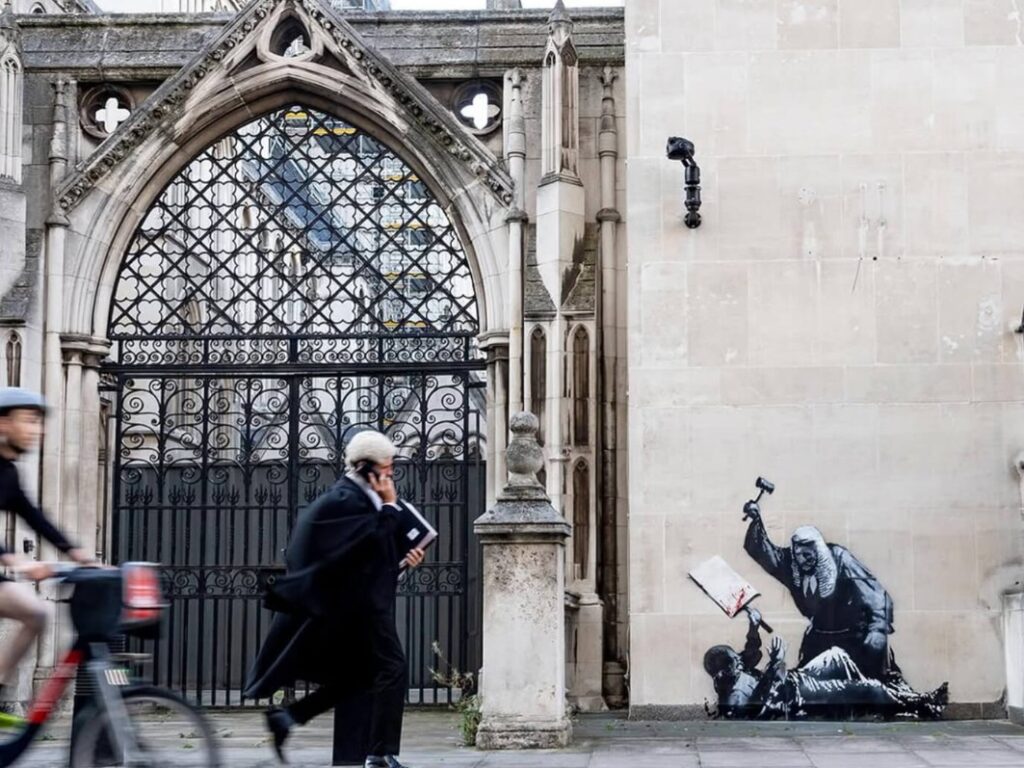
A tradition of protest art
With this piece, Banksy follows the legacy of British political art, from William Hogarth’s satire to the raw visuals of punk. His stencil, quick and incisive, delivers immediate readability and universal impact: who protects the citizen against power?
The irony of disappearance
The physical disappearance of the artwork did not prevent its circulation—quite the opposite. On Instagram, Banksy confirmed its authenticity by sharing a photo with his 13 million followers, triggering a flood of reactions.
The paradox is striking: to hide an image is to make it more visible. The censored piece became viral, amplifying its symbolic power.
A new chapter in Banksy’s story
This intervention joins the artist’s iconic actions – from Girl with a Balloon to his works in the West Bank – and reinforces his role as a visual conscience of contemporary society. In one night and a few strokes of stencil, Banksy reminds us that art is not mere decoration, but resistance.